Spanish grammar · B1 to B2 · Updated
The Spanish subjunctive, explained
The subjunctive is not a tense and it is not vaguely about doubt. It is the form Spanish uses when the verb in the second half of the sentence is not being stated as a fact: it is wanted, asked for, feared, denied, or still to come. Learn to spot the trigger in the first half and the mood in the second half follows on its own.
The short answer
Use the subjunctive when the first half of the sentence wants, asks, doubts, denies or reacts to the second half, and the two halves have different subjects: quiero que vengas. If the first half simply states something as a fact, use the indicative: sé que vienes.
How to remember it
WEIRDO: the six things that open the subjunctive
| Wishes | querer, esperar, preferir, ojalá | Quiero que vengas |
|---|---|---|
| Emotion | alegrarse, sentir, molestar, es una pena | Me alegro de que estés aquí |
| Impersonal | es necesario, es mejor, es raro | Es mejor que lo dejes |
| Requests | pedir, aconsejar, recomendar, decir as an order | Te pido que esperes |
| Doubt and denial | dudar, no creer, negar, no es verdad | Dudo que venga |
| Ojalá and its conjunctions | para que, antes de que, sin que, cuando about the future | Para que lo sepas |
The forms
The present subjunctive endings
| hablar | comer | vivir | |
|---|---|---|---|
| yo | hable | coma | viva |
| tú | hables | comas | vivas |
| él, ella, usted | hable | coma | viva |
| nosotros | hablemos | comamos | vivamos |
| vosotros | habléis | comáis | viváis |
| ellos, ustedes | hablen | coman | vivan |
20 sentences that show the difference
Everyday Spanish, the kind you would actually say. The label under each one says which part of the rule it shows.
Quiero que me llames.
I want you to call me.
Wish
Espero que llegues a tiempo.
I hope you get there on time.
Wish
Prefiero que lo hagas tú.
I would rather you did it.
Wish
Ojalá haga sol mañana.
I hope it is sunny tomorrow.
Ojalá
Me alegro de que estés aquí.
I am glad you are here.
Emotion
Siento que no puedas venir.
I am sorry you cannot come.
Emotion
Me molesta que llegue tarde.
It annoys me that he turns up late.
Emotion
Es una pena que se vaya.
It is a shame she is leaving.
Emotion
Es necesario que firmes aquí.
You need to sign here.
Impersonal
Es mejor que lo dejes.
You had better leave it.
Impersonal
Es raro que no conteste.
It is odd that he is not answering.
Impersonal
Te pido que me escuches.
I am asking you to listen to me.
Request
Te aconsejo que descanses.
I would advise you to rest.
Recommendation
El médico dice que tomes estas pastillas.
The doctor says to take these pills.
Decir as an order
Dudo que llegue hoy.
I doubt it will arrive today.
Doubt
No creo que sea buena idea.
I do not think it is a good idea.
Denial
No es verdad que estén cerrados.
It is not true that they are closed.
Denial
Te lo explico para que lo entiendas.
I am explaining it so that you understand.
Purpose
Llámame cuando llegues.
Call me when you get there.
Cuando about the future
Busco un piso que tenga terraza.
I am looking for a flat with a terrace.
Something not found yet
Where English gets in the way
English handles this with an infinitive and an object: I want him to go home, I need you to come, I would prefer her to wait. The person doing the second action turns into a little object pronoun, and the verb goes quietly into its bare form. Spanish cannot do that. The second person stays a full subject, so the verb has to be conjugated for them, and because the action is wanted rather than reported, it goes into the subjunctive. The English infinitive therefore expands into three Spanish words: que, a subject if you need one, and a conjugated verb. English does keep one small ruin of the same system, in I insist that he go home and God save the Queen, where the verb loses its s for exactly the reason Spanish changes vowel. Spanish never abandoned it.
The mistake to avoid
Three errors, and English speakers make all three in the same week. One, the imported infinitive. ✗ Quiero él volver a casa, a word for word copy of I want him to go home, which in Spanish is not a sentence at all → ✓ Quiero que vuelva a casa. Two, the right shape with the wrong mood. ✗ Quiero que vuelve a casa → ✓ Quiero que vuelva a casa. This one is the most persistent, because the sentence sounds finished and a Spanish speaker will understand it perfectly while wincing. Three, the que put where it is not wanted. When both halves have the same subject you need no que and no subjunctive: ✗ Quiero que vuelva a casa when you mean yourself → ✓ Quiero volver a casa. Test it every time by asking who does the second verb. Different person, subjunctive. Same person, infinitive.
The cases that break the rule
Creo que viene
Creer que states a belief as a fact, so it takes the indicative. Only the negative flips it: no creo que venga. The same pair works with es verdad que, es evidente que and está claro que.
Quiero ir
One person, one verb, no que. When both halves have the same subject, Spanish uses the infinitive and not the subjunctive. Quiero que vayas needs two people.
Cuando llego a casa, ceno
Cuando about a habit takes the indicative, because it is something that already happens. Only cuando pointing at the future opens the subjunctive: cuando llegue a casa, cenaré.
Aunque llueve, salimos
Aunque with the indicative means "although", and states the rain as a fact. With the subjunctive it means "even if", and leaves it open: aunque llueva. Both are correct and they mean different things.
Es verdad que está cerrado
Impersonal expressions only take the subjunctive when they do not assert. Es verdad, es evidente and está claro assert, so they take the indicative, while es mejor and es raro do not.
Quizá viene, quizá venga
One of the very few places where both are correct with no change of meaning, only of confidence. The indicative makes it likelier, the subjunctive makes it a maybe. The same goes for tal vez and posiblemente.
Spanish subjunctive exercises
8 sentences to fill in. Type your answer and check it, or read them straight through with the answers showing. Accents count here, the way they count in the language.
-
Quiero que me (llamar) ___ mañana.
I want you to call me tomorrow.
llames · Querer que is one person wanting another to act, and that always opens the subjunctive.
-
Espero que (tener) ___ un buen viaje.
I hope you have a good trip.
tengas · Esperar que is a wish. The yo form tengo gives the stem, so it is tenga and not tena.
-
Es mejor que (salir, nosotros) ___ ahora.
We had better leave now.
salgamos · Es mejor que is an impersonal expression that does not assert a fact. From salgo, so salgamos.
-
No creo que (ser) ___ tan caro.
I do not think it is that expensive.
sea · No creer que denies, and denial takes the subjunctive. Creo que on its own would be indicative.
-
Te lo digo para que no (llegar) ___ tarde.
I am telling you so that you do not turn up late.
llegues · Para que always takes the subjunctive, because a purpose has not happened yet.
-
Llámame cuando (terminar) ___.
Call me when you finish.
termines · Cuando pointing at the future takes the subjunctive. Cuando terminas would be a habit.
-
Busco un piso que (tener) ___ ascensor.
I am looking for a flat with a lift.
tenga · The flat has not been found yet, so it is a wish and not a thing. Tengo un piso que tiene ascensor would be indicative.
-
Me alegro de que (estar, tú) ___ mejor.
I am glad you are better.
estés · Alegrarse de que is a reaction, and emotion takes the subjunctive even when the fact is certain.
More exercises, from Don Quixote
8 more, these ones straight out of the course: the inn, the windmills, Rocinante and the road. Same rule, older Spanish.
-
Don Quijote quiere que Sancho lo (acompañar) ___.
Don Quixote wants Sancho to go with him.
acompañe · Querer que is one person wanting another to act, and that always opens the subjunctive.
-
Sancho no cree que los molinos (ser) ___ gigantes.
Sancho does not believe the windmills are giants.
sean · No creer que doubts, and doubt takes the subjunctive. Creer que on its own does not.
-
Te lo digo para que lo (saber) ___.
I am telling you so that you know.
sepas · Para que always takes the subjunctive, because a purpose has not happened yet.
-
Saldremos cuando el sol (salir) ___.
We will leave when the sun rises.
salga · Cuando pointing at the future takes the subjunctive. Cuando sale would be a habit.
-
Espero que el ventero nos (dar) ___ de cenar.
I hope the innkeeper gives us supper.
dé · Esperar que takes the subjunctive. The accent on dé is there to tell it apart from the preposition de.
-
Dudo que Dulcinea (existir) ___.
I doubt Dulcinea exists.
exista · Dudar que is doubt in its purest form, so the subjunctive is compulsory.
-
Busco un escudero que (saber) ___ leer.
I am looking for a squire who can read.
sepa · The squire does not exist yet, he is a wish. Tengo un escudero que sabe leer would be indicative.
-
Aunque (llover) ___ mañana, saldremos al campo.
Even if it rains tomorrow, we will ride out.
llueva · Aunque with the subjunctive means "even if", something not yet known. With the indicative it means "although", a fact.
Common questions
When do I use the Spanish subjunctive?
When the first half of the sentence wants, asks, doubts, denies or reacts emotionally to the second half, and the two halves have different subjects: quiero que vengas. Spot the trigger and the mood follows.
How do I form the present subjunctive?
Take the yo form of the present, drop the -o, and add the endings of the other family: -ar verbs take -e endings, -er and -ir verbs take -a endings. Hablo gives hable, tengo gives tenga, conozco gives conozca.
Does creo que take the subjunctive?
No. Creo que states a belief as fact and takes the indicative. No creo que denies it and takes the subjunctive. The same flip works with es verdad que and no es verdad que.
Does cuando always take the subjunctive?
No. Cuando takes the subjunctive only when it points at something still to come: cuando llegues, llámame. About the past or about a habit it takes the indicative: cuando llegué, te llamé, cuando llego, siempre te llamo. The same test works for en cuanto, hasta que, después de que and mientras.
Why is it quiero ir and not quiero que vaya?
Because the subjunctive needs two different subjects. If the same person wants and goes, Spanish uses the infinitive: quiero ir. Two subjects need que and the subjunctive: quiero que vayas. This one rule kills most beginner mistakes with the subjunctive.
Which conjunctions always take the subjunctive?
Six take it every single time, with no exceptions to learn: para que, antes de que, sin que, a menos que, con tal de que and en caso de que. They all point at something not yet real, which is why the mood never varies.
Does ojalá take the present or the imperfect subjunctive?
Both, and the choice changes the meaning. Ojalá venga means I hope he comes, and it could still happen. Ojalá viniera means I wish he would come, and you do not really expect it. The imperfect is the one that says this is a wish, not a hope.
How many subjunctive tenses are there?
Four in everyday Spanish: present (hable), imperfect (hablara), present perfect (haya hablado) and pluperfect (hubiera hablado). A future subjunctive exists but you will only meet it in old texts and legal writing.
The things to remember
- Look at the first half of the sentence, not the second. The trigger decides and the mood follows.
- Two different subjects with a que in between is the shape. Same subject on both sides takes the infinitive instead.
- The endings swap families: -ar verbs take -e endings, -er and -ir verbs take -a endings.
- It is built on the yo form, so every irregular yo carries over: tengo gives tenga, salgo gives salga, conozco gives conozca.
- Creo que is indicative and no creo que is subjunctive. The negation is what flips it.
The same rule in Don Quixote
Real lines from the course, not invented examples. Each one is the sentence the lesson uses to introduce the point.
Yo quiero que vuelva a casa.
I want him to go home.
Le pido que hable sin miedo y sin prisa.
I ask you to speak without fear and without hurry.
Me alegro de que tengamos techo esta noche.
I am glad we have a roof tonight.
No creo que se la lleve nadie.
I do not believe anyone is carrying it off.
Cuando reciba su bendición, saldremos.
Once I have her blessing, we will set out.
Busca el edificio que sea más alto.
Look for whichever building is tallest.
Buscó un sitio donde pudiera llevar a su familia.
He looked for a place where he could take his family.
The book this comes from
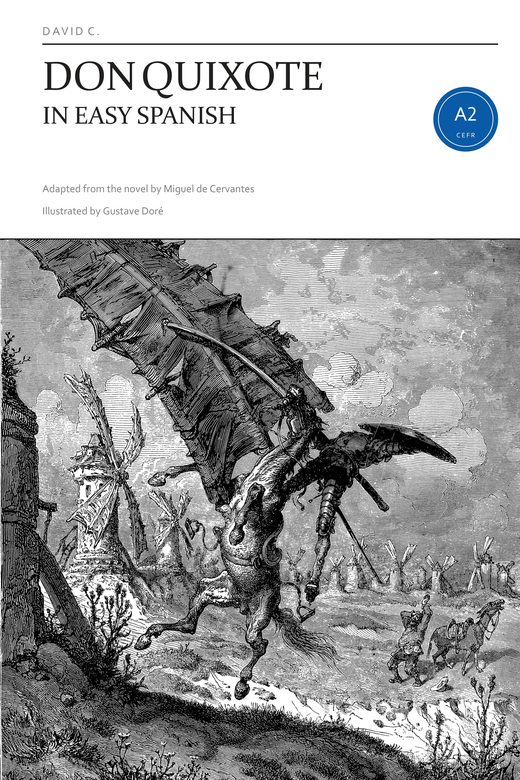
Don Quixote in Easy Spanish: the whole novel retold in Spanish you can actually read, in 58 short episodes, with the hard words glossed in the margin. It is where every Don Quixote sentence on this page comes from.
In EPUB and PDF, with a second novel in the same Spanish. See the books.
Where the course teaches this
7 lessons build it up, each one inside a chapter of the story rather than in the abstract. Free to read, with the vocabulary, the audio and the exercises.
- The present subjunctive: the form, and wantingLesson 43The Princess Micomicona
- Asking, begging, ordering: the subjunctive of influenceLesson 44The Favour the Princess Asks
- The subjunctive of emotion: me alegro de queLesson 45A Night at the Inn
- Doubt and denial: no creo queLesson 46The Giant’s Head
- Cuando plus the subjunctiveLesson 60The Third Sally
- El que sea: relative clauses in the subjunctiveLesson 61Looking for Dulcinea’s Palace
- The subjunctive, all of it at onceLesson 82Ricote, the Exiled Neighbour
Next to this one
The points that sit closest to this one, and that a student usually meets around the same time.