Level A1 · Chapter 1
The gentleman of La Mancha
A quiet, poor man of fifty, with an old house and a set of dangerous books.
What you will learn
- Describe what a person is like, using the verb ser.
- Tell whether a Spanish word is masculine or feminine, and make everything around it match.
- Tell tú from usted, and know which one you would be using.
Before you read
The verb ser is in nearly every sentence below: es, son. Do not study it yet. Just notice it. Notice too that some adjectives end in -o, some in -a and some in -s. That is not decoration, and we come back to it.The story in easy Spanish
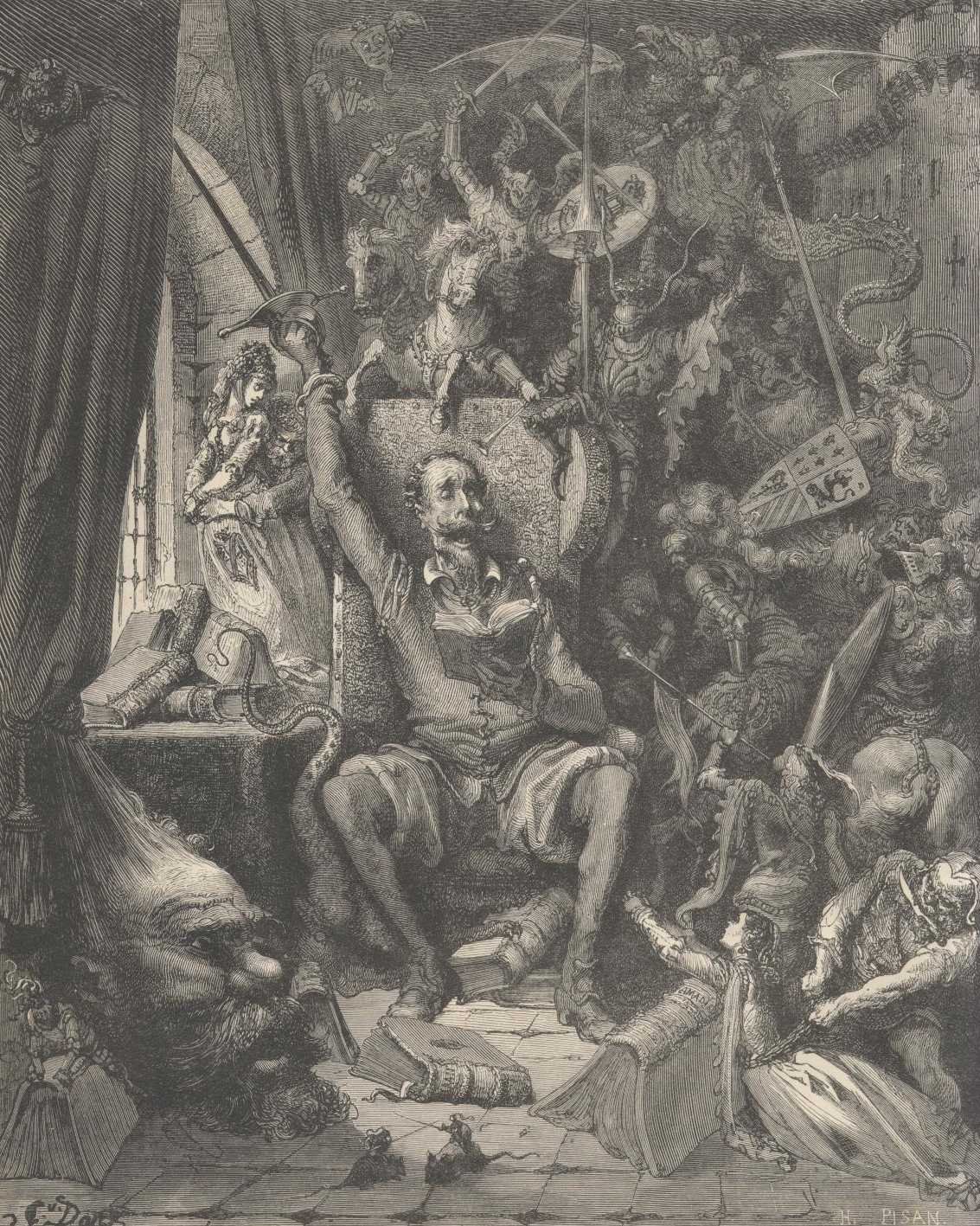
En un pueblo de la Mancha vive un hidalgo pobre. Su nombre es Alonso Quijano.
In a village of La Mancha there lives a poor gentleman. His name is Alonso Quijano.
Alonso Quijano es alto y delgado. Su cara es seca y su cuerpo es fuerte.
Alonso Quijano is tall and thin. His face is lean and his body is strong.
No es joven: es un hombre de unos cincuenta años.
He is not young: he is a man of about fifty.
Es tranquilo, serio y muy amable, pero también es un poco extraño.
He is calm, serious and very kind, but he is also a little odd.
Su casa es vieja, sus armas son antiguas y su caballo es flaco.
His house is old, his weapons are ancient and his horse is skinny.
El perro es rápido y bueno para la caza. Pero el hidalgo no es rico.
The dog is fast and good for hunting. But the gentleman is not rich.
Alonso Quijano es un hidalgo pequeño, no un gran señor. Es un hombre feliz con pocas cosas.
Alonso Quijano is a minor gentleman, not a great lord. He is a man who is happy with few things.
Pero sus libros son peligrosos.
But his books are dangerous.
Vocabulary
People
- el hidalgo
- the gentleman (minor nobleman)
- el hombre
- the man
- el señor
- the lord, the gentleman, Mr
- el nombre
- the name
What a person is like
- alto / alta
- tall
- delgado / delgada
- thin
- fuerte
- strong
- joven
- young
- tranquilo / tranquila
- calm
- serio / seria
- serious
- amable
- kind
- feliz
- happy
- extraño / extraña
- odd, strange
His possessions
- la casa
- the house
- las armas
- the weapons, the armour
- el caballo
- the horse
- el perro
- the dog
- el libro
- the book
Words that judge
- pobre
- poor
- rico / rica
- rich
- viejo / vieja
- old
- antiguo / antigua
- ancient, from long ago
- flaco / flaca
- skinny
- peligroso / peligrosa
- dangerous
SER + what you are. Gender and number
Alonso Quijano es alto y delgado.
Sus armas son antiguas.
El perro es rápido y bueno para la caza.
All three sentences use the same verb, ser, to say what someone or something is. It is the commonest verb in Spanish and it is irregular, so you learn the whole thing on day one and stop worrying about it.
| ser | ||
|---|---|---|
| yo | soy | I am |
| tú | eres | you are (familiar) |
| él / ella / usted | es | he / she is, you are (formal) |
| nosotros / nosotras | somos | we are |
| vosotros / vosotras | sois | you are (plural, Spain) |
| ellos / ellas / ustedes | son | they are |
One English form, are, covers four of those boxes. Spanish never repeats a form, which is why the ending alone tells you who is talking.
Gender. Every Spanish noun is either masculine or feminine, not just people and animals, but also tables, books and Tuesdays. There is nothing feminine about a table. Gender is a grammatical label glued to the word, left over from Latin, and looking for a reason behind it is time you will never get back. Learn each new noun with its article attached: not casa but la casa.
| singular | plural | |
|---|---|---|
| masculine | el libro | los libros |
| feminine | la casa | las casas |
Words ending in -o are usually masculine and words ending in -a are usually feminine. That rule gets you most of the way, and the exceptions arrive one at a time.
Agreement. Now the answer to the second question. A Spanish adjective copies the gender and number of its noun: el caballo flaco, la casa vieja, las armas antiguas. English adjectives never move (“old house”, “old houses”, “old man”), so this is a habit you have to build rather than a rule you have to understand. Adjectives ending in -e or in a consonant do not change for gender: un hombre amable, una mujer amable.
Talking to people. Spanish has two “you”. Tú is the everyday one and in Spain it is what you use with almost everybody, including shopkeepers and people twice your age. Usted is the formal one, kept for very old people, officials, and the moment you want to sound distant. In the plural, Spain says vosotros. Latin America says ustedes for everyone. This course teaches the Spain version, so vosotros stays.
What a hidalgo actually was
A hidalgo was a nobleman, and in 1605 that meant two things above all: he was exempt from certain taxes, and he could not work with his hands without losing his rank. A magnificent combination for starving with dignity.
The word comes from hijo de algo, “son of something”: son of somebody who once had something. Alonso Quijano has a surname, an old house, a skinny horse and his great-grandfathers’ rusting armour. What he does not have is money.
Spain was full of hidalgos like him, especially in the north, and the whole class was a running joke of the period: the man too grand to work and too broke to eat. Cervantes knew the territory first-hand. He was a soldier, lost the use of his left hand at Lepanto, spent five years as a captive in Algiers, and then worked as a tax collector, the least loved job available. He also did time in prison. The man who invented the penniless gentleman knew exactly what he was writing about.
Cervantes in the original · «Frisaba la edad de nuestro hidalgo con los…»
Frisaba la edad de nuestro hidalgo con los cincuenta años; era de complexión recia, seco de carnes, enjuto de rostro, gran madrugador y amigo de la caza.
Our gentleman was getting on for fifty. He was of a tough constitution, spare of flesh, lean of face, a great early riser and a lover of hunting.
Cervantes describes his man with short, physical adjectives: recia (tough), seco (lean), enjuto (spare). That is exactly what you did in this lesson with ser + adjective. Note recia and not recio: even in 1605, the adjective agrees with complexión, a feminine noun.