Spanish grammar · A1 to B2 · Updated
Ser vs estar in Spanish
Both of them mean "to be". Ser is for what something is: who it is, where it is from, what it is made of, and the qualities you would put on a passport. Estar is for where it is and what state it is in right now. The same adjective takes either one, and the choice changes the meaning: es aburrido means he is a boring man, está aburrido means he is bored this afternoon.
The short answer
Ser says what something is: identity, origin, material, profession, the qualities that do not depend on the day. Estar says where it is and what state it is in right now. When both fit the same adjective, ser describes the person and estar describes the day.
How to remember it
Character takes ser, condition takes estar
| Character | what identifies it: who, what, where from, what of | Es alto |
|---|---|---|
| Condition | the state it is in right now | Está cansado |
| DOCTOR | Description, Occupation, Characteristic, Time, Origin, Relationship, all ser | Es de Madrid |
| PLACE | Position, Location, Action, Condition, Emotion, all estar | Está en Madrid |
The forms
Ser and estar in the present
| ser | estar | |
|---|---|---|
| yo | soy | estoy |
| tú | eres | estás |
| él, ella, usted | es | está |
| nosotros | somos | estamos |
| vosotros | sois | estáis |
| ellos, ustedes | son | están |
20 sentences that show the difference
Everyday Spanish, the kind you would actually say. The label under each one says which part of the rule it shows.
Soy Ana.
I am Ana.
Identity
Es médica.
She is a doctor.
Occupation
Somos de Sevilla.
We are from Seville.
Origin
La mesa es de madera.
The table is made of wood.
Material
El coche es de mi hermano.
The car is my brother's.
Ownership
Son las nueve.
It is nine o'clock.
Time
La reunión es en la oficina.
The meeting is in the office.
Event
El café es caro aquí.
Coffee is expensive here.
Characteristic
Mi hermana es alta.
My sister is tall.
Description
Es aburrido.
He is boring.
Ser changes the meaning
Estoy en el trabajo.
I am at work.
Position
Las llaves están en la mesa.
The keys are on the table.
Location
Estoy cansado.
I am tired.
Condition
El café está frío.
The coffee is cold.
Condition
Estamos contentos.
We are happy.
Emotion
Está lloviendo.
It is raining.
Action in progress
La tienda está cerrada.
The shop is closed.
Result of an action
Está casado.
He is married.
Condition that lasts
Estás muy guapa hoy.
You look lovely today.
Change from the norm
Está aburrido.
He is bored.
Estar changes the meaning
Where English gets in the way
English has one verb and therefore never has to decide. He is quiet covers both the man who says little by nature and the man who has gone silent this evening, and English disambiguates with extra words if it bothers at all. Spanish forces the choice on every single description of a person, which means the choice becomes information. When a Spanish speaker says está muy callado, the estar alone tells you something is up. There is no way to make that observation in Spanish without committing to it. Two further points. First, forget permanent and temporary and think character against condition, because está muerto and está casado demolish the permanence story. Second, adjectives that describe a change of state naturally take estar, since they describe where something ended up: está roto, está abierto, está cansado, está armado.
The mistake to avoid
Four. One, ser with contento. ✗ Es contento → ✓ Está contento. Contentment is always estar. Two, ser with casado. ✗ Es casado → ✓ Está casado, in Spain at least. Three, the aburrido swap. Soy aburrido means I am boring. To say you are bored, estoy aburrido. Four, ser loco. ✗ Don Quijote es loco → ✓ Don Quijote está loco. He arrived at madness, he was not born there.
The cases that break the rule
Está muerto
As permanent as anything gets, and it takes estar. This one sentence kills the permanent against temporary shortcut on its own. Death is a state you end up in, not a quality you have.
Está casado
Meant to last, and still estar, for the same reason: it is a state somebody arrived at. Es casado exists in parts of Latin America and sounds odd in Spain.
La boda es en Barcelona
Events take ser even though this looks exactly like a place. Compare Barcelona está en Cataluña: the city sits there, the wedding happens there. If you can replace it with "takes place", use ser.
Está bueno
About food it means it tastes good; about a person it means they are attractive, and the remark is not always welcome. Es bueno is the one that means morally good or good quality.
Es listo, está listo
Es listo means clever. Está listo means ready. Same word, two unrelated meanings, and only the verb tells them apart.
Está siendo
Estar and ser stacked together, and it is correct: está siendo un año difícil, it is being a hard year. It marks something normally stable that is behaving unusually just now.
Ser vs estar exercises
8 sentences to fill in. Type your answer and check it, or read them straight through with the answers showing. Accents count here, the way they count in the language.
-
Mi hermana ___ profesora de inglés.
My sister is an English teacher.
es · Ser, because a profession is one of the things that identify her.
-
Las llaves ___ en la mesa de la cocina.
The keys are on the kitchen table.
están · Estar, because it says where a thing is. And the verb is plural, like the keys.
-
Hoy (yo) ___ muy cansado.
I am very tired today.
estoy · Estar, because it is the state you are in today, not what you are like.
-
___ las nueve y media.
It is half past nine.
Son · Ser. The clock always takes ser, and it agrees with the hour, so son for nine.
-
La tienda ___ cerrada los domingos.
The shop is closed on Sundays.
está · Estar, because a closed door is the result of an action. Participles nearly always take estar.
-
Este café ___ de Colombia.
This coffee is from Colombia.
es · Ser, because where something comes from is part of what it is.
-
La reunión ___ en la sala grande.
The meeting is in the big room.
es · Ser, because an event takes place. Only things sit somewhere, and those take estar.
-
¿Dónde ___ (tú)? Te estoy esperando.
Where are you? I am waiting for you.
estás · Estar, because you are asking for a position and not for an identity.
More exercises, from Don Quixote
8 more, these ones straight out of the course: the inn, the windmills, Rocinante and the road. Same rule, older Spanish.
-
Don Quijote ___ un hidalgo de La Mancha.
Don Quixote is a gentleman of La Mancha.
es · Ser, because this is who he is. Identity always takes ser.
-
La venta ___ en el camino de Puerto Lápice.
The inn is on the road to Puerto Lapice.
está · Estar, because it is where a thing is. Places take estar.
-
Sancho ___ cansado después de la manta.
Sancho is tired after the blanket.
está · Estar, because it is the state he is in tonight, not what he is like.
-
Los molinos ___ de piedra.
The windmills are made of stone.
son · Ser, because what a thing is made of is one of its qualities.
-
El ventero ___ socarrón y se ríe de todos.
The innkeeper is sly and laughs at everyone.
es · Ser, because this is his character, not his mood this evening.
-
Dulcinea ___ del Toboso.
Dulcinea is from El Toboso.
es · Ser, because where somebody is from is part of who they are.
-
La boda de Camacho ___ en el pueblo.
Camacho's wedding is in the village.
es · Ser, because an event takes place. Only things sit somewhere, and those take estar.
-
De tanto leer, don Quijote ___ loco.
From so much reading, Don Quixote is mad.
está · Estar loco is the fixed pair. Ser loco exists but sounds like an insult about the person.
Common questions
Is ser for permanent things and estar for temporary ones?
No, and that shortcut breaks fast. Está muerto is permanent and está casado is meant to last. Think character against condition instead: ser gives the qualities that identify something, estar gives the state it is in.
Why does es aburrido mean something different from está aburrido?
Because ser describes the man and estar describes the moment. Es aburrido says he is a boring person. Está aburrido says he is bored right now. The same swap works with listo, rico, verde and about a dozen more.
Which one goes with a place?
Estar, for where a thing is: la venta está allí. Ser goes with where an event happens: la boda es en Barcelona. And to say that something exists at all, neither of them works, you need hay.
Is it soy casado or estoy casado?
Estoy casado in Spain, and it is the safe answer anywhere. Marriage is a state somebody arrived at, and states take estar even when they last a lifetime. Soy casado is heard in parts of Latin America, where it is treated as a category rather than a state, but it sounds wrong in Spain.
How do I say I am cold in Spanish?
Neither verb: tengo frío, literally I have cold. Spanish uses tener for the sensations a body has, so also tengo hambre, tengo sed, tengo sueño, tengo miedo. Estoy frío means your body is cold to the touch, which is not what you meant, and soy frío means you are a cold person.
Do I use ser or estar for a job?
Ser for the job you have: es profesora. Estar de for a job you are doing for now and do not consider yours: está de camarero este verano. The second one carries the whole meaning of temporarily, so you do not need to add it.
Which verb goes with the weather?
Usually neither. Spanish says hace frío, hace sol, hace viento with hacer, and hay niebla or hay nubes with hay. Estar only turns up for the sky itself: está nublado, está despejado.
Ser or estar with a past participle?
Estar gives the state something ended up in: la puerta está cerrada, the door is shut. Ser gives the action happening to it, and needs an agent to sound natural: la puerta fue cerrada por el viento. Nine times out of ten in speech you want estar, and the participle agrees: está cerrada, están cerradas.
The things to remember
- Ser identifies, estar situates. That is the whole rule in four words.
- Forget permanent against temporary. Está muerto is forever and está casado is meant to last.
- Anything you can point at on a map takes estar. Any event that happens takes ser.
- A participle after the verb is nearly always estar: está abierto, está roto, está cansado.
- When one adjective takes both, ser is the person and estar is the day.
The same rule in Don Quixote
Real lines from the course, not invented examples. Each one is the sentence the lesson uses to introduce the point.
Don Diego es un hidalgo tranquilo.
Don Diego is a quiet gentleman.
Alonso Quijano es alto y delgado.
Alonso Quijano is tall and thin.
La maleta estaba cerrada con una cadena.
The bag was locked shut with a chain.
En una sala apartada había una mesa de jaspe.
In a private room there was a jasper table.
The book this comes from
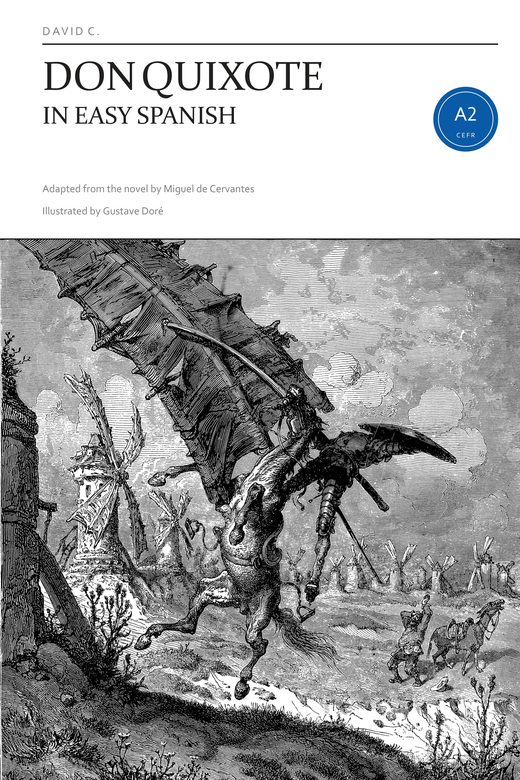
Don Quixote in Easy Spanish: the whole novel retold in Spanish you can actually read, in 58 short episodes, with the hard words glossed in the margin. It is where every Don Quixote sentence on this page comes from.
In EPUB and PDF, with a second novel in the same Spanish. See the books.
Where the course teaches this
4 lessons build it up, each one inside a chapter of the story rather than in the abstract. Free to read, with the vocabulary, the audio and the exercises.
- Ser and estar for describing a personLesson 65The Knight in the Green Coat
- SER + what you are. Gender and numberLesson 1The gentleman of La Mancha
- Describing a place, and estar plus a participleLesson 39The suitcase in Sierra Morena
- Hay, está and es for describing a placeLesson 84Arriving in Barcelona
Next to this one
The points that sit closest to this one, and that a student usually meets around the same time.