Spanish grammar · A1 to B2 · Updated
Por vs para in Spanish
Para points forward, to a purpose, a destination or a deadline. Por points back, to a cause, a route, an exchange or a stretch of time. If the English would be "in order to" or "for the benefit of", it is para. If it would be "because of", "through" or "in exchange for", it is por.
The short answer
Para points forward: a purpose, a destination, a deadline, the person something is meant for. Por points back: a cause, a route, an exchange, a stretch of time. If the English would be "in order to" or "meant for", it is para. If it would be "because of", "through" or "in exchange for", it is por.
How to remember it
Para is the arrow forward, por is the arrow back
| Forward | purpose, destination, deadline, recipient | Es para ti |
|---|---|---|
| Back | cause, motive, what set it off | Lo hice por ti |
| Through | a route, a place crossed, a means | Pasamos por Toledo |
| Swap | an exchange, a price, one thing for another | Lo compré por diez euros |
| PRODD | Purpose, Recipient, Opinion, Destination, Deadline, all para | Para mí, está bien |
The forms
The same English "for", split in two
| English | Spanish | why |
|---|---|---|
| a present for you | un regalo para ti | who it is meant for |
| I did it for you | lo hice por ti | because of you, on your behalf |
| we leave for Madrid | salimos para Madrid | where it is heading |
| we drove through Madrid | pasamos por Madrid | the route |
| for Friday | para el viernes | a deadline |
| for two hours | por dos horas | a stretch of time |
| I paid ten euros for it | lo pagué por diez euros | an exchange |
| it is for eating | es para comer | what it is for |
20 sentences that show the difference
Everyday Spanish, the kind you would actually say. The label under each one says which part of the rule it shows.
Este regalo es para ti.
This present is for you.
Recipient
Estudio para aprobar.
I study in order to pass.
Purpose
Salimos para Madrid mañana.
We leave for Madrid tomorrow.
Destination
Lo necesito para el viernes.
I need it by Friday.
Deadline
Para mí, está muy bien.
In my opinion it is fine.
Opinion
Trabaja para una empresa alemana.
She works for a German company.
Who you work for
Es un vaso para agua.
It is a water glass.
What it is for
Para ser tan joven, sabe mucho.
For someone so young, she knows a lot.
Against expectation
Estoy para salir.
I am about to go out.
On the point of
No estoy para bromas.
I am in no mood for jokes.
Set phrase
Lo hice por ti.
I did it for your sake.
Cause
Cerramos por vacaciones.
Closed for the holidays.
Reason
Pasamos por Toledo.
We went through Toledo.
Route
Lo compré por diez euros.
I bought it for ten euros.
Exchange
Te cambio el mío por el tuyo.
I will swap mine for yours.
Exchange
Estuvimos allí por dos horas.
We were there for two hours.
Stretch of time
Te llamo por la tarde.
I will call you in the afternoon.
Part of the day
Fue escrito por Cervantes.
It was written by Cervantes.
By, in the passive
Vamos por partes.
Let us take it a bit at a time.
Set phrase
Gracias por venir.
Thank you for coming.
Thanking
Where English gets in the way
English lets you say for and move on, leaving the listener to work out whether you meant a reason or a goal. Spanish will not let you off. You have to decide first, and the two choices produce two different sentences. Murió por su señora means he died because of her. Murió para su señora is not something anyone would say. Note too that por covers ground that English gives to other words entirely: through, along, across, by, because of, per. So do not learn por as a translation of for. Learn it as the preposition of causes and routes.
The mistake to avoid
Three that give English speakers away instantly. First, thanks: ✗ Gracias para el yelmo → ✓ Gracias por el yelmo. Gratitude is always about a cause, so it is always por. Second, purpose with an infinitive: ✗ Se mordió los labios por no reír → ✓ Se mordió los labios para no reír. Third, routes: ✗ Corrió para el campo, which says he headed off towards the field → ✓ Corrió por el campo, he ran across it. And one bonus: opinions take para, so ✗ Por mí, es una bacía → ✓ Para mí, es una bacía.
The cases that break the rule
Trabajo para él / trabajo por él
Para él is your employer. Por él means you are standing in for him today, doing his shift. One word apart and the two sentences describe completely different situations.
Gracias por
Thanking always takes por, even though English uses "for" and the thing looks like a purpose. It is a cause: the reason you are grateful.
Por la mañana
Parts of the day take por in Spain and en in much of Latin America. Both are correct where they are said. Only a clock time takes a la: a las diez de la mañana.
Voy a Madrid / voy para Madrid
A destination normally takes a. Para adds the sense of heading in that direction rather than arriving there, and is what you say when you set off.
Por dos horas
Spanish usually says nothing at all: estuvimos allí dos horas. Adding por is correct, and durante is more formal, but the bare version is what most people say.
Para que and por que
Para que means "so that" and takes the subjunctive. Porque means "because". Por qué with an accent is "why", and por que in two words without an accent is rare and formal.
Por vs para exercises
8 sentences to fill in. Type your answer and check it, or read them straight through with the answers showing. Accents count here, the way they count in the language.
-
Este regalo es ___ ti.
This present is for you.
para · Para, because it says who it is meant for. The arrow points forward, to its recipient.
-
Estudio mucho ___ aprobar el examen.
I study a lot in order to pass the exam.
para · Para, because it is a purpose. Wherever English could say "in order to", Spanish says para.
-
Cerramos ___ vacaciones hasta el día 20.
Closed for the holidays until the 20th.
por · Por, because it gives the reason. The arrow points back at what caused it.
-
Lo compré ___ diez euros en el mercado.
I bought it for ten euros at the market.
por · Por, because it is an exchange. Money for goods always takes por.
-
Necesito el informe ___ el viernes.
I need the report by Friday.
para · Para, because a deadline is a point ahead. Por el viernes would mean around Friday, vaguely.
-
Pasamos ___ Toledo de camino a Madrid.
We went through Toledo on the way to Madrid.
por · Por, because it is the route. Anything you cross or pass through takes por.
-
Gracias ___ venir tan pronto.
Thank you for coming so soon.
por · Por. Thanking always takes por, however much the English looks like a purpose.
-
___ mí, la película está bien.
As far as I am concerned, the film is fine.
Para · Para, because an opinion is aimed at someone: this is how it looks to me.
More exercises, from Don Quixote
8 more, these ones straight out of the course: the inn, the windmills, Rocinante and the road. Same rule, older Spanish.
-
Sancho sirve a su amo ___ una ínsula.
Sancho serves his master for an island.
por · Por, because it is what he gets in exchange.
-
Salieron ___ el campo de Montiel.
They rode out through the plain of Montiel.
por · Por, because it is the route they go through, not the place they are heading for.
-
Esta carta es ___ Dulcinea.
This letter is for Dulcinea.
para · Para, because she is who it is meant to reach.
-
Le dieron tres reales ___ el jubón.
They gave him three reales for the doublet.
por · Por, because one thing is swapped for another. Prices always take por.
-
___ ser escudero, Sancho habla muy bien.
For a squire, Sancho speaks very well.
Para · Para, in the "considering that he is" sense. Por here would mean because of.
-
Gracias ___ la cena, señor ventero.
Thank you for the supper, innkeeper.
por · Por, because you thank somebody for something already done. Thanks look backwards.
-
Estuvieron en la sierra ___ dos meses.
They were in the mountains for two months.
por · Por for a stretch of time you spend. Para would be a deadline.
-
La armadura tiene que estar lista ___ el lunes.
The armour has to be ready by Monday.
para · Para, because Monday is the deadline it points forward to.
Common questions
What is the quickest test for por and para?
Translate the English. If it would be "in order to", "for the benefit of", or "by" a deadline, use para. If it would be "because of", "through", "along" or "in exchange for", use por.
Why is it gracias por and not gracias para?
Because you are thanking somebody for a cause, for something already done, and causes take por. Para would point at a purpose still to come, which is not what thanks are about.
Which one goes with time?
Por for a stretch of time you spend: estuvo allí por dos meses. Para for the deadline something has to be ready by: para el lunes. English uses "for" in both, which is exactly why the pair is hard.
Is it por qué or para qué?
Por qué asks for the cause, and it is the ordinary why. Para qué asks what for, the purpose. ¿Por qué estudias? expects because I like it. ¿Para qué estudias? expects to get a job.
Which one goes with transport and telephone?
Por, because it is about passing through something: por teléfono, por correo, por avión, por internet. It is the same por as in por la calle, along the street. Para would make the phone the destination, which is not what you mean.
How do I say per in Spanish?
Por: dos veces por semana, cien kilómetros por hora, veinte euros por persona. The same por does rates and prices because both are exchanges, one thing measured against another.
Is it para mí or por mí?
Para mí means for me, meant for me: este café es para mí. Por mí means because of me or on my behalf: lo hizo por mí, he did it for my sake. Para mí also opens an opinion, the way English says if you ask me: para mí, está bien.
Which one means in order to?
Para, always, and it takes the infinitive straight after: estudio para aprender. If the purpose has a different subject you need para que and the subjunctive: te lo digo para que lo sepas. Por never means in order to.
The things to remember
- Para is the arrow forward: purpose, destination, deadline, who it is for.
- Por is the arrow back: cause, route, exchange, the reason it happened.
- Ask which way the sentence points. English "for" hides the difference, Spanish makes you choose.
- The passive by is always por: fue escrito por Cervantes.
- Gracias por, no por nada, por favor, por fin. Most set phrases take por, and they are worth learning whole.
The same rule in Don Quixote
Real lines from the course, not invented examples. Each one is the sentence the lesson uses to introduce the point.
El barbero corrió por el campo.
The barber ran across the field.
Sancho dejó su casa porque quería aquella isla.
Sancho left his house because he wanted that island.
Levantaron enramadas para que los novios comiesen a la sombra.
They raised arbours so that the couple could eat in the shade.
The book this comes from
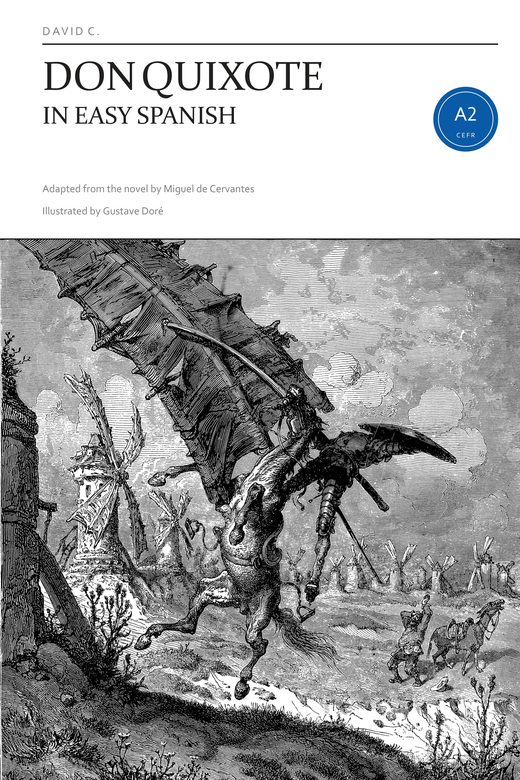
Don Quixote in Easy Spanish: the whole novel retold in Spanish you can actually read, in 58 short episodes, with the hard words glossed in the margin. It is where every Don Quixote sentence on this page comes from.
In EPUB and PDF, with a second novel in the same Spanish. See the books.
Where the course teaches this
3 lessons build it up, each one inside a chapter of the story rather than in the abstract. Free to read, with the vocabulary, the audio and the exercises.
- Por and paraLesson 36Mambrino’s helmet
- Sentences that join up: porque, para, si, creo queLesson 20Sancho Panza and the windmills
- Para que and a fin de que: the subjunctive of purposeLesson 67Camacho’s Wedding Feast
Next to this one
The points that sit closest to this one, and that a student usually meets around the same time.