Spanish grammar · A2 to B1 · Updated
The Spanish passive, and impersonal se
Spanish mostly avoids the English passive. Instead of "the book was sold" it says se vendió el libro, and instead of "one says" it says se dice. The passive with ser does exist and is perfectly real, but it belongs to newspapers and official documents rather than to speech.
The short answer
Spanish avoids the passive. Where English says "it is sold here", Spanish says se vende aquí: se plus the verb, and the thing sold acts as the subject. The full passive with ser exists (fue escrito por Cervantes) but it is mostly written, and only used when the doer matters.
How to remember it
Three ways round the passive, and ser is the last of them
| Passive se | se plus verb, agreeing with the thing | Se venden pisos |
|---|---|---|
| Impersonal se | se plus a singular verb, about people in general | Se vive bien aquí |
| Bare ellos | a plural verb with no subject at all | Me robaron el bolso |
| Ser passive | only when you name the doer, mostly written | Fue escrito por Cervantes |
| Estar plus participle | not a passive: the result, not the action | La puerta está abierta |
The forms
The same idea, four ways
| English | Spanish | which one |
|---|---|---|
| flats are sold here | se venden pisos | passive se, plural |
| Spanish is spoken here | se habla español | passive se, singular |
| you live well here | se vive bien aquí | impersonal se |
| my bag was stolen | me robaron el bolso | bare ellos |
| it was written by Cervantes | fue escrito por Cervantes | ser passive |
| the door is open | la puerta está abierta | estar, the result |
20 sentences that show the difference
Everyday Spanish, the kind you would actually say. The label under each one says which part of the rule it shows.
Se habla español.
Spanish is spoken here.
Passive se, singular
Se venden pisos.
Flats for sale.
Passive se, plural
Se alquila.
To let.
On a sign
Aquí se come muy bien.
The food is very good here.
Impersonal se
Se vive bien en este barrio.
It is a good place to live.
Impersonal se
¿Cómo se dice esto en español?
How do you say this in Spanish?
Impersonal se
No se puede fumar.
No smoking.
Impersonal se
Se prohíbe la entrada.
No entry.
On a sign
Me robaron el bolso.
My bag was stolen.
Bare ellos
Dicen que va a llover.
They say it is going to rain.
Bare ellos
Llaman a la puerta.
Someone is at the door.
Bare ellos
El Quijote fue escrito por Cervantes.
Don Quixote was written by Cervantes.
Ser passive, doer named
La ley fue aprobada en 2019.
The law was passed in 2019.
Ser passive, formal
La puerta está abierta.
The door is open.
Estar, the result
La puerta fue abierta por el viento.
The door was opened by the wind.
Ser, the action
Se me cayó el vaso.
I dropped the glass.
The accidental se
Se nos olvidó la fecha.
We forgot the date.
The accidental se
Se rompió solo.
It broke by itself.
No one to blame
Se busca camarero.
Waiter wanted.
Singular even about a person
Se necesitan voluntarios.
Volunteers needed.
Plural, so plural verb
Where English gets in the way
English has four ways of saying this and picks one by feel. You pay at the door, they say he lost them, one eats well here, people have supper late in Spain. All four are the same sentence in Spanish, and all four are se plus the verb. The other half of the trap is the passive. English loves books are sold here, with the verb to be and a participle. Spanish can build that, but almost never does in ordinary speech. It says se venden libros, and the sentence is shorter, older and much more common.
The mistake to avoid
Three errors, in order of how often they turn up. First, no agreement: ✗ Aquí se vende libros → ✓ Aquí se venden libros. If the thing is plural, so is the verb, every time. Second, the English generic you translated word for word: ✗ Tú pagas la cena en la puerta when you mean people in general → ✓ La cena se paga en la puerta. Third, forgetting the a with people: ✗ Se cobra todo el mundo → ✓ Se cobra a todo el mundo, because without it the sentence says that everybody is charging.
The cases that break the rule
Se venden pisos
The verb agrees with the flats, not with an invisible someone. This is what the passive se is: the thing has become the subject. Se vende pisos is heard and is not standard.
Se busca camarero
When the object is a person, the verb stays singular and an a appears: se busca a un camarero. Signs usually drop the a, and both forms are around.
Fue escrito por Cervantes
The full passive is correct and formal, and it is what you use when the doer matters. Without a por phrase it sounds translated, and a Spaniard would use se instead.
La puerta está abierta
Not a passive at all. Estar plus participle is the state that resulted; ser plus participle is the action happening. Fue abierta is the moment, está abierta is now.
Se me cayó
The accidental se, with an extra pronoun for the person it happened to. It moves the blame away: lo rompí admits you broke it, se me rompió says it broke on you.
Me robaron el bolso
A plural verb with no subject, and it means "someone stole". Spanish uses this constantly where English reaches for the passive, and it is often the most natural of the three.
Impersonal se exercises
8 sentences to fill in. Type your answer and check it, or read them straight through with the answers showing. Accents count here, the way they count in the language.
-
En esta tienda ___ venden libros usados.
They sell second-hand books in this shop.
se · Passive se, and venden is plural because the books are.
-
Aquí ___ come muy bien.
The food is very good here.
se · Impersonal se: nobody in particular, and the verb stays singular.
-
¿Cómo ___ dice esto en español?
How do you say this in Spanish?
se · The commonest impersonal se there is, and worth learning as a whole phrase.
-
Se (buscar) ___ voluntarios para el sábado.
Volunteers wanted for Saturday.
buscan · Plural, because the volunteers are the subject. With one person it would be se busca.
-
El Quijote (ser) ___ escrito por Cervantes.
Don Quixote was written by Cervantes.
fue · The full passive, because the doer is named. Without por Cervantes you would use se.
-
Me (robar) ___ el bolso en el metro.
My bag was stolen on the underground.
robaron · A plural verb with no subject. Spanish says this far more often than the passive.
-
Se ___ cayó el vaso sin querer.
I dropped the glass by accident.
me · The accidental se, with me for the person it happened to. Nobody is blamed.
-
La puerta (estar) ___ abierta desde ayer.
The door has been open since yesterday.
está · Estar for the result. Fue abierta would be the moment somebody opened it.
More exercises, from Don Quixote
8 more, these ones straight out of the course: the inn, the windmills, Rocinante and the road. Same rule, older Spanish.
-
Aquí ___ habla español.
Spanish is spoken here.
se · The impersonal se: nobody in particular does it. This is the sign you see in every shop window.
-
___ venden libros de caballerías.
Books of chivalry are sold.
Se · Here the verb is plural because libros is plural. Word for word: the books sell themselves.
-
En la venta ___ come muy bien.
You eat very well at the inn.
se · English uses you for nobody in particular. Spanish uses se, and the verb stays singular.
-
Los libros ___ quemaron aquella mañana.
The books were burned that morning.
se · This is the everyday passive in Spanish. The ser passive exists but sounds like a newspaper.
-
La novela fue (escribir) ___ por Cervantes.
The novel was written by Cervantes.
escrita · With ser the participle agrees: novela is feminine, so escrita. This is the one case where it changes.
-
___ dice que hay gigantes en el campo.
They say there are giants in the field.
Se · Se dice que is how Spanish reports rumour. There is no they at all in the sentence.
-
___ prohíbe entrar con armas.
Entry with weapons is forbidden.
Se · Rules and notices take se. Prohibimos would point a finger at whoever wrote it.
-
En aquellos tiempos ___ vivía peor.
In those days people lived worse.
se · The impersonal se works in any tense, not only the present.
Common questions
How do I say the passive in Spanish?
Usually with se: se vendió el libro, se construyeron las casas. The verb agrees with the thing. The passive with ser plus a participle is correct too, but it belongs to newspapers rather than to speech.
What is the difference between se vende and se dice?
Se vende has a subject that agrees, so in the plural it becomes se venden casas. Se dice is impersonal, has no subject at all, and stays singular: se dice que, se vive bien aquí.
When is the passive with ser normal?
When the doer is named or matters: la novela fue escrita por Cervantes. Even then Spanish often prefers to make the doer the subject and be done with it.
Why is it se venden casas and not se vende casas?
Because in that construction the thing is the subject, so the verb agrees with it: one house gives se vende casa, several give se venden casas. You will see the singular on signs all over Spain, and it is still considered a mistake in careful writing.
How do I say people say in Spanish?
Se dice que or dicen que, and both leave the person out. Dicen que va a llover is the everyday one. Spanish has no equivalent of the English one says, so these two carry the whole job.
Can I use se with people?
Yes, and then the personal a appears and the verb stays singular: se ayudó a los heridos. Without the a you would be saying the wounded helped themselves, which is why the a is doing real work here.
What is the difference between se and uno?
Se keeps the speaker out of it: aquí se trabaja mucho. Uno quietly includes them: uno nunca sabe is close to you never know, said about yourself. With a reflexive verb only uno works, because the se is already taken: uno se acostumbra.
Why does Spanish avoid the passive with ser?
Because se does the same job in fewer words and sounds natural in speech, where fue construido sounds like a news bulletin. The passive with ser survives in journalism and formal writing, and it needs a real agent to sound right: fue escrito por Cervantes.
The things to remember
- Spanish prefers se to the passive. Reach for se first and ser last.
- The passive se agrees with the thing: se vende un piso, se venden pisos.
- The impersonal se stays singular and means people in general: aquí se come bien.
- A bare plural verb with no subject also does the job: me robaron el bolso.
- Estar plus participle is the result, ser plus participle is the action. They are not the same.
The same rule in Don Quixote
Real lines from the course, not invented examples. Each one is the sentence the lesson uses to introduce the point.
Aquí se cobra a todo el mundo.
Everybody gets charged here.
Fue atado por unos hombres disfrazados.
He was tied up by some men in disguise.
The book this comes from
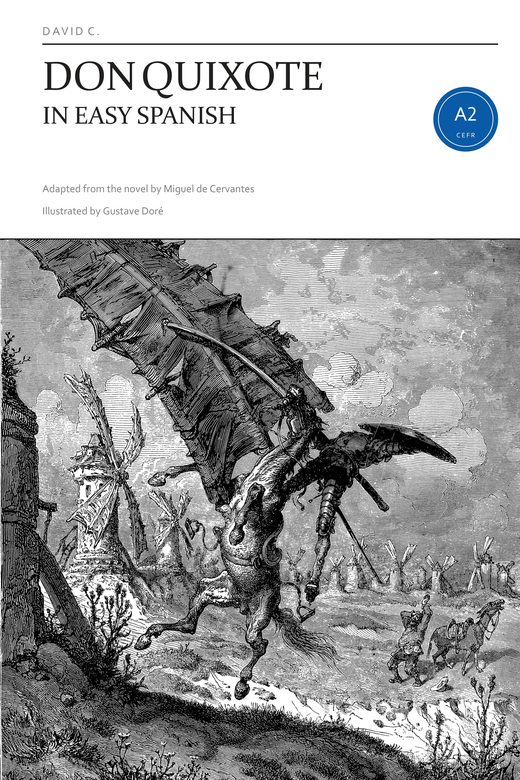
Don Quixote in Easy Spanish: the whole novel retold in Spanish you can actually read, in 58 short episodes, with the hard words glossed in the margin. It is where every Don Quixote sentence on this page comes from.
In EPUB and PDF, with a second novel in the same Spanish. See the books.
Where the course teaches this
2 lessons build it up, each one inside a chapter of the story rather than in the abstract. Free to read, with the vocabulary, the audio and the exercises.
- Impersonal se and the reflexive passiveLesson 31What you pay for at an inn
- The passive with ser and a participleLesson 55The Cage on the Ox Cart
Next to this one
The points that sit closest to this one, and that a student usually meets around the same time.