Level A2 · Chapter 21
The morning of the windmills
The windmill adventure, told again and in full, with the regular preterite. The A2 block begins.
What you will learn
- Tell in the past what happened on one single occasion.
- Form the regular preterite of -ar, -er and -ir verbs.
- Order events with de pronto, entonces and después.
Before you read
The whole text is in the past. This is the tense Spanish uses for one finished event, and it is the backbone of every story you will read from here to the end of the course. Watch the endings: miró, corrió, salieron. Nothing is added in front of the verb, the way English adds did. The ending does all the work.The story in easy Spanish
Una mañana de verano, don Quijote y Sancho salieron al campo de Montiel.
One summer morning, Don Quixote and Sancho rode out into the plain of Montiel.
Los dos hablaron mucho rato de la isla y del gobierno.
The two of them talked for a long while about the island and about governing it.
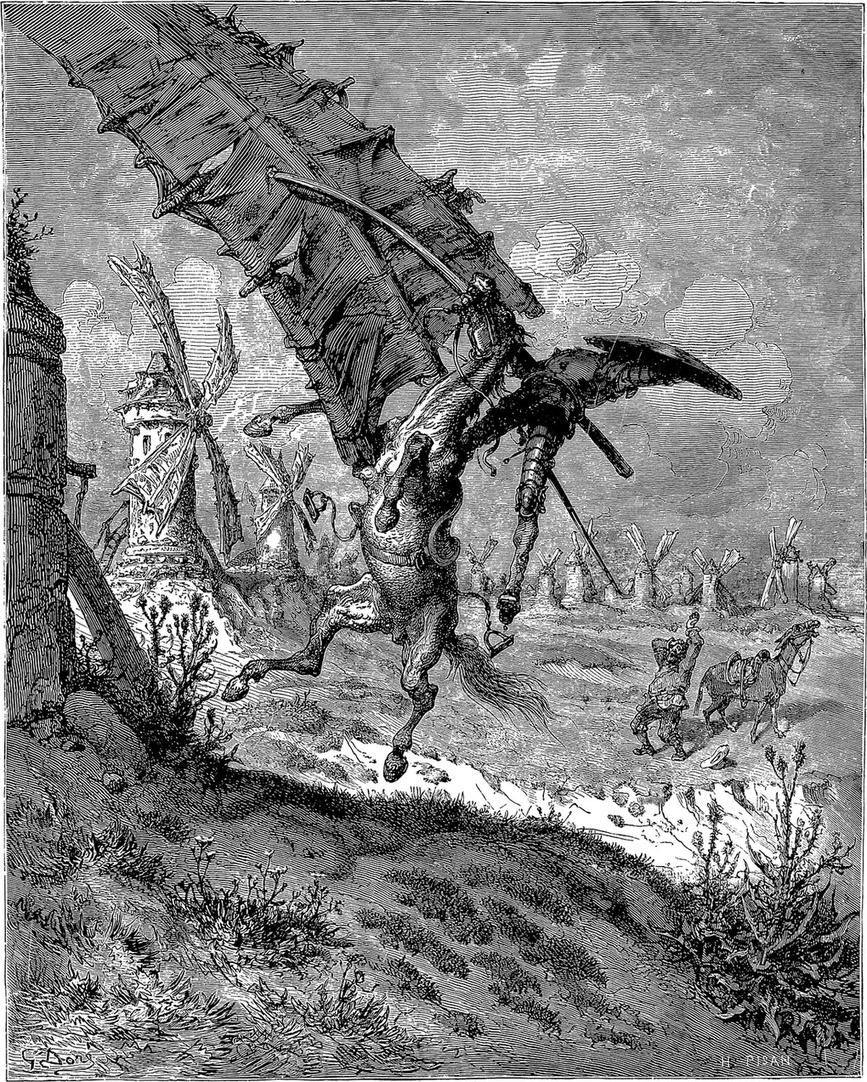
De pronto, el caballero descubrió treinta molinos de viento en la llanura.
Suddenly, the knight made out thirty windmills on the flat land.
«Mira, amigo Sancho: allí aparecieron treinta gigantes enormes.»
"Look, friend Sancho: thirty enormous giants have appeared over there."
Sancho miró la llanura con calma y solo encontró molinos.
Sancho looked calmly at the plain and found nothing but windmills.
El escudero le explicó su error dos veces. El caballero no escuchó nada.
The squire explained his mistake to him twice. The knight did not listen at all.
Entonces don Quijote corrió con la lanza contra el primer molino.
Then Don Quixote charged at the first windmill with his lance.
En ese momento el viento movió las aspas con mucha fuerza.
At that moment the wind swung the sails round with great force.
Las aspas rompieron la lanza y levantaron al caballo por el aire.
The sails broke the lance and lifted the horse into the air.
Caballo y caballero rodaron por el suelo, muy lejos el uno del otro.
Horse and knight rolled across the ground, a long way from each other.
Sancho bajó del burro y ayudó a su señor.
Sancho got down off his donkey and helped his master up.
«El sabio Frestón cambió los gigantes en molinos. Ese mago me odia.»
"The wizard Frestón turned the giants into windmills. That magician hates me."
Después comieron pan y queso debajo de un árbol.
Afterwards they ate bread and cheese under a tree.
Nadie ganó nada aquel día, pero los dos siguieron el camino.
Nobody won anything that day, but the two of them carried on down the road.
Vocabulary
The countryside
- la llanura
- the plain
- el campo de Montiel
- the plain of Montiel
- el árbol
- the tree
- el suelo
- the ground
- el aire
- the air
The windmill
- el aspa
- the sail, the vane
- el viento
- the wind
- la fuerza
- the force, the strength
- el gigante
- the giant
- el sabio
- the wizard
Verbs for telling a story
- descubrir
- to make out, to catch sight of
- aparecer
- to appear
- explicar
- to explain
- rodar
- to roll
- ayudar
- to help
When it happened
- de pronto
- suddenly
- entonces
- then, at that moment
- después
- afterwards
- aquel día
- that day
- dos veces
- twice
The regular preterite
Sancho miró la llanura con calma.
Don Quijote corrió con la lanza contra el molino.
Los dos salieron al campo de Montiel.
Spanish has no helper word for the past. English builds it with did, Spanish builds it inside the verb, and the ending tells you both the person and the tense at once.
| hablar (to speak) | comer (to eat) | salir (to go out) | |
|---|---|---|---|
| yo | hablé | comí | salí |
| tú | hablaste | comiste | saliste |
| él, ella, usted | habló | comió | salió |
| nosotros | hablamos | comimos | salimos |
| vosotros | hablasteis | comisteis | salisteis |
| ellos, ellas, ustedes | hablaron | comieron | salieron |
Three things worth memorising
First, -er and -ir share one set of endings. That halves the work: learn comí, comiste, comió and you already know salí, saliste, salió.
Second, the accent on the yo and the él forms is not decoration. Take it off and you get a different word. Hablo is I speak, habló is he spoke. Miro is I look, miró is she looked. The whole sentence turns from today into last summer on the strength of one small mark.
Third, the nosotros form of -ar and -ir verbs is identical in the present and in the preterite. Hablamos is both we speak and we spoke, and salimos is both we go out and we went out. Spanish is happy to let context decide. Add ayer or aquel día and nobody is confused.
What this tense is for
The preterite reports one finished event, seen from outside, with a beginning and an end. The wind swung the sails once, the lance broke once, Sancho got off his donkey once. That is why the whole windmill scene sits in this tense from the first line to the last.
It pairs naturally with time markers that pin an event to a moment: de pronto, entonces, en ese momento, después, aquel día, dos veces. Lesson 23 will bring the other past tense, the one for description and habit, and lesson 24 will put the two side by side.
From grain to bread
A windmill was not scenery. It was the flour factory of an entire district, and bread was between half and two thirds of what an ordinary Spaniard ate in 1605. Nothing else in the village mattered as much as whether the mill was turning.
The miller took his fee in kind, a scoop of grain out of every load, called the maquila. He was the one man who handled everyone else’s food and kept a portion of it, so Spanish folk tales are full of millers who cheat, and almost none who are kind. Every household could do the arithmetic and nobody could check it.
Which sharpens the joke in this chapter. Don Quixote charges the most useful building on the horizon, the one thing on that bare plain that keeps his neighbours alive, and he sees monsters. Sancho, who has carried grain to a mill all his life, sees a mill. The knight is fighting literature and the squire is looking at lunch.
Cervantes in the original · «En esto, descubrieron treinta o cuarenta molinos de…»
En esto, descubrieron treinta o cuarenta molinos de viento que hay en aquel campo.
At this point they made out thirty or forty windmills that stand in that field.
Cervantes tells the scene in the very tense you have just learned. Descubrieron is the regular preterite of descubrir, with the shared -er and -ir ending -ieron. Note also hay, in the present: the windmills were still standing in that field as Cervantes wrote, and most of them still are.