Level A1 · Chapter 20.5
Review 4: lessons 16 to 20
The vocabulary from lessons 16 to 20 that does not come back, the grammar of the block in one table, and two exercises. The end of A1.
What you will learn
- Choose between preterite, imperfect and present perfect without stopping to think.
- Compare two things with más que, menos que and tan como.
- Tell a whole scene of Don Quixote in the past, and read it without the translation.
The story in easy Spanish
Don Quijote vio a seis mercaderes de Toledo en el camino.
Don Quixote saw six merchants from Toledo on the road.
Iban a comprar seda y llevaban un mozo de mulas detrás.
They were going to buy silk and had a mule boy behind them.
Quiso oír que Dulcinea era la mujer más hermosa del mundo.
He wanted to hear that Dulcinea was the most beautiful woman in the world.
Ellos pidieron un retrato, pero él se puso quieto y atacó.
They asked for a portrait, but he went still and charged.
Rocinante tropezó y el mozo rompió la lanza en pedazos.
Rocinante stumbled and the boy broke the lance into pieces.
Un vecino lo llevó despacio a casa, muy cansado y roto.
A neighbour carried him slowly home, very tired and broken.
El cura y el barbero han quemado sus libros en el corral.
The priest and the barber have burned his books in the yard.
Solo miraron el título, y la hoguera hizo mucho humo.
They only looked at the title, and the bonfire made a lot of smoke.
Un albañil puso ladrillos donde estaba la puerta de la biblioteca.
A bricklayer put bricks where the library door used to be.
Ahora hay una pared, y él cree que fue un encantador.
Now there is a wall, and he thinks it was an enchanter.
Dice que un dragón se llevó los libros porque lo odia.
He says a dragon took the books away because it hates him.
Después convenció a un labrador que quiere ser gobernador.
Afterwards he convinced a farmhand who wants to be a governor.
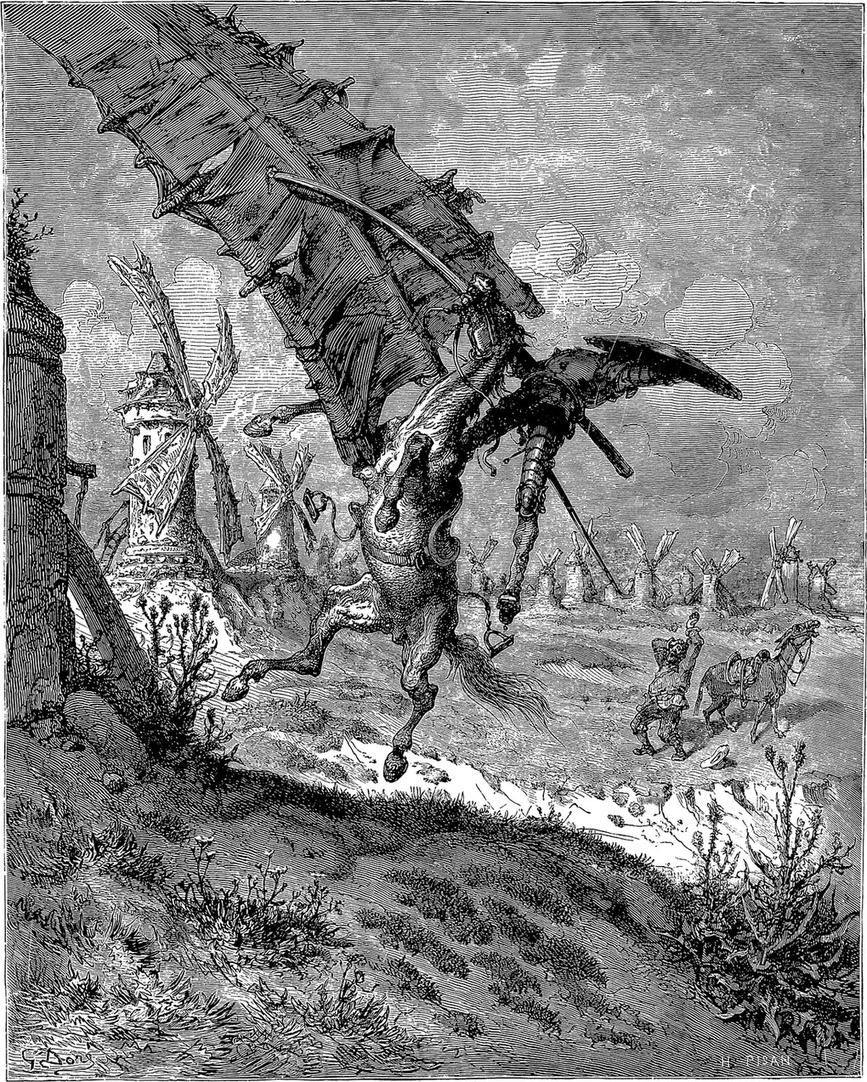
Los molinos movieron sus brazos, y aquel suceso fue duro.
The windmills swung their arms round, and that episode was a hard one.
Vocabulary
The merchants (lesson 16)
- el mercader
- the merchant
- la seda
- the silk
- el suceso
- the event, the episode
- quieto / quieta
- still, motionless
- el mozo de mulas
- the mule boy
The most beautiful woman (lesson 17)
- el retrato
- the portrait
- hermoso / hermosa
- beautiful
- tropezar
- to stumble, to trip
The library (lesson 18)
- la culpa
- the fault, the blame
- el título
- the title
- quemar
- to burn
- cansado / cansada
- tired
- roto / rota
- broken
- la hoguera
- the bonfire
The wall (lesson 19)
- el corral
- the yard
- el humo
- the smoke
- el albañil
- the bricklayer
- el ladrillo
- the brick
- la pared
- the wall
- el encantador
- the enchanter
- el dragón
- the dragon
- odiar
- to hate
Sancho and the windmills (lesson 20)
- el labrador
- the farmhand
- el gobernador
- the governor
- el brazo
- the arm, the sail
- convencer
- to convince
Lessons 16 to 20, and the whole of A1, in one table
The vocabulary list above first, as always. Cover the English, read the Spanish, mark what does not come back in three seconds. This is the last checklist of the block, so be strict.
| point | rule | from the summary above |
|---|---|---|
| irregular preterite | fue, fui, vio, hizo, tuvo, puso, dio, and none of them take an accent | Don Quijote vio a seis mercaderes. |
| imperfect | background, habit and description, the camera held still | Iban a comprar seda. |
| present perfect | haber plus the participle, for time that is still open | Han quemado sus libros. |
| irregular participles | hecho, dicho, visto, puesto, escrito, roto | muy cansado y roto |
| comparatives | más que, menos que, tan como, and el más for the superlative | la mujer más hermosa del mundo |
| relative que | hooks a whole clause onto a noun, and is never left out | un labrador que quiere ser gobernador |
| connectors | porque, para + infinitive, si + present, creo que | porque lo odia |
A story needs the first two tenses together. The imperfect paints the room and the preterite is what happens in it. The full conjugations, including fue doing duty for both ser and ir, are in the verb tables at the back of the book.
That is the whole of A1: ser and estar, gender and number, the articles, the present in three families, demonstratives, possessives, adjectives, numbers and the clock, reflexives, negation and questions, the connectors, gustar, the imperative, three past tenses, comparatives and the relative que. That is a grammar, not a phrasebook. Now go back up to the summary and read it again with the English column hidden.