Level A1 · Chapter 20
Sancho Panza and the windmills
A poor farmhand accepts an island that does not exist, and his master charges thirty giants that are windmills. The end of the A1 block.
What you will learn
- Give a reason with porque and a purpose with para + infinitive.
- Set a condition with si + present.
- Give an opinion with creo que.
Before you read
Until now your sentences have been short and separate. In this lesson they start joining up: four small words, porque, para, si and creo que, glue two ideas into one sentence, which is what makes speech sound like speech instead of a list.The story in easy Spanish
En el pueblo vivía un labrador pobre y honrado. Se llamaba Sancho Panza.
In the village there lived a poor, honest farmhand. His name was Sancho Panza.
Don Quijote habló con él muchos días para convencerlo.
Don Quixote talked to him for many days in order to convince him.
«Si vienes conmigo, puedes ser gobernador de una isla.»
"If you come with me, you can be governor of an island."
Sancho dejó su casa porque quería aquella isla para sus hijos.
Sancho left his house because he wanted that island for his children.
Salieron de noche porque nadie debía verlos.
They left at night because nobody was to see them.
En el campo había treinta o cuarenta molinos de viento.
Out on the plain there were thirty or forty windmills.
«Mira, amigo: allí hay gigantes. Voy contra ellos para ganar la batalla.»
"Look, my friend: there are giants over there. I am going at them to win the battle."
«Señor, creo que son molinos. Se mueven porque hace viento.»
"Sir, I think they are windmills. They are moving because it is windy."
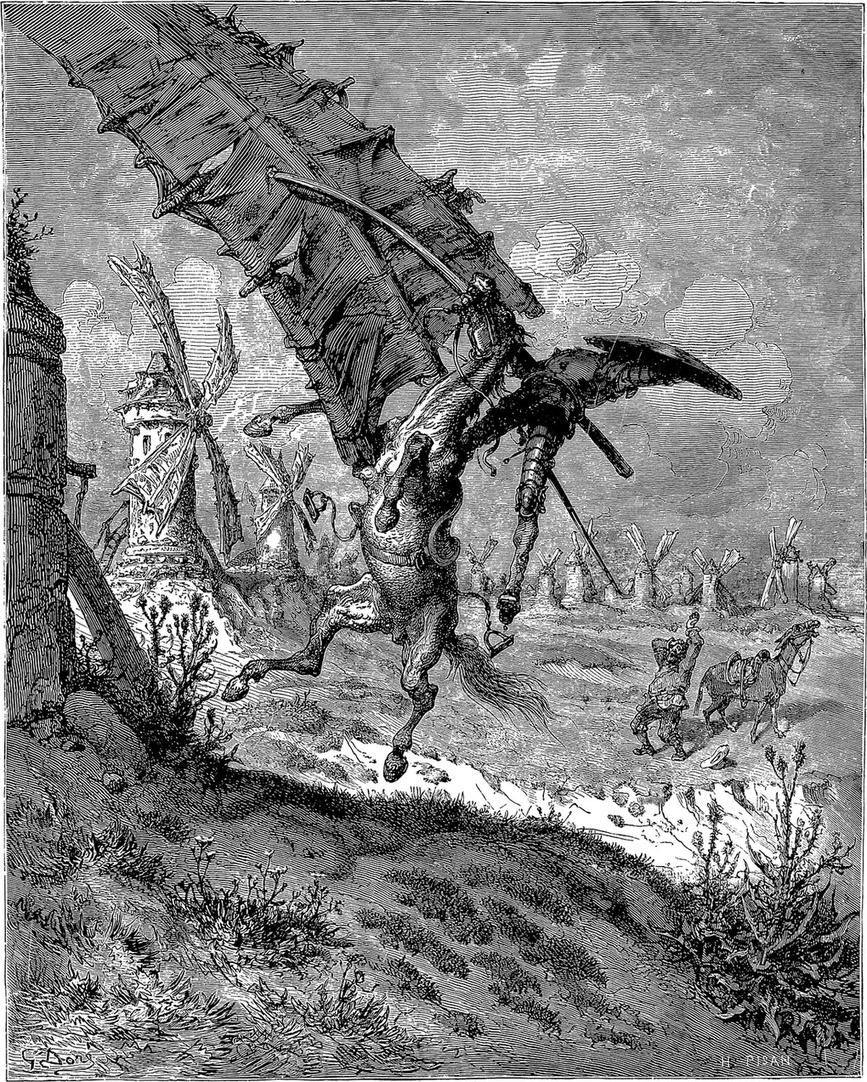
Don Quijote no escuchó. Atacó con la lanza y golpeó el primer brazo.
Don Quixote did not listen. He charged with his lance and struck the first sail.
El viento movió el brazo y rompió la lanza.
The wind swung the sail round and broke the lance.
Caballo y caballero rodaron por el campo. Sancho llegó con su burro.
Horse and knight went rolling across the field. Sancho arrived on his donkey.
«Creo que eran molinos, señor.» «Frestón los cambió porque me odia.»
"I think they were windmills, sir." "Frestón changed them because he hates me."
Si un caballero cae, se levanta. Don Quijote se levantó y siguió el camino.
If a knight falls, he gets up. Don Quixote got up and carried on down the road.
Vocabulary
Sancho and the deal
- el labrador
- the farmhand
- el escudero
- the squire
- el gobernador
- the governor
- la isla
- the island
- convencer
- to convince
The windmill
- el molino de viento
- the windmill
- el brazo
- the arm, the sail
- el viento
- the wind
- el gigante
- the giant
The battle
- la batalla
- the battle
- rodar
- to roll
- golpear
- to strike, to hit
- la aventura
- the adventure
- honrado / honrada
- honest
Sentences that join up: porque, para, si, creo que
Sancho dejó su casa porque quería aquella isla.
Voy contra ellos para ganar mi primera batalla.
Creo que son molinos.
Four words, and your Spanish stops sounding like a list.
| word | adds | followed by | example |
|---|---|---|---|
| porque | a reason | a conjugated verb | Salieron de noche porque nadie debía verlos. |
| para | a purpose | an infinitive | Habló con él para convencerlo. |
| si | a condition | the present | Si vienes conmigo, puedes ser gobernador. |
| creo que | an opinion | a conjugated verb | Creo que son molinos. |
Two of them need care
para takes the bare infinitive when both halves have the same subject, and at A1 they always will. Para ganar, para convencerlo, para comer. English uses to, in order to or for -ing, while Spanish uses para plus the dictionary form, nothing else.
si is the one that surprises people. In English you say if you come but I will be, while in Spanish the si half stays in the plain present, and the other half can be present too: Si vienes conmigo, puedes ser gobernador. Never put a future or a subjunctive after si, a mistake that survives into B1 if nobody stops it at A1.
And keep the two porques apart. ¿por qué? (two words, with an accent) asks. porque (one word) answers. ¿Por qué salieron de noche? Porque nadie debía verlos.
Everything you have, on one page
This is the last lesson of A1. Here is the whole machine you have been assembling since the first village in La Mancha:
| tense | what it does | from the story |
|---|---|---|
| present | now, always, general truth | Se mueven porque hace viento. |
| imperative | orders | Mira, amigo. |
| preterite | one finished event | Atacó con la lanza. |
| imperfect | description, habit, background | En el campo había cuarenta molinos. |
| present perfect | today, recently, still open | Ha vuelto a casa enfermo. |
Add ser and estar, the articles, agreement, the possessives and demonstratives, questions and negation, gustar, comparatives, the relative que and these four connectors, and you have the grammar of A1. It is enough to read a whole scene of Cervantes without the English column beside it. Try the story above again with the translations hidden.
A2 opens with this same field of windmills, told once more, and with the pronouns, the periphrases and ser versus estar that turn correct sentences into fluent ones.
The windmills, cutting-edge technology
The joke only works if you know what a windmill was in 1605: brand new. They reached La Mancha around 1575, thirty years before the novel, recent enough that a man of Don Quixote’s age remembered a landscape without them. Forty white towers on a bare ridge, each with four arms turning by themselves, grinding the grain of a whole district with no river and no mule.
They were the most advanced machinery an ordinary Spaniard would ever see. La Mancha is flat, dry and windy: no streams for water mills, so wind did the work instead. A miller could grind in a morning what a donkey-driven mill took two days to do.
So the scene is not simply a madman punching a building. It is the oldest thing in the book, a knight from a fourteenth-century romance, charging the newest thing on the horizon, and losing. Sancho, who is neither old nor new but merely awake, watches from a donkey and says the sentence that has followed the pair for four hundred years: sir, I think they are windmills.
Cervantes in the original · «Non fuyades, cobardes y viles criaturas…»
Non fuyades, cobardes y viles criaturas, que un solo caballero es el que os acomete.
Flee not, cowardly and vile creatures, for it is a single knight who attacks you.
Non fuyades is old Spanish for no huyáis, "do not flee" (the f had already become an h by 1605). Don Quixote talks like this on purpose: he is imitating the Castilian of his novels, which sounded antique to Cervantes’ readers too. Note the relative you learned last lesson, working here in the original: el que os acomete.