Level A1 · Chapter 19
A wall where the door used to be
The books burn in the yard and a bricklayer walls up the library. The housekeeper invents a wizard, and Don Quixote believes her.
What you will learn
- Join two sentences with the relative que.
- Expand a noun with an adjective or with de + noun.
- Tell a whole scene in the past, mixing preterite and imperfect.
Before you read
One small word turns up in almost every paragraph: que. Watch what sits in front of it and what comes after. In English the equivalent word is who, which or that, and English is allowed to leave it out. Spanish is not, which is the whole lesson.The story in easy Spanish
El ama y la sobrina hicieron una hoguera en el corral de la casa.
The housekeeper and the niece built a bonfire in the yard of the house.
Echaron allí casi todos los libros que había en la biblioteca.
They threw onto it nearly all the books that were in the library.
El humo que subía al cielo se veía desde el camino.
The smoke that rose into the sky could be seen from the road.
El cura salvó seis libros que eran buenos y no hacían daño.
The priest saved six books that were good and did no harm.
Al día siguiente vino un albañil que tenía cal y ladrillos.
The next day a bricklayer came who had lime and bricks.
Puso una pared en el lugar de la puerta de la biblioteca.
He put up a wall in the place of the library door.
Dos días después, don Quijote se levantó y buscó la habitación de los libros.
Two days later Don Quixote got up and looked for the room with the books.
No vio la puerta. Puso las manos en la pared blanca y no comprendió nada.
He did not see the door. He put his hands on the white wall and understood nothing.
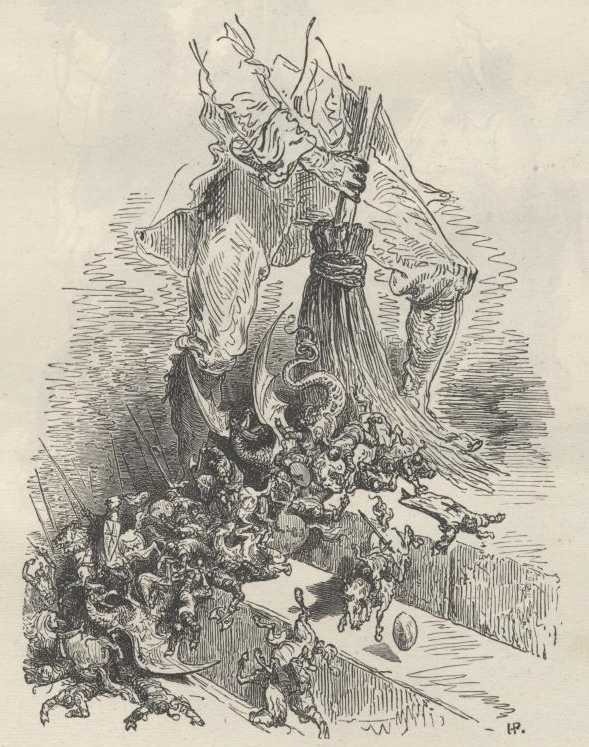
«Aquí no hay biblioteca», dijo el ama. «Vino un encantador que iba en un dragón.»
"There is no library here," said the housekeeper. "An enchanter came who was riding on a dragon."
«Hizo mucho humo y se llevó los libros que teníamos.»
"He made a lot of smoke and carried off the books we had."
Don Quijote comprendió: era Frestón, el mago que odiaba a los caballeros andantes.
Don Quixote understood: it was Frestón, the wizard who hated knights-errant.
Vocabulary
The fire
- la hoguera
- the bonfire
- el humo
- the smoke
- el corral
- the yard
- el cielo
- the sky
Building work
- el albañil
- the bricklayer
- el ladrillo
- the brick
- la cal
- the lime, the whitewash
- la pared
- the wall
- la habitación
- the room
Magic
- el encantador
- the enchanter
- el mago
- the wizard
- el dragón
- the dragon
- el daño
- the harm, the damage
- odiar
- to hate
The relative QUE, and how to stretch a noun
Echaron los libros que había en la biblioteca.
Vino un albañil que tenía cal y ladrillos.
Se llevó los libros que teníamos.
No. In Spanish que is never dropped. This is the single most useful rule in the lesson, because English drops it constantly and you will not notice you are doing it.
The good news: where English chooses between who, which and that (and worries about people versus things), Spanish uses que for everything.
| Spanish | English |
|---|---|
| el mago que odiaba a los caballeros | the wizard who hated knights |
| el humo que subía al cielo | the smoke which rose to the sky |
| el albañil que vino ayer | the bricklayer that came yesterday |
| los libros que teníamos | the books (nothing) we had |
All four rows are the same word in Spanish. The last row is the one to watch.
Three ways to stretch a noun
Everything after the noun is extra information about it, and Spanish stacks it in a fixed order: noun first, detail afterwards. English does the opposite half the time (the library door), which is why word order feels backwards at first.
| tool | example | English |
|---|---|---|
| adjective | la pared blanca | the white wall |
| de + noun | la puerta de la biblioteca | the library door |
| que + clause | la pared que puso el albañil | the wall the bricklayer put up |
You can chain them: el humo de la hoguera que hicieron en el corral, which means the smoke of the bonfire they built in the yard. Three nouns, one idea, no commas.
One small thing you will see in the text: after que the verb can come before its subject. La pared que puso el albañil is more natural than que el albañil puso. Both are correct, but the first sounds more Spanish.
Houses and their rooms
To find the wall trick believable you need to picture the house. A hidalgo’s house in La Mancha was a single storey around a corral: a kitchen with a chimney big enough to sit inside, a couple of sleeping alcoves, a store for grain and oil, and the yard with the hens, the donkey and the woodpile. The bonfire happens there because that is where every fire happened.
The walls were adobe (mud brick) or fired brick, both finished with lime whitewash. That is why a bricklayer can make a door disappear in one morning and leave no trace: he fills the opening, throws lime over the whole surface, and the room is simply gone. No skirting board, no paint mismatch, nothing for a puzzled knight to find with his hands.
Which is what makes the housekeeper’s lie so efficient. She does not need to be believed on the details. The house itself has removed the evidence, and Don Quixote supplies the wizard for free.
Cervantes in the original · «Ya no hay aposento ni libros en esta casa…»
Ya no hay aposento ni libros en esta casa, porque todo se lo llevó el mesmo diablo
There is no room and no books in this house any more, because the devil himself carried it all off
The housekeeper answers, and she has learned her lie well. Aposento is the room, and mesmo is the old form of mismo. Note the double negative you know: no hay ... ni ... ni.