Level B2 · Chapter 67
Camacho’s Wedding Feast
A rich farmer pays for the biggest wedding La Mancha has ever seen. Sancho eats, Don Quixote watches, and the whole village knows the bride wanted somebody else.
What you will learn
- Say what something is done for when the doer and the person affected are not the same.
- Tell apart para and para que, which English runs together into one word.
- Read a long descriptive paragraph without losing the thread of the sentence.
Before you read
This is the first lesson of B2, and the first thing you will notice is that the sentences are longer. Nothing new is being asked of your grammar yet: it is the same three past tenses and the same subjunctive as before, held together across more words. What is new is one small piece of machinery. Count the times para que and a fin de que turn up, and look hard at the verb form that follows each of them.The story in easy Spanish
En un prado verde, junto al pueblo de Quiteria, habían levantado unas enramadas para que los novios comiesen a la sombra.
In a green meadow beside Quiteria’s village, leafy arbours had been raised so that the bride and groom could eat in the shade.
Camacho el rico había mandado traer músicos y danzantes de tres leguas a la redonda.
Camacho the rich had sent for musicians and dancers from three leagues around.
También había llamado a los mejores cocineros de la comarca, a fin de que nadie olvidase aquella boda en cincuenta años.
He had also called in the best cooks in the district, so that nobody would forget that wedding for fifty years.
Don Quijote y Sancho llegaron de noche y durmieron al raso, para no molestar a nadie.
Don Quixote and Sancho arrived at night and slept in the open, so as not to bother anyone.
Se apartaron del camino para que no los tomasen por convidados de última hora.
They moved off the road so that they would not be taken for last-minute guests.
Al amanecer, antes que la luz, despertó a Sancho el olor del asado.
At dawn, before the light did, the smell of roasting meat woke Sancho.
El escudero se levantó sin decir palabra y se acercó a las ollas.
The squire got up without a word and went over to the cooking pots.
En una de ellas cabía un carnero entero, y los gansos colgaban de los árboles como fruta.
A whole ram fitted inside one of them, and geese hung from the trees like fruit.
Los quesos estaban puestos unos sobre otros, igual que los ladrillos de una pared.
The cheeses were stacked one on top of another, just like the bricks of a wall.
En una caldera de aceite freían la masa y la sacaban con dos palas de madera.
In a cauldron of oil they were frying dough and lifting it out with two wooden paddles.
Un cocinero le dio un cucharón para que sacase del puchero lo que quisiera.
A cook handed him a ladle so that he could scoop out of the pot whatever he liked.
Sancho sacó tres gallinas y dos gansos, y se sentó a comer sin pedir permiso.
Sancho scooped out three hens and two geese, and sat down to eat without asking leave.
Mientras comía, le explicaba a su amo que en este mundo no hay más que dos linajes.
As he ate, he explained to his master that in this world there are only two lineages.
El de los que tienen y el de los que no tienen, dijo con la boca llena.
That of the haves and that of the have-nots, he said with his mouth full.
Don Quijote no comió nada, porque estaba mirando a los danzantes del prado.
Don Quixote ate nothing, because he was watching the dancers out in the meadow.
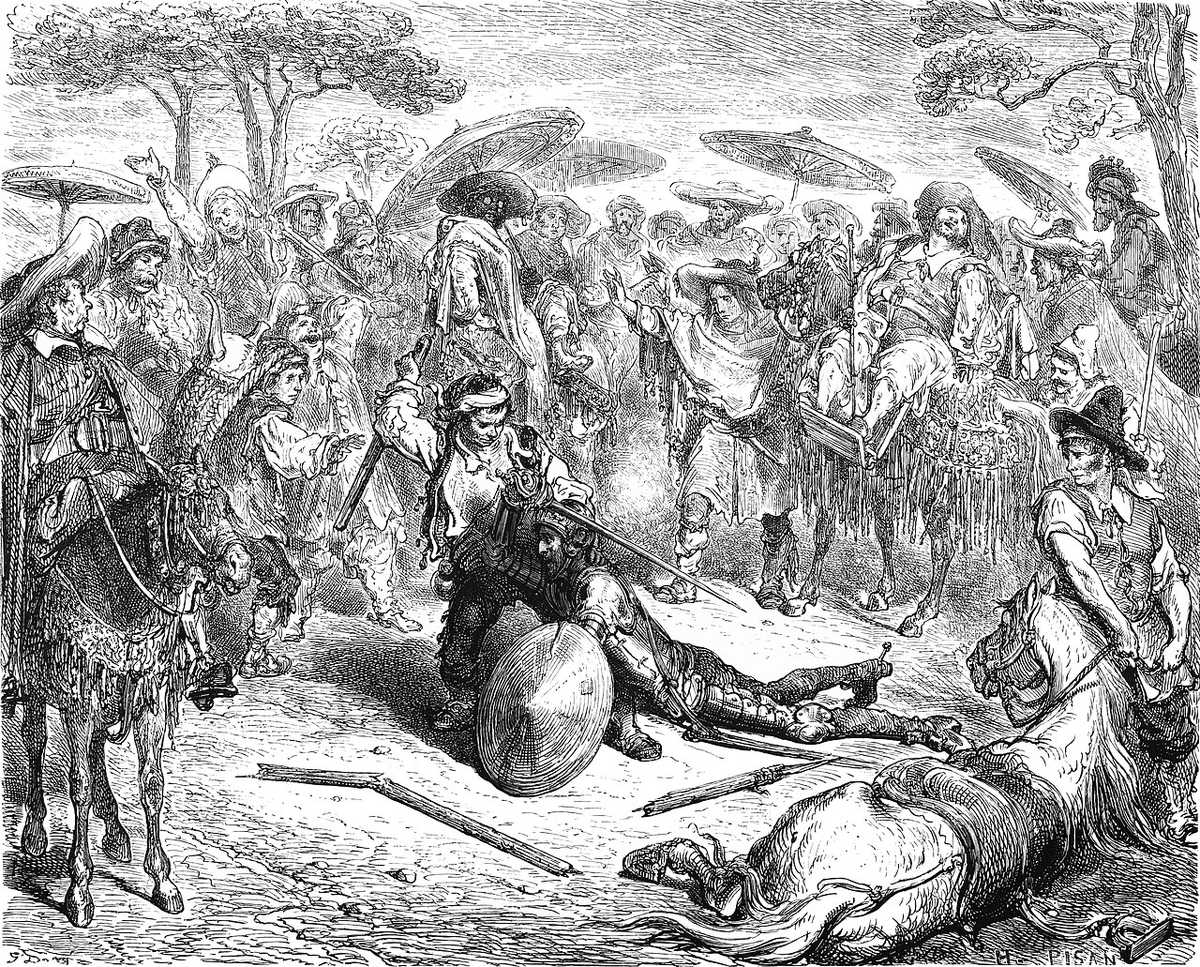
Representaban una batalla entre el Amor y el Interés, con dos castillos de madera.
They were acting out a battle between Love and Self-Interest, with two wooden castles.
Uno lo defendían unas doncellas armadas de versos y de buenas razones.
One of them was defended by maidens armed with verses and good arguments.
El otro lo asaltaban a golpe de bolsas de dinero, y el dinero ganaba siempre.
The other was stormed with blows from bags of money, and the money always won.
Allí le contaron la historia entera, que en el pueblo sabía cualquiera.
There they told him the whole story, which anybody in the village knew.
Quiteria y Basilio se habían criado juntos, y todos daban por hecho que acabarían casados.
Quiteria and Basilio had grown up together, and everyone took it for granted that they would end up married.
Pero el padre de la novia la prometió a Camacho para que su hija no viviese pobre.
But the bride’s father promised her to Camacho so that his daughter would not live poor.
Y adelantó la boda a fin de que no hubiera tiempo de arrepentirse.
And he brought the wedding forward so that there would be no time for second thoughts.
Basilio era el mozo más diestro del lugar, y tiraba la barra, corría, esgrimía y cantaba.
Basilio was the ablest young man in the place, and he threw the bar, ran, fenced and sang.
De nada le sirvió, porque ninguna de esas cosas se cuenta en la dote.
None of it helped him, because not one of those things counts towards a dowry.
Desde el compromiso andaba callado por los campos, hablando solo, y los vecinos temían por su juicio.
Since the engagement he had wandered the fields in silence, talking to himself, and the neighbours feared for his sanity.
Don Quijote dijo que un casamiento no debe deshacerse por dinero.
Don Quixote said that a marriage should not be undone by money.
Añadió que él acompañaría a los novios a la iglesia para que se viese una cosa.
He added that he would escort the couple to church so that one thing might be seen.
Que un caballero andante honra las bodas y defiende a quien no tiene con qué defenderse.
That a knight errant honours weddings and defends whoever has nothing to defend himself with.
Sancho, con la boca todavía llena, contestó que él era del bando de Camacho.
Sancho, his mouth still full, replied that he was on Camacho’s side.
Dijo que a las ollas de Camacho se les ve el fondo, y a las de Basilio no.
He said that Camacho’s pots have a bottom you can see, and Basilio’s do not.
Vocabulary
The wedding kitchen
- el asado
- the roast meat
- el cucharón
- the ladle
- la caldera
- the cauldron
- la masa
- the dough
- el ganso
- the goose
- la gallina
- the hen
- el puchero
- the stewpot
- freír
- to fry
The celebration
- la enramada
- the leafy arbour
- el convidado
- the guest
- el danzante
- the dancer
- el músico
- the musician
- la comarca
- the district
- la legua
- the league
- el bando
- the side, the faction
- a la redonda
- round about
Marrying in the seventeenth century
- la dote
- the dowry
- el compromiso
- the engagement
- el casamiento
- the marriage
- criarse
- to grow up
- arrepentirse
- to have second thoughts
- adelantar
- to bring forward
- deshacerse
- to be undone
- diestro
- skilful
Para que and a fin de que: the subjunctive of purpose
Levantaron enramadas para que los novios comiesen a la sombra.
Durmieron al raso para no molestar a nadie.
Adelantó la boda a fin de que no hubiera tiempo de arrepentirse.
English has one word, so, doing two jobs, and Spanish splits them. What decides the split is not the meaning but the subject: whether the same person does both halves of the sentence.
1. Same subject: para + infinitive
Durmieron al raso para no molestar a nadie. They slept out and they were the ones not bothering anyone. One subject, so no second conjugated verb is needed and none is allowed.
2. Different subject: para que + subjunctive
Un cocinero le dio un cucharón para que sacase lo que quisiera. The cook hands, Sancho scoops. Two subjects, so Spanish needs a full clause, and the verb of that clause goes into the subjunctive without exception.
| main verb | verb after para que | example |
|---|---|---|
| present or future | present subjunctive | Lo hace para que nadie lo olvide. |
| past | imperfect subjunctive | Lo hizo para que nadie lo olvidase. |
The imperfect subjunctive has two sets of endings, -ase / -ara and -iese / -iera, and they mean exactly the same thing. Olvidase and olvidara are interchangeable. Cervantes prefers the forms in -se, which is why this lesson is full of them, and modern Spain leans slightly towards -ra. Use whichever you like, but be able to read both.
3. The formal twin
A fin de que is para que in a suit. Same grammar, same subjunctive, higher register: it belongs to written Spanish, to contracts and to a narrator describing a rich man staging a wedding. Its infinitive partner is a fin de. There is also con el fin de, and in a bad mood no sea que, which means so that something does not happen and takes the subjunctive too.
One trap worth naming now. Para que answers what for, never why. If you want to give a cause and not a purpose, you need porque, and porque takes the indicative: No comió porque estaba mirando a los danzantes.
What a rich farmer’s wedding cost
Camacho is not a nobleman. He is a labrador rico, a farmer with money, and in Cervantes’ Spain that was a recent and slightly scandalous category. Nobility could not be bought outright, but a wedding could be, and a village wedding was where a family showed the whole district what it was now worth. The inventory in this chapter, the whole ram in one pot, the geese hanging in the trees, the cheeses stacked like masonry, is not comic exaggeration. Household accounts from the period record feasts on this scale, lasting two or three days, and ruining the family that gave them.
The dowry is the machinery underneath the story. A marriage in 1615 was a contract between two households about property, and the bride’s father wrote it. Quiteria is not asked. Basilio can throw the bar further than any man in the province, and none of that appears on the document, which is exactly the point Cervantes is making by listing his skills at the moment they stop mattering.
The dance of Love against Self-Interest that Don Quixote watches is a real form, an entremés or interlude performed at village celebrations, and it says out loud what the wedding is doing quietly. Cervantes puts the allegory and the thing it describes side by side in the same meadow, lets money win in the dance, and then spends the next chapter arranging for money to lose in the story.
Cervantes in the original · «Dos linajes solos hay en el mundo…»
Dos linajes solos hay en el mundo, como decía una agüela mía, que son el tener y el no tener
There are only two lineages in the world, as a grandmother of mine used to say, the haves and the have-nots
Sancho says this in II, 20, standing in front of Camacho’s cooking pots with a ladle in his hand, and the placement is the whole joke. It is a proverb, and Sancho attributes it, as he attributes most things, to a grandmother whose sayings cover every situation in the book. Note agüela, the old spelling of abuela, which the edition keeps. What makes the line more than folk wisdom is that it is the plot of the chapter said out loud by the one character who is not thinking about the plot. Quiteria is marrying Camacho because Camacho has and Basilio has not, and the reader has just spent two pages reading an inventory of what having looks like. Sancho is not moralising. He is eating, and the philosophy and the stomach happen to agree.