Spanish grammar · A1 to B1 · Updated
Spanish relative pronouns: que, quien, donde, lo que
Que does nearly all of the work, for people and for things alike. Quien is for people after a preposition, donde for places, and lo que for "what" when there is no noun to point at. The clause can also swing into the subjunctive, and that shifts the meaning from a particular thing to any thing of that kind.
The short answer
Que does nearly all the work: it covers who, whom, which and that, for people and things alike. Quien is only for people and only after a preposition. El que and el cual are the formal versions, and donde replaces en el que when the thing is a place.
How to remember it
Que first, and only reach further when you must
| Que | people and things, subject or object, no preposition | El hombre que vino |
|---|---|---|
| Preposition plus que | the article comes back: el que, la que | La casa en la que vivo |
| Quien | people only, and only after a preposition | La mujer con quien hablé |
| Donde | for a place, instead of en el que | La casa donde vivo |
| Cuyo | whose, and it agrees with what is owned | El hombre cuya casa vimos |
The forms
Which one to use
| English | Spanish | note |
|---|---|---|
| the man who came | el hombre que vino | que, not quien |
| the book that I read | el libro que leí | que, and never dropped |
| the woman I spoke to | la mujer con quien hablé | quien after a preposition |
| the house I live in | la casa en la que vivo | or donde |
| the day when we met | el día en que nos conocimos | en que for time |
| the man whose car | el hombre cuyo coche | cuyo agrees with coche |
20 sentences that show the difference
Everyday Spanish, the kind you would actually say. The label under each one says which part of the rule it shows.
El hombre que vino ayer.
The man who came yesterday.
Que, a person
El libro que leí anoche.
The book I read last night.
Que, a thing
La chica que conociste.
The girl you met.
Que as an object
Las llaves que perdí.
The keys I lost.
Que, never dropped
La casa en la que vivo.
The house I live in.
Preposition plus el que
El tema del que hablamos.
The subject we talked about.
De plus el que
La mujer con quien hablé.
The woman I spoke to.
Quien after a preposition
Los amigos a quienes escribí.
The friends I wrote to.
Quienes, plural
La casa donde vivo.
The house where I live.
Donde for a place
El día en que nos conocimos.
The day we met.
En que for time
El hombre cuya hija conoces.
The man whose daughter you know.
Cuyo agrees with hija
Lo que dijiste es verdad.
What you said is true.
Lo que for an idea
Todo lo que sé.
Everything I know.
Lo que again
Mi hermano, que vive en Cádiz, viene mañana.
My brother, who lives in Cadiz, is coming tomorrow.
Between commas, extra information
El chico que vive en Cádiz es mi hermano.
The boy who lives in Cadiz is my brother.
No commas, it identifies him
Quien mucho abarca, poco aprieta.
He who grasps at much holds little.
Quien alone in a proverb
La razón por la cual lo hizo.
The reason he did it.
El cual, formal
Busco a alguien que hable ruso.
I am looking for someone who speaks Russian.
Subjunctive, not found yet
Conozco a alguien que habla ruso.
I know someone who speaks Russian.
Indicative, this person exists
Eso es lo que quería decir.
That is what I meant.
Lo que in a set phrase
Where English gets in the way
English lets you delete the relative pronoun whenever it is the object: the man I saw, the books we had, the day she arrived. Spanish never allows this, and the gap is the first thing that gives an English speaker away in writing. If you can slip a that back into your English sentence and it still works, you need que in the Spanish one.
The mistake to avoid
The dropped relative: ✗ Se llevó los libros teníamos, which has two verbs and nothing joining them. The right form is ✓ Se llevó los libros que teníamos. The other mistake is translating who as quien: ✗ el hombre quien vino → ✓ el hombre que vino. Quien does exist, but it appears after prepositions and in set phrases, not here.
The cases that break the rule
El libro que leí
English can drop the relative: "the book I read". Spanish never can. Que has to be there, and leaving it out is the single most audible mistake in this topic.
El hombre quien vino
Wrong. Quien only appears after a preposition or standing on its own in a saying. Without a preposition it is always que, even about people.
La casa en la que vivo
After a preposition, que needs its article back: en la que, del que, con el que. Bare "en que" survives for time expressions but sounds odd for places.
Cuyo coche
Cuyo agrees with the thing owned, not with the owner: el hombre cuya casa, la mujer cuyos hijos. It is formal, and speech uses de quien instead.
Que hable, que habla
A relative clause takes the subjunctive when the thing described has not been found yet: busco a alguien que hable ruso. With the indicative the person exists.
Mi hermano, que vive en Cádiz
The commas change the meaning. Without them, the clause picks one brother out of several. With them, you have only one brother and this is extra information.
Spanish relative pronoun exercises
8 sentences to fill in. Type your answer and check it, or read them straight through with the answers showing. Accents count here, the way they count in the language.
-
El libro ___ me prestaste era muy bueno.
The book you lent me was very good.
que · Que, and it can never be left out, however natural that feels in English.
-
La mujer con ___ hablé es la directora.
The woman I spoke to is the director.
quien · Quien, because there is a preposition and the subject is a person.
-
La casa en la ___ vivo es muy antigua.
The house I live in is very old.
que · After a preposition, que needs its article: en la que. Donde would also work.
-
El hombre ___ hija conoces es mi vecino.
The man whose daughter you know is my neighbour.
cuya · Cuya agrees with hija, the thing owned, and not with el hombre.
-
Todo lo ___ dijiste es verdad.
Everything you said is true.
que · Lo que for an idea with no noun behind it.
-
Busco a alguien que (hablar) ___ ruso.
I am looking for someone who speaks Russian.
hable · Subjunctive, because I have not found them yet. Conozco a alguien que habla would be indicative.
-
El día en ___ nos conocimos llovía.
The day we met it was raining.
que · En que for a time expression, where a place would take donde.
-
Mi hermano, ___ vive en Cádiz, viene mañana.
My brother, who lives in Cadiz, is coming tomorrow.
que · Que between commas. The commas say I have only one brother.
More exercises, from Don Quixote
8 more, these ones straight out of the course: the inn, the windmills, Rocinante and the road. Same rule, older Spanish.
-
El caballo ___ se llama Rocinante está flaco.
The horse that is called Rocinante is thin.
que · Que covers that, which and who. It is the one relative you can almost always use.
-
La venta en ___ durmieron era un castillo para él.
The inn they slept in was a castle to him.
la que · After a preposition, que needs an article: en la que, con el que, de los que.
-
El cura, ___ conocía los libros, los quemó.
The priest, who knew the books, burned them.
que or quien · Between commas, both work. Quien is only for people, and it sounds a shade more formal.
-
Lo ___ dice Sancho es verdad.
What Sancho says is true.
que · Lo que means what in the sense of the thing that. Never qué with an accent here, because it is not a question.
-
La mujer con ___ habló era Teresa.
The woman he spoke to was Teresa.
la que or quien · With a person after a preposition, quien and la que are both correct.
-
El escudero ___ mujer se llama Teresa es Sancho.
The squire whose wife is called Teresa is Sancho.
cuya · Cuyo agrees with the thing owned and not with the owner. The owner here is a man, but the wife is feminine, so cuya.
-
Los molinos, ___ eran treinta, parecían gigantes.
The windmills, of which there were thirty, looked like giants.
que · Between commas the clause only adds information. Without commas it would be telling you which windmills.
-
Es el hombre a ___ vimos ayer.
He is the man we saw yesterday.
quien or el que · A person after a preposition again. A quien is the safest choice in writing.
Common questions
When do I use quien instead of que?
After a preposition, for people: el hombre con quien hablé. Without a preposition, que covers people and things alike, so el hombre que vino is right and el hombre quien vino is not.
What are el que and el cual for?
For clarity after a longer preposition or between commas: la casa en la que vivo, las razones por las cuales lo hizo. El cual is the formal one and belongs to writing more than to speech.
Why does the verb sometimes go into the subjunctive?
Because the thing described is not known to exist. Busco un libro que tiene mapas means a particular book. Busco un libro que tenga mapas means any book of that kind, and I do not know whether there is one.
Does que need a comma?
Only when the clause is extra information rather than the part that identifies. Los alumnos que llegaron tarde means only the late ones. Los alumnos, que llegaron tarde means all of them, and by the way they were late. The comma changes who you are talking about.
How do I say whose in Spanish?
Cuyo, and it agrees with the thing owned, not with the owner: el hombre cuya casa vimos, la mujer cuyos hijos conozco. It is formal, and in speech people usually rebuild the sentence with de quien or start again.
Where does the preposition go?
In front, never at the end. English says the girl I spoke to, Spanish says la chica con la que hablé. After a preposition, que needs its article: el libro del que te hablé, la casa en la que vivo.
When do I use donde instead of en el que?
For places, and it is shorter and more natural: la casa donde nací. En la que means exactly the same and sounds more formal. Donde only works for real places, so for a moment in time you need en que: el año en que nací.
What is the difference between que and qué?
The accent marks a question or an exclamation. Que without it joins two halves of a sentence: el libro que leí. Qué with it asks or exclaims: ¿qué quieres?, ¡qué bonito!. The accent stays even inside an indirect question: no sé qué quieres.
The things to remember
- Que covers who, whom, which and that, for people and things alike.
- Spanish never drops it. The book I read is always el libro que leí.
- Quien is for people and only after a preposition.
- After a preposition the article comes back: en la que, del que, con el que.
- Commas change the meaning: with them the clause is extra, without them it identifies.
The same rule in Don Quixote
Real lines from the course, not invented examples. Each one is the sentence the lesson uses to introduce the point.
Echaron los libros que había en la biblioteca.
They threw in the books that were in the library.
Soy el bachiller que acompaña este cuerpo muerto.
I am the graduate who is accompanying this dead body.
Busca el edificio que sea más alto.
Look for whichever building is tallest.
The book this comes from
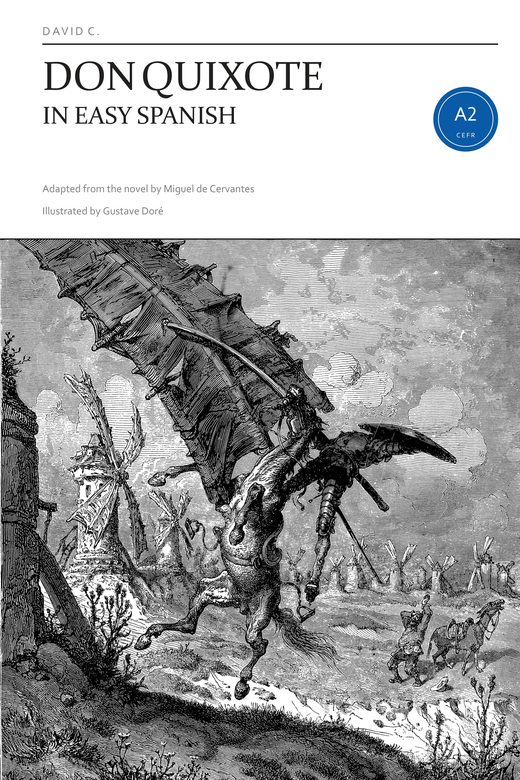
Don Quixote in Easy Spanish: the whole novel retold in Spanish you can actually read, in 58 short episodes, with the hard words glossed in the margin. It is where every Don Quixote sentence on this page comes from.
In EPUB and PDF, with a second novel in the same Spanish. See the books.
Where the course teaches this
3 lessons build it up, each one inside a chapter of the story rather than in the abstract. Free to read, with the vocabulary, the audio and the exercises.
- The relative QUE, and how to stretch a nounLesson 19A wall where the door used to be
- Relatives: que, donde, quienLesson 34The scholar who came from Baeza
- El que sea: relative clauses in the subjunctiveLesson 61Looking for Dulcinea’s Palace
Next to this one
The points that sit closest to this one, and that a student usually meets around the same time.