Spanish grammar · B1 · Updated
Lo que, lo bueno, lo peor
Lo in front of an adjective turns it into an idea: lo bueno is the good part of it, lo peor is the worst of it. Lo que is "what" when nothing has been named yet. Neither of them has anything to do with lo the object pronoun, and mixing the two up is common.
The short answer
Lo is not masculine: it is the neuter, and it turns an adjective into an abstract noun. Lo bueno is "the good thing about it". Lo que means "what" or "the thing that": lo que dijiste. Neither ever goes in front of a noun.
How to remember it
Lo makes an idea out of an adjective
| Lo plus adjective | the abstract quality: the good part, the hard part | Lo bueno |
|---|---|---|
| Lo que | what, the thing that | Lo que dijiste |
| Lo de | the business of, that thing about | Lo de ayer |
| Lo más | the most, with an adjective | Lo más difícil |
| Never with a noun | lo libro does not exist | ✗ Lo libro |
The forms
The three shapes
| Spanish | English | note |
|---|---|---|
| lo bueno | the good thing | the quality on its own |
| lo difícil | the hard part | the quality on its own |
| lo que dijiste | what you said | a whole clause |
| lo de ayer | that business yesterday | a known situation |
| lo más importante | the most important thing | lo plus a superlative |
| lo mío | my own affairs | lo plus a possessive |
20 sentences that show the difference
Everyday Spanish, the kind you would actually say. The label under each one says which part of the rule it shows.
Lo bueno es que ya terminó.
The good thing is that it is over.
Lo plus adjective
Lo difícil es empezar.
The hard part is starting.
Lo plus adjective
Lo peor fue el viaje.
The worst part was the journey.
Lo plus adjective
Lo mejor de todo.
The best thing of all.
Lo plus adjective
Lo importante es participar.
The important thing is to take part.
Lo plus adjective
Lo que dijiste es verdad.
What you said is true.
Lo que
No entiendo lo que quieres.
I do not understand what you want.
Lo que
Todo lo que sé.
Everything I know.
Todo lo que
Haz lo que quieras.
Do what you like.
Lo que plus subjunctive
Lo de ayer fue raro.
That business yesterday was odd.
Lo de
Lo de tu hermano me preocupa.
That thing with your brother worries me.
Lo de
Lo más difícil ya pasó.
The hardest part is over.
Lo más
Lo mío es la cocina.
Cooking is my thing.
Lo plus possessive
Cada uno a lo suyo.
Everyone to their own business.
Lo suyo
Por lo visto, no viene.
Apparently he is not coming.
Set phrase
Por lo menos avisó.
At least he let us know.
Set phrase
A lo mejor viene.
Maybe he will come.
Set phrase, takes the indicative
Lo siento.
I am sorry.
Lo standing for a whole situation
No lo sé.
I do not know.
Lo standing for a whole idea
Es más caro de lo que parece.
It is dearer than it looks.
De lo que in a comparison
Where English gets in the way
English needs a noun to carry an abstraction: the good thing, the best part, the difficult bit. Spanish does it with a bare article, and the result is shorter and much more frequent than an English speaker expects. Because there is no equivalent word to translate, the construction tends to be skipped altogether by learners, who reach for la cosa buena or la mejor parte. Neither is wrong exactly, but neither sounds native, and la cosa buena in particular is the kind of phrase that marks a translated sentence at fifty paces. The other half of the problem is direction: English says what he saw where Spanish says lo que vio, so learners drop the lo and produce ✗ que vio eran tres mujeres. The lo is not optional. It is the part that means the thing.
The mistake to avoid
Three. One, using cosa instead of lo. ✗ La cosa mejor del libro → ✓ Lo mejor del libro. Two, dropping the lo before que. ✗ Que veía eran tres mujeres → ✓ Lo que veía eran tres mujeres. Three, making the adjective agree. ✗ Los importantes son los detalles → ✓ Lo importante son los detalles. Neuter lo has no plural.
The cases that break the rule
Lo libro
Does not exist. Lo never goes in front of a noun, because a noun already has a gender. It only goes with adjectives, with que, with de and with possessives.
Lo bueno, not el bueno
El bueno is a person, the good one. Lo bueno is the quality itself, the good thing about the situation. One letter apart and two different meanings.
Lo que and el que
Lo que is a thing or an idea with no gender. El que is a specific masculine one: el que compré is the one I bought.
A lo mejor
Means "maybe" and takes the indicative, unlike quizá and tal vez which can take the subjunctive. A lo mejor viene, never a lo mejor venga.
Lo siento
Literally "I feel it", with lo standing for the whole situation. Spanish does this a lot: no lo sé, lo entiendo, ya lo verás. English drops the object and Spanish will not.
De lo que
In a comparison before a whole clause: es más caro de lo que parece. Que on its own would need a plain noun after it.
Lo que exercises
8 sentences to fill in. Type your answer and check it, or read them straight through with the answers showing. Accents count here, the way they count in the language.
-
___ bueno es que ya hemos terminado.
The good thing is that we have finished.
Lo · Lo plus adjective for the quality itself. El bueno would be a person.
-
No entiendo ___ que quieres decir.
I do not understand what you mean.
lo · Lo que for a whole clause with no gender behind it.
-
___ de ayer fue muy raro.
That business yesterday was very odd.
Lo · Lo de plus a noun: a situation you both already know about.
-
___ más difícil ya ha pasado.
The hardest part is over.
Lo · Lo plus a superlative. It means the hardest part and not the hardest person.
-
Haz ___ que te dé la gana.
Do whatever you like.
lo · Lo que with the subjunctive, because what you want is not yet known.
-
Es más caro de ___ que parece.
It is dearer than it looks.
lo · De lo que in a comparison before a whole clause.
-
A ___ mejor viene esta tarde.
Maybe he will come this afternoon.
lo · A lo mejor takes the indicative, unlike quizá.
-
___ mío es la cocina, no la música.
Cooking is my thing, not music.
Lo · Lo plus a possessive: my own field, my own affairs.
More exercises, from Don Quixote
8 more, these ones straight out of the course: the inn, the windmills, Rocinante and the road. Same rule, older Spanish.
-
___ que dice Sancho es verdad.
What Sancho says is true.
Lo · Lo que means the thing that. It is not a question, so no accent on que ever.
-
No entiendo ___ que quieres.
I do not understand what you want.
lo · English what does two jobs. As a question it is qué, and inside a sentence it is lo que.
-
___ bueno de la venta es el vino.
The good thing about the inn is the wine.
Lo · Lo plus an adjective makes an abstract noun: the good part, the good thing. Never el bueno, which would be a man.
-
___ peor fue la manta.
The worst part was the blanket.
Lo · Lo peor, lo mejor, lo más. The adjective stays masculine singular because it refers to no noun at all.
-
Haz ___ que te digo y calla.
Do what I tell you and be quiet.
lo · Lo que again, this time as the object of the sentence.
-
___ importante es no rendirse.
The important thing is not to give up.
Lo · Lo importante, lo difícil, lo raro. Spanish builds these without a noun and English cannot.
-
No sabes ___ difícil que es.
You have no idea how hard it is.
lo · Lo plus adjective plus que means how. Here the adjective does agree if there is a noun behind it.
-
___ malo es que no hay cena.
The bad thing is that there is no supper.
Lo · Lo malo es que introduces the catch. It is one of the most useful openings in spoken Spanish.
Common questions
What does lo plus an adjective mean?
The abstract part of it. Lo bueno is the good thing about it, lo peor is the worst of it, lo difícil is the hard part. English usually needs a whole phrase where Spanish needs two words.
When do I use lo que?
For "what" when there is no noun to point at: no entiendo lo que dices. If there is a noun, plain que does the job: el libro que leo. Lo que also sums up a whole clause: llegó tarde, lo que me molestó.
Is this the same lo as in lo veo?
No. That lo is the object pronoun standing in for a masculine thing. This lo is a neuter article that has no plural and never refers to a specific object. They only look alike.
What does lo que pasa es que mean?
The thing is, or what is happening is that. It is the standard way Spanish opens an explanation or an excuse: lo que pasa es que no tengo tiempo. Learning it as a single block is more useful than taking it apart.
What is lo de?
The business of, the thing about, and it lets you point at a whole situation without naming it: lo de ayer, what happened yesterday, lo del dinero, that business with the money. It is very common and there is no neat English word for it.
What is the difference between lo que and el que?
Lo que refers to a thing with no name yet: an idea, a situation, what somebody said. El que refers to a specific noun you have already mentioned, and it has to match its gender: el que compré, the one I bought. If you could point at it, use el que.
How do I say as fast as I could?
Lo más rápido que pude. The pattern is lo más plus an adjective or adverb plus que, and it is how Spanish builds all of these: lo antes posible, as soon as possible, lo mejor que sé, as best I know how.
Does lo bueno take a plural?
No. Lo has no plural and no feminine, because it is not pointing at a thing that could be counted. Lo bueno is the good part of it, and it stays that shape however many things are involved.
The things to remember
- Lo is neuter, not masculine, and never goes in front of a noun.
- Lo plus adjective makes an abstract idea: lo bueno, the good thing.
- Lo que means "what" or "the thing that", and covers a whole clause.
- Lo de plus a noun means "that business about": lo de ayer.
- Spanish keeps a lo where English drops the object: no lo sé, lo siento.
The same rule in Don Quixote
Real lines from the course, not invented examples. Each one is the sentence the lesson uses to introduce the point.
Lo más fácil era mentir.
The easiest thing was to lie.
The book this comes from
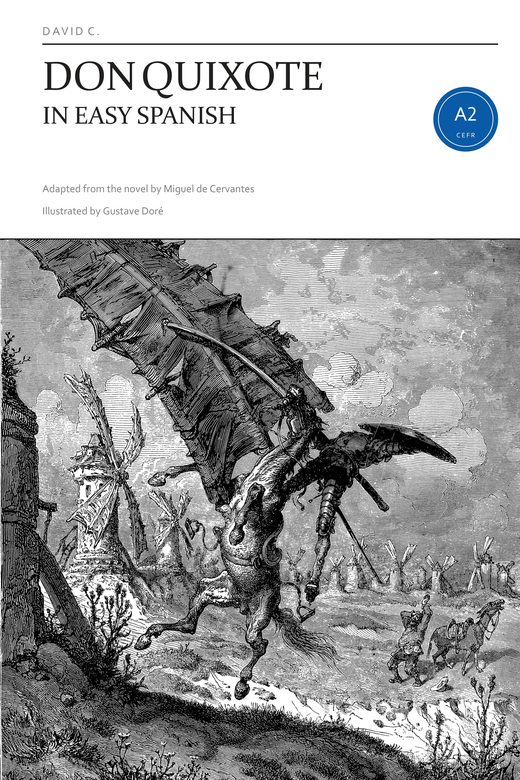
Don Quixote in Easy Spanish: the whole novel retold in Spanish you can actually read, in 58 short episodes, with the hard words glossed in the margin. It is where every Don Quixote sentence on this page comes from.
In EPUB and PDF, with a second novel in the same Spanish. See the books.
Where the course teaches this
One lesson covers it, each one inside a chapter of the story rather than in the abstract. Free to read, with the vocabulary, the audio and the exercises.
- Lo bueno, lo peor, lo queLesson 62Three Peasant Girls on the Road
Next to this one
The points that sit closest to this one, and that a student usually meets around the same time.