Spanish grammar · A1 to A2 · Updated
Este, ese and aquel in Spanish
Three distances where English has two. Este is here by me, ese is there by you, aquel is over there away from both of us. The same three-way split runs through aquí, ahí and allí, and it works for time as well as for space.
The short answer
Spanish has three demonstratives where English has two. Este is here, next to me. Ese is there, next to you. Aquel is over there, away from both of us. They match the words aquí, ahí and allí, and each one has four forms plus a neuter for an idea with no gender.
How to remember it
Three distances, one for each person
| Este | here, by me. Goes with aquí | Este libro |
|---|---|---|
| Ese | there, by you. Goes with ahí | Ese libro |
| Aquel | over there, away from us both. Goes with allí | Aquel libro |
| Four forms | masculine and feminine, singular and plural | este, esta, estos, estas |
| The neuter | esto, eso, aquello, for an idea or a thing with no name yet | ¿Qué es esto? |
The forms
The three sets in full
| este, here | ese, there | aquel, over there | |
|---|---|---|---|
| masculine singular | este | ese | aquel |
| feminine singular | esta | esa | aquella |
| masculine plural | estos | esos | aquellos |
| feminine plural | estas | esas | aquellas |
| neuter | esto | eso | aquello |
| its adverb | aquí | ahí | allí |
20 sentences that show the difference
Everyday Spanish, the kind you would actually say. The label under each one says which part of the rule it shows.
Este libro es mío.
This book is mine.
Here, by me
Esta casa es antigua.
This house is old.
Feminine
Estos zapatos me quedan bien.
These shoes fit me.
Plural
Ese que llevas es más bonito.
The one you have is nicer.
There, by you
Esa idea no me convence.
I am not sure about that idea.
There, by you
Aquella montaña es la más alta.
That mountain over there is the tallest.
Far from both
Aquellos años fueron difíciles.
Those years were hard.
Far in time
¿Qué es esto?
What is this?
Neuter, no name yet
Eso no es verdad.
That is not true.
Neuter, a whole idea
Todo aquello quedó atrás.
All that is behind us.
Neuter, distant
Dame ese.
Give me that one.
Standing alone, no noun
Prefiero esta.
I prefer this one.
Standing alone
Este año ha sido raro.
This year has been odd.
Este for now
Esa semana no estuve.
I was away that week.
Ese for a time already mentioned
En aquella época no había coches.
In those days there were no cars.
Aquel for a distant past
Ni esto ni aquello.
Neither one thing nor the other.
Set phrase
Eso es.
That is it, exactly.
Agreeing
Por eso te lo digo.
That is why I am telling you.
Set phrase
Aquí, este; ahí, ese; allí, aquel.
Here this, there that, over there that one.
The whole system in one line
Esa película, la vi.
That film, I saw it.
Fronting with a pronoun
Where English gets in the way
English packs two distances into that: the sword by your elbow and the sword thirty feet away get the same word. Spanish splits them. If the thing is by the person you are speaking to, it is ese. If it is away from both of you, it is aquel. When you are unsure, ask yourself which place word you would use (aquí, ahí or allí) and take the demonstrative from the same row of the table.
The mistake to avoid
Two errors, both very common. English speakers reach for the neuter because it looks like the "basic" form: ✗ esto peto es fuerte. The neuter can never sit in front of a noun: say ✓ este peto es fuerte. And, translating the out of habit, they write ✗ el este peto, ✗ la esa lanza. Drop the article: ✓ este peto, ✓ esa lanza.
The cases that break the rule
Esto, eso, aquello
The neuter has no accent and no plural, and it never goes with a noun. Use it when you do not know what the thing is, or when you mean a whole idea: eso no es verdad.
Éste with an accent
Books before 2010 write éste, ése, aquél with an accent when they stand alone. The Academy dropped it. It is not a mistake in an old text, and you should not write it now.
Ese used dismissively
Applied to a person, ese can be rude: ese for "that bloke". Tone does the work, and the same word about a book is completely neutral.
Aquel in time
The three distances work for time as well as space. Este año is now, ese año is the one just mentioned, aquellos años is a long way back and slightly wistful.
Ese fading in Latin America
Much of Latin America uses ese where Spain uses aquel, so the three-way system flattens towards two. Both are correct where they are spoken.
Este as a filler
In speech, este... is what Spaniards say while they think, the way English says "erm". It is worth recognising and not worth copying.
Este, ese, aquel exercises
8 sentences to fill in. Type your answer and check it, or read them straight through with the answers showing. Accents count here, the way they count in the language.
-
___ libro que tengo aquí es muy bueno.
This book I have here is very good.
Este · Este for what is next to me. Aquí in the sentence is the giveaway.
-
___ camisa que llevas es bonita.
That shirt you are wearing is nice.
Esa · Esa for what is next to you, and feminine because camisa is.
-
___ montañas del fondo son los Pirineos.
Those mountains in the distance are the Pyrenees.
Aquellas · Aquellas for what is far from both of us, feminine plural.
-
¿Qué es ___? No lo había visto nunca.
What is this? I have never seen it before.
esto · The neuter, because you do not yet know what the thing is called.
-
___ no es verdad y lo sabes.
That is not true and you know it.
Eso · The neuter again, standing for a whole idea rather than a thing.
-
Me gustan ___ zapatos que están ahí.
I like those shoes over there by you.
esos · Esos goes with ahí, the middle distance. Masculine plural for zapatos.
-
En ___ época no había electricidad.
In those days there was no electricity.
aquella · Aquella for a distant time. The three distances work for time too.
-
___ año he leído mucho más.
This year I have read a lot more.
Este · Este for the year we are in. Note the perfect he leído, because the year is still open.
More exercises, from Don Quixote
8 more, these ones straight out of the course: the inn, the windmills, Rocinante and the road. Same rule, older Spanish.
-
___ libro que tengo aquí es mío.
This book I have here is mine.
Este · Este is what is next to me. Aquí is the word that goes with it.
-
¿Ves ___ caballo que está a tu lado?
Do you see that horse beside you?
ese · Ese is what is next to you, not to me. Spanish has three distances where English has two.
-
___ molinos de allí lejos parecen gigantes.
Those windmills far over there look like giants.
Aquellos · Aquel is what is away from both of us. Allí is its word.
-
En ___ tiempos había caballeros andantes.
In those days there were knights errant.
aquellos · Distance in time works like distance in space, and a long time ago takes aquel.
-
___ noche no durmieron nada.
That night they did not sleep at all.
Esa or Aquella · Esa for a night already mentioned, aquella for one far back in the story. Both work here.
-
¿Qué es ___?
What is this?
esto · Esto is neuter, for something you cannot name yet. It never carries an accent, and there is no plural.
-
Dame ___ libros que tienes ahí.
Give me those books you have there.
esos · Ahí is the middle distance, so ese. Aquí, ahí and allí line up with este, ese and aquel.
-
Todo ___ me parece un sueño.
All this seems like a dream to me.
esto · A whole situation has no gender, so it takes the neuter: esto, eso, aquello.
Common questions
What is the difference between ese and aquel?
Ese is near the person you are talking to, aquel is away from both of you. English collapses the two into "that", which is why the third one feels like an extra that nobody asked for.
Do este and ese need an accent?
Not any more. The Academy dropped the accent on the pronouns in 2010, so éste and ésta are no longer required. You will still see them in older books, and they are not wrong there.
What is esto for?
The neuter form, for something not yet named or for an idea rather than an object: ¿qué es esto? and esto no me gusta. Esto, eso and aquello never carry an accent and never sit in front of a noun.
Why does Spanish have three when English has two?
Because they map onto the three people in the conversation, not onto distance alone. Este is near me, ese is near you, aquel is away from us both. English collapses the middle one into that, which is why ese is the hard one for English speakers.
What is the difference between aquí, ahí and allí?
The same three steps, for places: aquí goes with este, ahí with ese, allí with aquel. Learning them as three pairs is easier than learning them as six words. Acá and allá are vaguer versions, common in Latin America.
Can ese sound dismissive?
Yes. Put in front of a person it can carry a shrug: ese tío, that bloke. It is tone rather than grammar, and it is one of the reasons Spanish speakers pick ese over aquel when they want to keep something at arm's length.
How do I say this one and that one?
Just the demonstrative on its own, with no word for one: este me gusta más que ese. Spanish has no equivalent of the English one here, and adding uno is a mistake English speakers make often.
What is the difference between esto and este?
Este points at a thing you can name and has to match its gender: este libro, esta mesa. Esto points at something with no name yet: a situation, an idea, a mess on the table. ¿Qué es esto? is what you say before you know what it is.
The things to remember
- Three distances, not two: este here, ese by you, aquel over there.
- They pair up with aquí, ahí and allí. Learn them as three columns.
- Each has four forms, and they agree with the noun like any adjective.
- The neuter esto, eso, aquello has no plural and never goes with a noun.
- The accent on éste was abolished in 2010. Old books have it, you should not.
The same rule in Don Quixote
Real lines from the course, not invented examples. Each one is the sentence the lesson uses to introduce the point.
Este peto es fuerte.
This breastplate is strong.
Este castillo está encantado.
This castle is under a spell.
The book this comes from
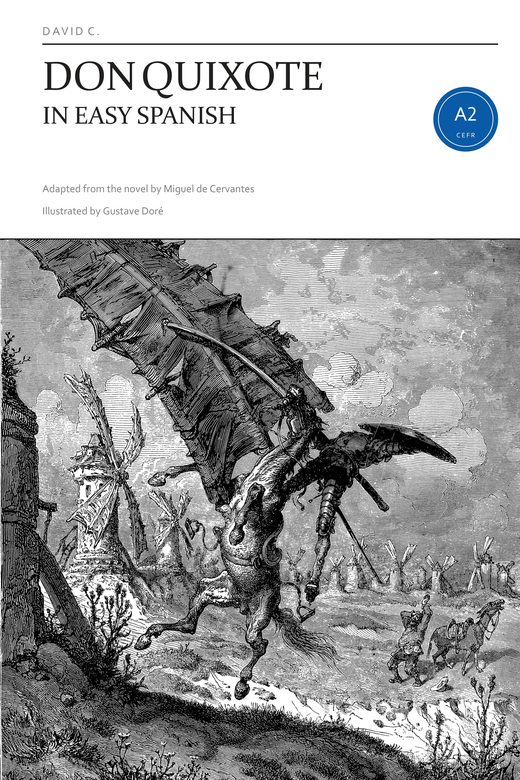
Don Quixote in Easy Spanish: the whole novel retold in Spanish you can actually read, in 58 short episodes, with the hard words glossed in the margin. It is where every Don Quixote sentence on this page comes from.
In EPUB and PDF, with a second novel in the same Spanish. See the books.
Where the course teaches this
2 lessons build it up, each one inside a chapter of the story rather than in the abstract. Free to read, with the vocabulary, the audio and the exercises.
- Este, ese, aquel: the three distancesLesson 5The great-grandfather's armour
- Demonstratives: este, ese, aquelLesson 29That enchanted castle
Next to this one
The points that sit closest to this one, and that a student usually meets around the same time.