Level A1 · Chapter 5
The great-grandfather's armour
The gentleman finds a hundred-year-old suit of armour in a corner, and spends four days cleaning it.
What you will learn
- Point at an object and say whether it is here, there, or over there.
- Handle three distances where English has only two.
- Talk about a thing without naming it: esto, eso, aquello.
Before you read
In this text the gentleman is pointing at things the whole time: este, ese, aquel. Watch where each object is standing when he says it. The distance is the whole point, and the grammar section will explain why there are three of them and not two.The story in easy Spanish
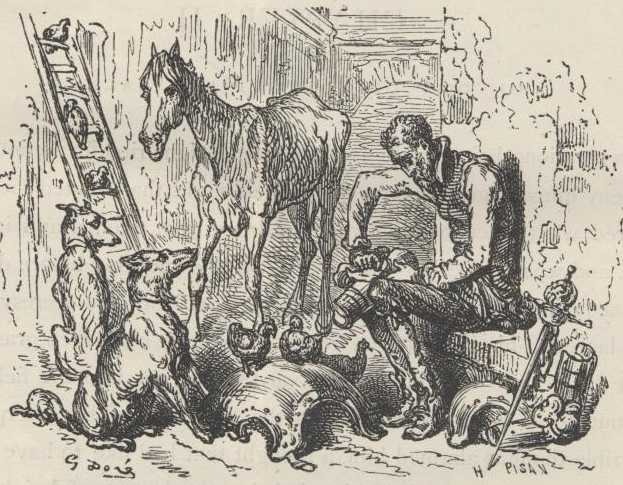
El hidalgo entra en un cuarto oscuro y polvoriento. En un rincón hay unas armas muy viejas.
The gentleman walks into a dark, dusty room. In one corner there is a very old suit of armour.
Estas armas son de sus bisabuelos. Tienen más de cien años y mucho óxido.
This armour belonged to his great-grandparents. It is over a hundred years old and covered in rust.
El hidalgo toma un peto y habla solo delante de todo el hierro. «Este peto es fuerte y esa lanza de ahí es muy larga.»
The gentleman picks up a breastplate and talks to himself in front of all that iron. "This breastplate is strong, and that lance over there is very long."
«Y aquella espada del fondo es la espada de un caballero de verdad.»
"And that sword at the far end is the sword of a real knight."
Aquí hay hierro, ahí hay polvo y allí, al fondo, hay más polvo.
Here there is iron, there there is dust, and over there, at the far end, there is more dust.
Aquello del rincón no es basura: es la historia de su familia. El hidalgo limpia todo esto durante cuatro días.
That stuff in the corner is not junk: it is his family history. The gentleman cleans the whole lot for four days.
Pero hay un problema: no tiene celada entera, solo un morrión simple. Eso no es bueno para un caballero andante.
But there is a problem: he has no full helmet, only a plain headpiece. That is not good for a knight-errant.
Vocabulary
The armour
- las armas
- the armour, the arms
- el peto
- the breastplate
- la lanza
- the lance
- la espada
- the sword
- la celada
- the closed helmet
- el morrión
- the open headpiece
- el hierro
- the iron
The room
- el rincón
- the corner (inside)
- el fondo
- the far end, the back
- el óxido
- the rust
- el polvo
- the dust
- oscuro / oscura
- dark
The family
- el bisabuelo
- the great-grandfather
- la familia
- the family
Este, ese, aquel: the three distances
Este peto es fuerte.
Esa lanza de ahí es muy larga.
Aquella espada del fondo es magnífica.
Distance. English gives you two settings, this and that. Spanish gives you three, and they line up with the three place words you already know: aquí, ahí, allí.
| where the thing is | masc. sing. | fem. sing. | masc. pl. | fem. pl. | place word |
|---|---|---|---|---|---|
| near me | este | esta | estos | estas | aquí |
| near you | ese | esa | esos | esas | ahí |
| far from both of us | aquel | aquella | aquellos | aquellas | allí |
este is the breastplate in his hands. ese is the lance leaning against the wall next to you. aquel is the one you have to raise your chin to look at: the sword glinting at the far end of the room. Think of aquel as that one over yonder, the word English lost a few centuries ago and never replaced.
Then there are three neuter forms: esto, eso, aquello. Use them when the thing has no name yet, or when you mean a whole situation rather than one object. Esto no es basura: this stuff, all of it. Eso no es bueno: that fact, that state of affairs. The neuters never stand in front of a noun. There is no esto peto.
One more thing, and it is the one that trips people up in writing: the demonstrative takes the place of the article. English says this breastplate with no the, and Spanish does exactly the same: este peto. Never el este peto.
(You may see éste with an accent in older books. The accent was dropped. Do not write it.)
Armour that was already museum stock
Here is the joke the first readers got instantly, and we tend to miss. That armour was not merely old: it was useless. A hundred years earlier a man in plate on a horse decided battles. By 1605 Spanish armies fought in the tercios, blocks of pikemen with arquebusiers at the corners, and no amount of iron stops a lead ball. Full plate had shrunk to a parade costume and a breastplate for officers.
So the armour hanging on a nail in a hidalgo house was doing the same work as an old photograph on a mantelpiece: proving there had once been a great-grandfather worth remembering. Every reader in 1605 knew a house like that. Our gentleman is the one man in Spain who takes the decoration down and puts it on.
And he spends four days at it, which is the detail that gives the game away. Rust does not come off. He is not preparing for battle. He is polishing a relic and calling it preparation.
Cervantes in the original · «Y lo primero que hizo fue limpiar unas armas que…»
Y lo primero que hizo fue limpiar unas armas que habían sido de sus bisabuelos, que, tomadas de orín y llenas de moho, luengos siglos había que estaban puestas y olvidadas en un rincón.
The first thing he did was to clean up some armour that had belonged to his great-grandparents and which, eaten with rust and covered with mould, had lain forgotten in a corner for long ages.
Three words you already own: armas, bisabuelos, rincón. Orín is the old word for rust, and luengos siglos means "long centuries": Cervantes is exaggerating, and he knows it.