Level A1 · Chapter 4
The books of chivalry
The gentleman reads day and night, sells his land, argues with the priest, and reaches a very strange decision.
What you will learn
- Conjugate -er and -ir verbs in the present.
- Say what someone reads, eats, believes or decides.
- Keep apart ser, estar, hay and ir: the four verbs that get tangled.
Before you read
The verbs no longer all end in -a. Look at lee, come, vende, sube, decide: these are the other two families, and between them and lesson 3 you now have every regular verb in Spanish.The story in easy Spanish
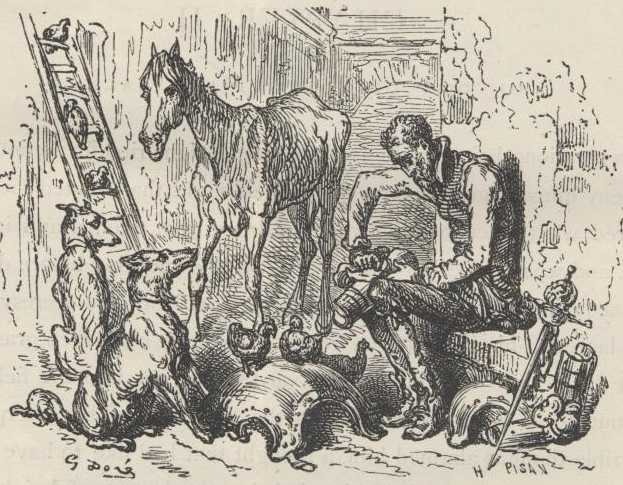
Alonso Quijano lee libros de caballerías todo el día. En esos libros hay caballeros, gigantes y princesas.
Alonso Quijano reads books of chivalry all day long. In those books there are knights, giants and princesses.
Lee de día y lee de noche, come muy poco y descansa menos.
He reads by day and he reads by night, he eats very little and rests even less.
Vende sus tierras, compra más libros, y los libros suben por la pared.
He sells his land, he buys more books, and the books climb higher up the wall.
El cura y el barbero van muchas veces a su casa, y los tres discuten.
The priest and the barber go to his house often, and the three of them argue.
La pregunta es siempre la misma: ¿quién es el mejor caballero del mundo?
The question is always the same: who is the best knight in the world?
En los libros lee frases muy raras: no comprende nada, pero cree que son bellas.
In the books he reads very strange sentences: he understands nothing, but he thinks they are beautiful.
Para él, los gigantes existen y los encantamientos también.
For him, giants exist, and so do enchantments.
Su cabeza está ya dentro de los libros. Y entonces decide una cosa muy extraña.
His head is inside the books now. And then he decides something very strange.
Vocabulary
-ER verbs
- leer
- to read
- comer
- to eat
- vender
- to sell
- comprender
- to understand
- creer
- to believe, to think
-IR verbs
- vivir
- to live
- subir
- to go up
- discutir
- to argue
- decidir
- to decide
- existir
- to exist
People in the village
- el cura
- the priest
- el barbero
- the barber
- el caballero
- the knight
What is in the books
- el gigante
- the giant
- la princesa
- the princess
- el encantamiento
- the enchantment
- la frase
- the sentence
- raro / rara
- strange, odd
- bello / bella
- beautiful
The present tense of -ER and -IR verbs
Alonso Quijano lee libros de caballerías.
Come muy poco y descansa menos.
Y entonces decide una cosa muy extraña.
Two families left, and they are very nearly the same one. They only part company in nosotros and vosotros.
| comer: to eat | vivir: to live | |
|---|---|---|
| yo | como | vivo |
| tú | comes | vives |
| él / ella / usted | come | vive |
| nosotros | comemos | vivimos |
| vosotros | coméis | vivís |
| ellos / ellas / ustedes | comen | viven |
Four of the six boxes are identical, so in practice you are learning one set of endings with two small exceptions. Add lesson 3 and you now hold all three groups: every regular verb in the language, in the present tense.
Notice that yo ends in -o in all three groups: tomo, como, vivo. That never changes, and it is the single most useful ending to have automatic.
The four verbs that get tangled. English uses “to be” for three of these and English speakers therefore reach for the wrong one. Keep the jobs separate:
| verb | its job | example |
|---|---|---|
| ser | what something is, permanently | Es un hidalgo pobre. |
| estar | where it is, or how it is right now | Su cabeza está en los libros. |
| hay | something exists, and is new here | Hay gigantes en los libros. |
| ir | movement towards somewhere | El cura va a su casa. |
Ir is irregular and very short: voy, vas, va, vamos, vais, van. It carries a after it whenever there is a destination (va a su casa), and Spanish will not let you drop that a.
Books of chivalry: the blockbusters of their day
Books of chivalry were the publishing phenomenon of the sixteenth century. Invincible knights, giants, wizards, imprisoned princesses, and a battle every three pages. Hundreds of thousands of words each, and the moment you finished one, the sequel was already in the shops.
Serious people looked down on them. Moralists wrote pamphlets against them, complaining that they corrupted the young and were badly written anyway. Any resemblance to what gets said today about box sets and video games is entirely intentional.
Cervantes wrote Don Quixote to laugh at them, and did the job so thoroughly that he killed the genre: after 1605 almost none were published. He also knew them in forensic detail, because you cannot parody what you have not read to the last page. The strong suspicion is that he loved them.
Cervantes in the original · «Del poco dormir y del mucho leer se le secó el…»
Del poco dormir y del mucho leer se le secó el celebro, de manera que vino a perder el juicio.
From too little sleep and too much reading his brain dried up, so that he came to lose his wits.
The two verbs in Cervantes’ sentence are the two families of this lesson: dormir in -ir, leer in -er. Here they are used as nouns (“the little sleeping and the much reading”), which Spanish does simply by putting el in front of an infinitive. And that is how the madness arrives: not from a blow to the head, but from a reading habit.