Spanish grammar · A1 · Updated
The Spanish present tense: -ar, -er and -ir verbs
Three families, and the -er and -ir sets differ in only two forms. Learn the six endings of each and you can conjugate most of the language. The irregular verbs are irregular in the stem rather than in the endings, which is exactly why the endings are the part worth drilling first.
The short answer
Spanish verbs come in three families by their ending: -ar, -er and -ir. Drop the ending and add the personal endings. The -er and -ir sets differ in only two places, nosotros and vosotros, so in practice there are two patterns and a bit, not three.
How to remember it
Three families, and two of them are nearly the same
| -ar | -o, -as, -a, -amos, -áis, -an | hablo |
|---|---|---|
| -er | -o, -es, -e, -emos, -éis, -en | como |
| -ir | the same as -er except nosotros and vosotros | vivo |
| The yo form | the key to the subjunctive and the commands later on | tengo gives tenga |
| No pronoun needed | the ending already says who, so yo is only for stress | Hablo español |
The forms
The three families in the present
| hablar | comer | vivir | |
|---|---|---|---|
| yo | hablo | como | vivo |
| tú | hablas | comes | vives |
| él, ella, usted | habla | come | vive |
| nosotros | hablamos | comemos | vivimos |
| vosotros | habláis | coméis | vivís |
| ellos, ustedes | hablan | comen | viven |
20 sentences that show the difference
Everyday Spanish, the kind you would actually say. The label under each one says which part of the rule it shows.
Hablo español.
I speak Spanish.
Regular -ar
Comemos a las dos.
We eat at two.
Regular -er
Vivimos en Madrid.
We live in Madrid.
Regular -ir
¿Trabajas mañana?
Are you working tomorrow?
Present for the future
Estudio todos los días.
I study every day.
A habit
Ahora leo un libro muy bueno.
I am reading a very good book.
Right now
El tren sale a las ocho.
The train leaves at eight.
A timetable
Tengo dos hermanos.
I have two brothers.
Irregular yo
Hago la cena.
I am making dinner.
Irregular yo
Salgo a las siete.
I leave at seven.
Irregular yo
Conozco a su hermana.
I know his sister.
Irregular yo
Quiero un café.
I would like a coffee.
Stem change e to ie
Puedo ayudarte.
I can help you.
Stem change o to ue
Pido la cuenta.
I ask for the bill.
Stem change e to i
Jugamos al fútbol.
We play football.
Nosotros never changes the stem
Soy de Sevilla.
I am from Seville.
Fully irregular
Voy al mercado.
I am going to the market.
Fully irregular
Hace frío.
It is cold.
Weather with hacer
Llevo dos años aquí.
I have been here for two years.
Present where English uses a perfect
Estoy comiendo.
I am eating.
The continuous, used far less than in English
Where English gets in the way
English must have a subject in front of every verb, even a fake one, as in “it is raining”. Spanish puts the information in the ending instead, so the pronoun would be a repetition. Saying yo tomo, yo ando, yo compro all day sounds like someone insisting on their own importance.
The mistake to avoid
English speakers keep the pronouns in: ✗ Yo tomo pan y yo ando por el campo. It is not wrong, it is just heavy, and a Spaniard hears someone thumping the table. The natural form is ✓ Tomo pan y ando por el campo.
The cases that break the rule
Yo hablo, not yo hablo
The ending already says who is speaking, so the pronoun is optional and usually left out. Putting it in every time sounds insistent, as if you were correcting somebody.
Tengo, hago, salgo, pongo, conozco
A group whose yo form is odd and whose other five are regular. This matters far beyond the present, because the subjunctive and the usted commands are built on that yo form.
Quiero, puedo, pido
Stem changes hit every form except nosotros and vosotros, which keep the plain stem. Learn them as a boot shape around the table and you never have to think again.
Llevo dos años aquí
Where English reaches for a perfect, Spanish stays in the present: llevo dos años, hace dos años que vivo aquí. Using a past tense here is one of the commonest learner mistakes.
Estoy comiendo
Spanish has a continuous and uses it much less than English. Como a las dos covers both "I eat" and "I am eating"; the continuous is only for what is happening at this very second.
Mañana trabajo
The plain present does duty as a future all the time, and it sounds settled. Mañana trabajo is what you say, not mañana trabajaré.
Spanish present tense exercises
8 sentences to fill in. Type your answer and check it, or read them straight through with the answers showing. Accents count here, the way they count in the language.
-
Yo (hablar) ___ español e inglés.
I speak Spanish and English.
hablo · Regular -ar. And in real speech the yo would be left out.
-
Nosotros (comer) ___ a las dos.
We eat at two.
comemos · The -er nosotros is -emos. This is one of the two places -er and -ir differ.
-
¿Dónde (vivir, vosotros) ___ ahora?
Where do you live now?
vivís · The -ir vosotros is -ís, with an accent. The -er one is -éis.
-
(Tener, yo) ___ dos hermanas mayores.
I have two older sisters.
Tengo · Irregular yo, regular everywhere else. Tienes, tiene, tenemos.
-
(Querer, yo) ___ un café con leche.
I would like a white coffee.
Quiero · Stem change e to ie. Queremos keeps the plain stem, as nosotros always does.
-
(Poder, nosotros) ___ ir mañana si quieres.
We can go tomorrow if you like.
Podemos · Nosotros never takes the stem change. Puedo does, podemos does not.
-
(Llevar, yo) ___ dos años en esta ciudad.
I have been in this city for two years.
Llevo · Present, not a past tense. English says "have been" and Spanish stays here.
-
Mañana (trabajar, yo) ___ hasta las ocho.
Tomorrow I am working until eight.
trabajo · The present used for a settled future. Trabajaré would sound more distant.
More exercises, from Don Quixote
8 more, these ones straight out of the course: the inn, the windmills, Rocinante and the road. Same rule, older Spanish.
-
Don Quijote (leer) ___ libros de caballerías todo el día.
Don Quixote reads books of chivalry all day.
lee · A regular er verb: leo, lees, lee. The endings carry the person, so the pronoun is not needed.
-
Nosotros (vivir) ___ en un lugar de La Mancha.
We live in a village in La Mancha.
vivimos · The ir verbs share every ending with the er verbs except this one and the vosotros form.
-
Yo (tener) ___ mucha hambre.
I am very hungry.
tengo · Tener grows a g in the yo form only: tengo, tienes, tiene. Hacer, poner and salir do the same.
-
Sancho (querer) ___ una ínsula para gobernar.
Sancho wants an island to govern.
quiere · The e turns into ie when the stress falls on it: quiero, quieres, quiere, but queremos.
-
Vosotros (hablar) ___ demasiado.
You talk too much.
habláis · The vosotros ending is áis, with the accent. Latin America uses ustedes hablan instead.
-
Yo (salir) ___ mañana temprano.
I am leaving early tomorrow.
salgo · The present covers the near future in Spanish, exactly as the English I am leaving does.
-
El caballo (dormir) ___ de pie.
The horse sleeps standing up.
duerme · The o turns into ue under the stress: duermo, duermes, duerme, but dormimos.
-
Ellos (pedir) ___ vino al ventero.
They ask the innkeeper for wine.
piden · A third stem change: e into i, only in ir verbs. Pido, pides, pide, pedimos, piden.
Common questions
What are the present tense endings?
-ar: o, as, a, amos, áis, an. -er: o, es, e, emos, éis, en. -ir: o, es, e, imos, ís, en. The -er and -ir sets differ only in the nosotros and vosotros forms.
What is a stem-changing verb?
One that changes its vowel when the stress lands on it: poder gives puedo, querer gives quiero, pedir gives pido. Nosotros and vosotros keep the original vowel, which is why the pattern is drawn as a boot.
When is the Spanish present not the English present?
Often. Hablo español covers both "I speak" and "I am speaking". And Spanish uses the present for the near future, mañana voy a Madrid, where English needs a different tense.
How do I say I am doing something right now?
Either the plain present or estar plus the gerund: como and estoy comiendo both work. Spanish uses the plain present far more than English does, and keeps estoy comiendo for when it matters that it is happening at this second.
Which verbs are irregular only in the yo form?
A big group, and it is worth learning together because the whole subjunctive is built on it: hago, pongo, salgo, traigo, caigo, conozco, conduzco, veo, doy, sé, quepo. Every other person is regular.
Can the present talk about the future?
Yes, and Spanish does it constantly: mañana voy a Madrid, el lunes empiezo. Anything already arranged can go in the present, exactly as English says I fly on Tuesday.
What are the stem changes in the present?
Four: e to ie (quiero), o to ue (puedo), e to i (pido) and u to ue, which only happens in jugar. The infinitive does not tell you which one a verb takes, so they are learned verb by verb.
Why does nosotros not change the stem?
Because the change only happens when the stress falls on that syllable, and in nosotros and vosotros it falls on the ending instead. That is why the pattern looks like a boot on the page: quiero, quieres, quiere, queremos, queréis, quieren.
The things to remember
- Three families by ending, and the -er and -ir sets differ in only two places.
- The ending says who, so the pronoun is optional and normally dropped.
- The yo form is worth extra attention: the subjunctive and the commands are built on it.
- Stem changes skip nosotros and vosotros. Every time.
- The present covers now, habits, timetables and the near future.
The same rule in Don Quixote
Real lines from the course, not invented examples. Each one is the sentence the lesson uses to introduce the point.
Alonso Quijano madruga mucho.
Alonso Quijano gets up very early.
Alonso Quijano lee libros de caballerías.
Alonso Quijano reads books of chivalry.
The book this comes from
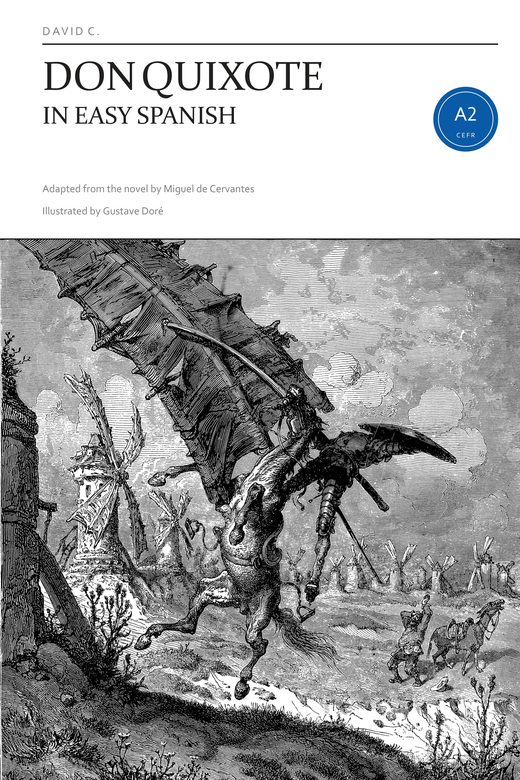
Don Quixote in Easy Spanish: the whole novel retold in Spanish you can actually read, in 58 short episodes, with the hard words glossed in the margin. It is where every Don Quixote sentence on this page comes from.
In EPUB and PDF, with a second novel in the same Spanish. See the books.
Where the course teaches this
2 lessons build it up, each one inside a chapter of the story rather than in the abstract. Free to read, with the vocabulary, the audio and the exercises.
- The present tense of -AR verbsLesson 3A day in the village
- The present tense of -ER and -IR verbsLesson 4The books of chivalry
Next to this one
The points that sit closest to this one, and that a student usually meets around the same time.