Spanish grammar · A1 to B1 · Updated
Spanish commands: the imperative
The positive tú form is the bare present: habla, come. The positive usted form borrows the subjunctive: hable, coma. Every negative command borrows the subjunctive too: no hables, no hable. So half of the imperative is really the subjunctive wearing a different hat, and that is the shortcut nobody mentions.
The short answer
Only one Spanish command form is its own: the positive tú, which is just the él form of the present (habla, come). Every other command, positive usted, all the negatives, and nosotros, is the present subjunctive. So learn eight irregular tú forms and the rest comes free.
How to remember it
Positive tú is its own, everything else is the subjunctive
| Positive tú | the él form of the present | Habla |
|---|---|---|
| Negative tú | no plus the subjunctive | No hables |
| Usted | the subjunctive, positive and negative alike | Hable, no hable |
| Vosotros positive | the infinitive with the -r changed to -d | Hablad |
| Nosotros | the subjunctive, and it means "let us" | Hablemos |
The forms
The full set for hablar and comer
| positive | negative | |
|---|---|---|
| tú | habla, come | no hables, no comas |
| usted | hable, coma | no hable, no coma |
| nosotros | hablemos, comamos | no hablemos, no comamos |
| vosotros | hablad, comed | no habléis, no comáis |
| ustedes | hablen, coman | no hablen, no coman |
20 sentences that show the difference
Everyday Spanish, the kind you would actually say. The label under each one says which part of the rule it shows.
Habla más despacio.
Speak more slowly.
Positive tú
Come algo.
Eat something.
Positive tú
Abre la ventana.
Open the window.
Positive tú
No hables tan alto.
Do not talk so loudly.
Negative tú
No comas eso.
Do not eat that.
Negative tú
Hable más despacio, por favor.
Speak more slowly, please.
Usted
Pase, pase.
Come in, come in.
Usted, a welcome
Siéntese, por favor.
Please sit down.
Usted with a pronoun
Vamos.
Let us go.
The one irregular nosotros
Hablemos de otra cosa.
Let us talk about something else.
Nosotros
Ten cuidado.
Be careful.
Irregular tú
Ven aquí.
Come here.
Irregular tú
Dime.
Tell me.
Irregular tú with a pronoun
Haz lo que quieras.
Do as you like.
Irregular tú
Pon la mesa.
Lay the table.
Irregular tú
Sal de aquí.
Get out of here.
Irregular tú
Sé bueno.
Be good.
Irregular tú
Ve a casa.
Go home.
Irregular tú
Dámelo.
Give it to me.
Two pronouns on the end
No me lo des.
Do not give it to me.
Pronouns back in front
Where English gets in the way
English has one command form (tell me) and adds please to soften it. Spanish changes the verb itself: dime to a friend, dígame to a stranger. Picking the wrong one is not a grammar slip, it is a social one.
The mistake to avoid
English speakers leave the pronoun loose: ✗ Di me lo, ✗ Cierra las. In affirmative commands everything is one word, with a written accent if needed: ✓ Dímelo, ✓ Ciérralas. And do not mix the two levels of address: ✗ Dime usted → ✓ Dígame usted.
The cases that break the rule
Ten, ven, di, haz, pon, sal, sé, ve
The eight irregular positive tú forms, and they are the only real memory work in the whole topic. Most are one syllable. Every one of them behaves normally in the negative: no tengas, no vengas, no digas.
Ve
It is both go (ir) and watch (ver). Ve a casa is go home, ve la película is watch the film. Nothing but the sentence tells you which.
Dámelo, no me lo des
Pronouns go on the end of a positive command and in front of a negative one. The accent appears on the positive to keep the stress where it was.
Hablad
The vosotros positive is the infinitive with -r swapped for -d, and it is the only command not built on the subjunctive. Latin America does not use it at all: there it is hablen.
Sentaos
When the vosotros command takes a reflexive pronoun, the -d disappears: sentad plus os gives sentaos, not sentados. The one exception is idos.
Vamos
The nosotros command of ir is vamos, not vayamos, in the positive. In the negative it goes back to normal: no vayamos.
Spanish imperative exercises
8 sentences to fill in. Type your answer and check it, or read them straight through with the answers showing. Accents count here, the way they count in the language.
-
(Hablar, tú) ___ más despacio, por favor.
Speak more slowly, please.
Habla · Positive tú is the él form of the present: él habla, so habla.
-
No (hablar, tú) ___ tan alto.
Do not talk so loudly.
hables · Every negative command is the subjunctive, whoever it is aimed at.
-
(Pasar, usted) ___, por favor.
Come in, please.
Pase · Usted always takes the subjunctive, positive and negative alike.
-
(Tener, tú) ___ cuidado con el escalón.
Mind the step.
Ten · One of the eight irregulars. In the negative it behaves: no tengas.
-
(Venir, tú) ___ aquí un momento.
Come here a moment.
Ven · Another of the eight. Short, irregular, and used constantly.
-
(Sentarse, usted) ___, por favor.
Please sit down.
Siéntese · The pronoun goes on the end of a positive command, and the accent holds the stress.
-
No me (dar, tú) ___ más excusas.
Do not give me any more excuses.
des · Negative, so subjunctive, and the pronoun goes back in front of the verb.
-
(Ir, nosotros) ___ al cine esta noche.
Let us go to the cinema tonight.
Vamos · Vamos and not vayamos. Only in the positive: the negative is no vayamos.
More exercises, from Don Quixote
8 more, these ones straight out of the course: the inn, the windmills, Rocinante and the road. Same rule, older Spanish.
-
Sancho, (callar) ___ un momento.
Sancho, be quiet for a moment.
calla · The tú command looks like he speaks, not like you speak: calla, come, escribe.
-
No (hablar, tú) ___ tanto, Sancho.
Do not talk so much, Sancho.
hables · A negative command is not the same word. It switches to the subjunctive: no hables, no comas.
-
Señor cura, (esperar, usted) ___ un momento.
Father, wait a moment.
espere · The usted command is the subjunctive too, positive or negative alike.
-
Sancho, (venir) ___ aquí.
Sancho, come here.
ven · One of the eight short ones: di, haz, ve, pon, sal, ten, ven, sé.
-
No me (decir, tú) ___ eso.
Do not tell me that.
digas · Negative, so subjunctive, and the pronoun comes before the verb instead of stuck on the end.
-
Amigos, (salir, vosotros) ___ al campo.
Friends, ride out into the country.
salid · The vosotros command is the infinitive with the r turned into a d: salir, salid.
-
Don Quijote, (tener) ___ cuidado con esos molinos.
Don Quixote, be careful with those windmills.
ten · Tener is one of the eight irregulars: ten, and not tienes.
-
No (ser, tú) ___ tonto, que son molinos.
Do not be a fool, they are windmills.
seas · Positive it is sé, negative it is no seas. The two forms share nothing.
Common questions
How do I form a tú command?
For a positive one, use the third person singular of the present: habla, come, escribe. For a negative one, use the present subjunctive: no hables, no comas. The two forms have nothing in common.
Which tú commands are irregular?
Eight, worth memorising as a block: di, haz, ve, pon, sal, sé, ten, ven. All of them are positive forms. Their negatives are regular subjunctives: no digas, no hagas, no vayas.
Where do pronouns go with a command?
Stuck onto the end of a positive one, with an accent to hold the stress in place: dímelo, levántate. In front of a negative one and written separately: no me lo digas, no te levantes.
How do I tell someone not to do something?
Every negative command uses the present subjunctive, with no exceptions: no hables, no comas, no vengas. That is why the positive and negative look nothing alike: habla but no hables, ven but no vengas.
How do I form the usted command?
The present subjunctive, positive or negative: hable, coma, venga, and no hable, no coma, no venga. For ustedes add an n: hablen. This is why the usted form has no irregular list to learn separately.
What is the nosotros command?
Let us do something, and it also comes from the subjunctive: hablemos, comamos, salgamos. In speech vamos a hablar is far more common. With a reflexive verb the s falls off before nos: vámonos, not vamosnos.
What is the vosotros command?
Take the infinitive and swap the r for a d: hablad, comed, venid. It has no irregulars at all. With a reflexive pronoun the d drops: sentaos, callaos, and the one exception is idos.
Is the imperative rude in Spanish?
No. Spanish uses it far more freely than English, and dame or dime between friends carries no edge at all. Adding por favor, or asking with the present (¿me pones un café?), is what softens it when you are with strangers.
The things to remember
- Positive tú is the él form of the present. Nothing else to learn there.
- Everything else, including every negative, is the present subjunctive.
- Eight irregular tú forms: ten, ven, di, haz, pon, sal, sé, ve. That is the whole list.
- Pronouns go on the end of a positive command and in front of a negative one.
- Vosotros positive swaps the -r of the infinitive for a -d, and is not used in Latin America.
The same rule in Don Quixote
Real lines from the course, not invented examples. Each one is the sentence the lesson uses to introduce the point.
Lleva siempre dinero.
Always carry money.
No se vaya usted.
Do not go.
The book this comes from
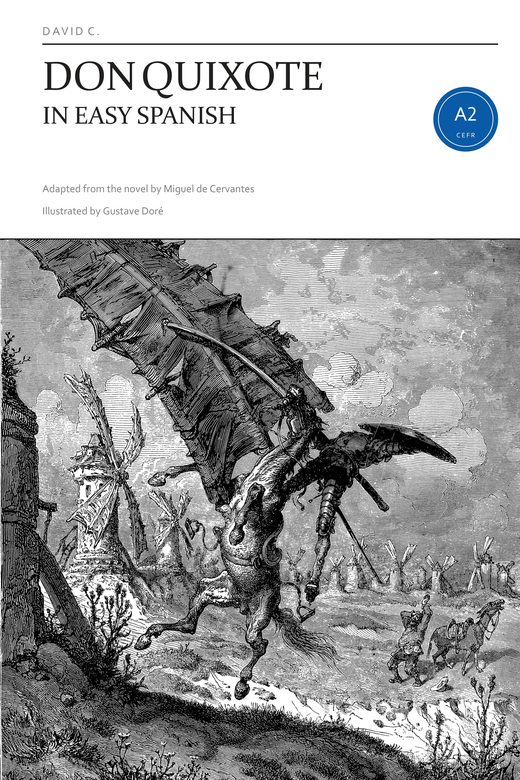
Don Quixote in Easy Spanish: the whole novel retold in Spanish you can actually read, in 58 short episodes, with the hard words glossed in the margin. It is where every Don Quixote sentence on this page comes from.
In EPUB and PDF, with a second novel in the same Spanish. See the books.
Where the course teaches this
2 lessons build it up, each one inside a chapter of the story rather than in the abstract. Free to read, with the vocabulary, the audio and the exercises.
- The affirmative imperative: tú and ustedLesson 14The innkeeper's advice
- Negative orders, and addressing somebody as ustedLesson 47The Reunion at the Inn
Next to this one
The points that sit closest to this one, and that a student usually meets around the same time.