Spanish grammar · A1 · Updated
Spanish question words
Qué, quién, cuál, cómo, cuándo, dónde, cuánto and por qué, every one of them with an accent when it asks. The two that trip people up are qué against cuál, and por qué in two words against porque in one. Spanish also opens the question with an upside-down mark, and that is not optional.
The short answer
Every Spanish question word carries a written accent: qué, quién, cómo, cuándo, dónde, cuánto, por qué, cuál. The same words without the accent are ordinary words with a different job. There is no do or does: the verb goes straight after the question word, and the subject after that.
How to remember it
Accent for a question, no accent for anything else
| The accent | marks the word as a question, direct or reported | ¿Dónde vives? |
|---|---|---|
| No accent | the same word doing an ordinary job | Donde vivo hace frío |
| No auxiliary | there is no do or does. Just invert | ¿Dónde vives tú? |
| Two marks | the opening ¿ is compulsory in writing | ¿Qué? |
| Prepositions in front | never left dangling at the end | ¿Con quién vas? |
The forms
The full set
| Spanish | English | note |
|---|---|---|
| qué | what, which | before a noun too: ¿qué libro? |
| quién, quiénes | who | agrees in number |
| cómo | how, what like | also ¿cómo? for pardon |
| cuándo | when | |
| dónde, adónde | where, where to | adónde with a verb of motion |
| cuánto, cuánta, cuántos | how much, how many | agrees with the noun |
| por qué | why | two words, and porque is because |
| cuál, cuáles | which one | picks from a set |
20 sentences that show the difference
Everyday Spanish, the kind you would actually say. The label under each one says which part of the rule it shows.
¿Qué quieres?
What do you want?
Qué on its own
¿Qué libro prefieres?
Which book do you prefer?
Qué before a noun
¿Quién es?
Who is it?
Quién
¿Quiénes son esos?
Who are those people?
Quiénes, plural
¿Cómo estás?
How are you?
Cómo
¿Cómo es tu casa?
What is your house like?
Cómo for description
¿Cuándo llegas?
When do you arrive?
Cuándo
¿Dónde vives?
Where do you live?
Dónde
¿Adónde vas?
Where are you going?
Adónde with movement
¿De dónde eres?
Where are you from?
Preposition in front
¿Cuánto cuesta?
How much is it?
Cuánto
¿Cuántas hermanas tienes?
How many sisters do you have?
Cuántas agrees
¿Por qué no vienes?
Why do you not come?
Por qué, two words
Porque no puedo.
Because I cannot.
Porque, one word, no accent
¿Cuál prefieres?
Which one do you prefer?
Cuál picks from a set
¿Cuál es tu nombre?
What is your name?
Cuál, not qué, before es
¿Con quién vas?
Who are you going with?
Preposition in front
No sé dónde está.
I do not know where it is.
Accent kept in a reported question
Donde tú digas.
Wherever you say.
No accent, not a question
¿Qué tal?
How is it going?
Set phrase
Where English gets in the way
To ask a question English rebuilds the sentence (What does he do?, with a does that means nothing) and then leaves the preposition dangling at the end. Spanish puts the question word in front, preposition and all, and changes nothing else. What English spreads across the sentence, Spanish concentrates in the first word.
The mistake to avoid
English speakers write ✗ ¿Por que no contesta? without the accent, or run it together as ✗ Porqué es un caballo. The right forms are ✓ ¿Por qué no contesta? (two words, accent, asking) and ✓ Porque es un caballo. (one word, no accent, answering). And it is ✗ ¡Qué una aventura! but ✓ ¡Qué aventura!, with no article.
The cases that break the rule
¿Cuál es tu nombre?
Before the verb ser, Spanish uses cuál where English uses "what": ¿cuál es tu nombre?, ¿cuál es el problema?. Qué before ser asks for a definition: ¿qué es un hidalgo?
No sé dónde está
The accent stays in a reported question, even with no question marks: no sé quién es, dime cuándo vienes. If you could turn it back into a direct question, it keeps its accent.
Por qué and porque
Three different things. Por qué, two words with an accent, asks why. Porque, one word, answers because. El porqué, one word with an article, is the noun "the reason".
¿Con quién vas?
The preposition goes in front and never dangles at the end. English "who are you going with" reverses this, and copying the English word order is the commonest mistake here.
¿Cuánta gente?
Cuánto agrees with the noun that follows: cuánto dinero, cuánta gente, cuántos libros, cuántas veces. On its own after a verb it does not change: ¿cuánto cuesta?
The ¿ at the start
Compulsory in writing, and the one piece of Spanish punctuation that has no English equivalent. It exists because Spanish word order does not otherwise announce a question until the end.
Spanish question word exercises
8 sentences to fill in. Type your answer and check it, or read them straight through with the answers showing. Accents count here, the way they count in the language.
-
¿___ vives? En Madrid.
Where do you live? In Madrid.
Dónde · Dónde with an accent, and no auxiliary: the verb comes straight after.
-
¿___ es tu nombre?
What is your name?
Cuál · Cuál before ser, where English says "what". Qué es would ask for a definition.
-
¿___ hermanas tienes?
How many sisters do you have?
Cuántas · Cuántas agrees with hermanas, feminine plural.
-
¿___ no vienes con nosotros?
Why do you not come with us?
Por qué · Two words with an accent for the question. Porque in one word would be the answer.
-
¿___ quién vas al cine?
Who are you going to the cinema with?
Con · The preposition goes in front. Spanish never leaves it dangling at the end.
-
No sé ___ está mi cartera.
I do not know where my wallet is.
dónde · The accent stays in a reported question, even with no question marks.
-
¿___ es tu casa? Es grande y blanca.
What is your house like? It is big and white.
Cómo · Cómo asks what something is like, not only how.
-
¿___ vas? Al mercado.
Where are you going? To the market.
Adónde · Adónde with a verb of movement. Dónde alone would ask where you are.
More exercises, from Don Quixote
8 more, these ones straight out of the course: the inn, the windmills, Rocinante and the road. Same rule, older Spanish.
-
¿___ es esto que llevas en la mano?
What is this you are carrying?
Qué · Qué asks what. Inside a question it always carries the accent, and that accent is not optional.
-
¿___ está la venta?
Where is the inn?
Dónde · Dónde for where. With movement it takes a: adónde vas.
-
¿___ vienes a verme?
When are you coming to see me?
Cuándo · Cuándo with an accent is the question. Cuando without it joins two halves of a sentence.
-
¿___ es tu amo?
Who is your master?
Quién · Quién for people only, and it has a plural: quiénes son.
-
¿___ molinos hay en el campo?
How many windmills are there in the field?
Cuántos · Cuánto agrees with the noun: cuántos molinos, cuántas ventas, cuánta hambre.
-
¿___ te llamas?
What is your name?
Cómo · Spanish asks how you call yourself, not what. Cómo, not qué.
-
¿___ no comes nada?
Why are you not eating anything?
Por qué · Por qué in two words for the question. Porque in one word is the answer.
-
¿___ de los dos caballos prefieres?
Which of the two horses do you prefer?
Cuál · Cuál picks one out of a group. Qué asks for a definition instead: qué es un caballo.
Common questions
What is the difference between qué and cuál?
Qué asks for a definition or goes straight in front of a noun: ¿qué es esto? and ¿qué libro quieres? Cuál asks you to pick from a set: ¿cuál quieres? In front of es, the normal form is ¿cuál es tu nombre?
Why do question words carry an accent?
To separate the question from the statement. Cuando llegó means when he arrived, ¿cuándo llegó? asks it. The accent stays in indirect questions too: no sé cuándo llegó.
Por qué, porque, por que or porqué?
Por qué asks the question. Porque answers it. El porqué is a noun meaning the reason. Por que in two words without an accent is rare and only turns up when por belongs to the verb in front of it.
How do I say how in Spanish?
Cómo: ¿cómo se dice?, ¿cómo estás?. Do not confuse it with qué tal, which is a greeting rather than a question about method, and note that ¿cómo? on its own means sorry, I did not catch that.
Where does the subject go in a Spanish question?
After the verb: ¿dónde vive tu hermano?, never ¿dónde tu hermano vive?. Spanish has no equivalent of the English do, so the whole question is made by moving the subject and by the intonation.
How do I ask a yes or no question?
Just change the tone, and write the two question marks: ¿vienes?. There is no word order change and no auxiliary. That is why the upside down mark at the front is doing real work: it is the only warning the sentence is a question.
Do I really need the upside down question mark?
Yes, in anything written properly. It exists because Spanish gives no other early signal, so without it a long sentence reads as a statement until the very end. Spaniards drop it in text messages, and it is still a spelling mistake.
What is the difference between cuánto and cuántos?
Cuánto goes with things you cannot count and with verbs: ¿cuánto cuesta?, ¿cuánta gente?. Cuántos goes with things you can: ¿cuántos años tienes?, ¿cuántas veces?. It agrees with the noun, exactly like mucho.
The things to remember
- Every question word has a written accent, and it keeps it in a reported question.
- There is no do or does. Put the verb straight after the question word.
- Prepositions go in front: ¿de dónde eres?, never at the end.
- Cuál before ser, where English says "what": ¿cuál es tu nombre?
- Por qué asks, porque answers, el porqué is the noun.
The same rule in Don Quixote
Real lines from the course, not invented examples. Each one is the sentence the lesson uses to introduce the point.
¿Dónde están los gigantes?
Where are the giants?
The book this comes from
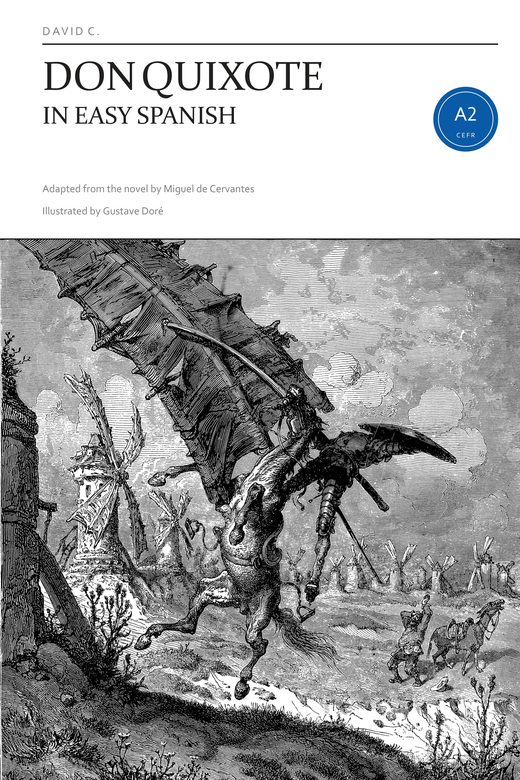
Don Quixote in Easy Spanish: the whole novel retold in Spanish you can actually read, in 58 short episodes, with the hard words glossed in the margin. It is where every Don Quixote sentence on this page comes from.
In EPUB and PDF, with a second novel in the same Spanish. See the books.
Where the course teaches this
One lesson covers it, each one inside a chapter of the story rather than in the abstract. Free to read, with the vocabulary, the audio and the exercises.
- Question wordsLesson 11One July morning
Next to this one
The points that sit closest to this one, and that a student usually meets around the same time.