Spanish grammar · A2 to B2 · Updated
Reported speech in Spanish
When you report what somebody said, the tense steps back one place: present becomes imperfect, preterite becomes pluperfect, future becomes conditional. Commands go into the subjunctive. The pronouns and the time words move as well, and that is usually where the sentence breaks.
The short answer
Que is compulsory: dijo que venía, never "he said he was coming" with nothing in between. If the reporting verb is in the past, the tenses step back one: present becomes imperfect, preterite becomes pluperfect, future becomes conditional. And an order becomes que plus the subjunctive.
How to remember it
Que always, and every tense steps back one
| Que | compulsory, never dropped | Dijo que venía |
|---|---|---|
| Present becomes | imperfect | vengo gives venía |
| Preterite becomes | pluperfect | vine gives había venido |
| Future becomes | conditional | vendré gives vendría |
| An order becomes | que plus the imperfect subjunctive | ven gives que viniera |
The forms
How each tense steps back
| direct | reported | tense |
|---|---|---|
| vengo | dijo que venía | present to imperfect |
| vine | dijo que había venido | preterite to pluperfect |
| venía | dijo que venía | imperfect does not move |
| vendré | dijo que vendría | future to conditional |
| ven | me dijo que viniera | order to subjunctive |
| ¿vienes? | me preguntó si venía | question with si |
20 sentences that show the difference
Everyday Spanish, the kind you would actually say. The label under each one says which part of the rule it shows.
Dice que viene.
He says he is coming.
Present reporting verb, nothing moves
Dijo que venía.
He said he was coming.
Present becomes imperfect
Dijo que había venido.
He said he had come.
Preterite becomes pluperfect
Dijo que vendría.
He said he would come.
Future becomes conditional
Dijo que estaba cansado.
He said he was tired.
Imperfect does not move
Me dijo que esperara.
He told me to wait.
An order becomes the subjunctive
Me pidió que le ayudara.
He asked me to help him.
Pedir que plus subjunctive
Me preguntó si venía.
He asked me whether I was coming.
Yes-no question takes si
Me preguntó dónde vivía.
He asked me where I lived.
Question word keeps its accent
Dijo que sí.
He said yes.
Que sí
Dijo que no lo sabía.
He said he did not know.
Negative reported
Dijo que su hermano llegaba hoy.
He said his brother was arriving today.
Possessive shifts too
Dijo que vendría al día siguiente.
He said he would come the next day.
Mañana becomes al día siguiente
Dijo que estaba allí.
He said he was there.
Aquí becomes allí
Prometió que llamaría.
He promised he would call.
Prometer
Contestó que no podía.
He replied that he could not.
Contestar
Explicó que era difícil.
He explained that it was hard.
Explicar
Añadió que volvería pronto.
He added that he would be back soon.
Añadir
Insistió en que fuéramos.
He insisted that we go.
Insistir en que plus subjunctive
Dijo que tenía razón.
He said he was right.
A common phrase
Where English gets in the way
The backshift itself works the same way in both languages, which makes this lesson mostly a matter of drilling forms rather than rethinking anything. Three differences are real. First, English drops that without a second thought, he said he was an honourable man, while Spanish keeps que and repeats it before every clause in the chain. Leaving it out is not casual Spanish, it is broken Spanish. Second, English can report a command with an infinitive, she asked him to take her, and Spanish cannot: it needs que plus a past subjunctive, pidió que la llevara. Third, English keeps the question shape in the word order, he asked was he honourable in older writing, whereas Spanish puts everything back into statement order and takes the question marks away.
The mistake to avoid
Four. One, the missing que. ✗ Dijo era hombre de bien → ✓ Dijo que era hombre de bien. This is the single most frequent English-speaker error in the whole topic, because English lets you drop that and the habit carries straight over. Two, the infinitive for a request. ✗ Le pidió llevarla a España → ✓ Le pidió que la llevara a España. Three, not shifting the tense. ✗ Decía que es una mujer → ✓ Decía que era una mujer. If the reporting verb is past, the reported verb goes back too. Four, question marks left in. ✗ Preguntó si ¿era hombre de bien? → ✓ Preguntó si era hombre de bien. The accent on dónde or quién stays, but the signs go.
The cases that break the rule
Dijo que venía
Que can never be dropped. English says "he said he was coming" with nothing in between and Spanish cannot. Leaving it out is the single most audible mistake in this topic.
Dijo que estaba cansado
The imperfect does not step back, because there is nowhere further to go. The same is true of the pluperfect and the conditional: once you are at the bottom, you stay there.
Me dijo que viniera
Decir has two jobs. Reporting information takes the indicative: dijo que venía. Reporting an order takes the subjunctive: me dijo que viniera. Same verb, two grammars.
Me preguntó si venía
A yes-no question is reported with si, not with que. And si here means "whether", not "if" in a condition, so it takes an ordinary tense.
Me preguntó dónde vivía
The question word keeps its written accent inside a reported question, even though there are no question marks anywhere.
Aquí, hoy, mañana
Words of place and time shift too: aquí becomes allí, hoy becomes aquel día, mañana becomes al día siguiente, este becomes aquel. English does exactly the same.
Spanish reported speech exercises
8 sentences to fill in. Type your answer and check it, or read them straight through with the answers showing. Accents count here, the way they count in the language.
-
Dijo que (venir, él) ___ a las ocho.
He said he was coming at eight.
venía · A past reporting verb, so the present viene steps back to the imperfect.
-
Me dijo que (esperar, yo) ___ en la puerta.
He told me to wait at the door.
esperara · An order becomes que plus the imperfect subjunctive. Decir has two grammars.
-
Prometió que me (llamar) ___ al día siguiente.
He promised he would call me the next day.
llamaría · A future reported from the past becomes a conditional. And mañana became al día siguiente.
-
Me preguntó ___ tenía tiempo.
He asked me whether I had time.
si · A yes-no question is reported with si and not with que.
-
Dijo que ya (comer, él) ___.
He said he had already eaten.
había comido · The preterite comí steps back to the pluperfect.
-
Me preguntó ___ vivía yo.
He asked me where I lived.
dónde · The question word keeps its accent even with no question marks.
-
Dijo ___ estaba muy cansado.
He said he was very tired.
que · Que is compulsory. English can leave it out and Spanish never can.
-
Insistió en que (ir, nosotros) ___ con él.
He insisted that we go with him.
fuéramos · Insistir en que takes the subjunctive, and the past pulls it into the imperfect one.
More exercises, from Don Quixote
8 more, these ones straight out of the course: the inn, the windmills, Rocinante and the road. Same rule, older Spanish.
-
Dijo: «tengo hambre». Dijo que (tener) ___ hambre.
He said: "I am hungry". He said he was hungry.
tenía · The present moves back to the imperfect. Every tense takes one step back once dijo is in front.
-
Dijo: «saldré mañana». Dijo que (salir) ___ al día siguiente.
He said: "I will leave tomorrow". He said he would leave the next day.
saldría · The future becomes the conditional. And mañana becomes al día siguiente, because tomorrow has moved.
-
Dijo: «he visto gigantes». Dijo que (ver) ___ gigantes.
He said: "I have seen giants". He said he had seen giants.
había visto · The present perfect becomes the pluperfect. Everything slides one place further into the past.
-
Preguntó: «¿dónde estás?». Preguntó dónde (estar, yo) ___.
He asked: "where are you?". He asked where I was.
estaba · A question with a question word keeps the word and loses the question marks. The accent on dónde stays.
-
Preguntó: «¿tienes hambre?». Preguntó si (tener, yo) ___ hambre.
He asked: "are you hungry?". He asked if I was hungry.
tenía · A yes or no question needs si to hold it up. Without si the sentence falls apart.
-
Me pidió: «ven aquí». Me pidió que (venir) ___.
He asked me: "come here". He asked me to come.
viniera or viniese · An order becomes the imperfect subjunctive, because pedir que always opens the subjunctive.
-
Dijo: «soy caballero». Dijo que (ser) ___ caballero.
He said: "I am a knight". He said he was a knight.
era · Ser follows the same rule as everything else: present into imperfect.
-
Dijo: «no lo hagas». Dijo que no lo (hacer) ___.
He said: "do not do it". He said not to do it.
hiciera or hiciese · A negative order reported is still the imperfect subjunctive. Both endings are correct.
Common questions
How do the tenses shift in reported speech?
Present becomes imperfect, preterite and present perfect become pluperfect, future becomes conditional, and the present subjunctive becomes the imperfect subjunctive. The imperfect and the pluperfect are already as far back as they go and stay put.
What happens to a command?
It goes into the subjunctive after decir que: ven becomes me dijo que viniera. Notice that decir takes the indicative when it reports a fact and the subjunctive when it passes on an order.
What else has to move?
The pronouns, and the words for time and place. Hoy becomes aquel día, mañana becomes al día siguiente, aquí becomes allí, este becomes aquel. Forgetting these is what makes a sentence sound wrong even when the tenses are right.
Do I always have to shift the tense?
No. If the reporting verb is in the present, nothing moves: dice que viene. And even after a past verb you can keep the present when the thing is still true: dijo que se llama Ana is fine, because she still does.
How do I report a question?
With si for a yes or no question and with the question word for the rest: preguntó si venía, preguntó qué quería. The question word keeps its accent even with no question marks, and the subject does not jump in front of the verb the way it does in a direct question.
When does dijo que take the subjunctive?
Only when the words being reported were an order. Dijo que venía reports a statement and takes the indicative. Dijo que viniera reports the command come here. Decir is the one verb that does both jobs, and the mood is what tells them apart.
What happens to the subjunctive in reported speech?
It moves back one step like everything else: the present subjunctive becomes the imperfect subjunctive. Quiero que vengas becomes quería que vinieras, and espero que haya llegado becomes esperaba que hubiera llegado.
Can I drop the que?
No. English lets you say he said he was tired with nothing in the middle, and Spanish never does: dijo que estaba cansado. The que is compulsory, and leaving it out is one of the clearest signs of an English speaker.
The things to remember
- Que is compulsory and never dropped.
- A past reporting verb steps every tense back one: present to imperfect, preterite to pluperfect, future to conditional.
- The imperfect, pluperfect and conditional do not move, because there is nowhere further back.
- An order becomes que plus the imperfect subjunctive: me dijo que viniera.
- A yes-no question is reported with si; a question word keeps its accent.
The same rule in Don Quixote
Real lines from the course, not invented examples. Each one is the sentence the lesson uses to introduce the point.
La carta decía que era una mujer y que se llamaba Zoraida.
The letter said that she was a woman and that her name was Zoraida.
Contó que se llamaba Cardenio.
He said that his name was Cardenio.
El ventero les dijo que preparasen las monedas.
The innkeeper told them to get their coins ready.
The book this comes from
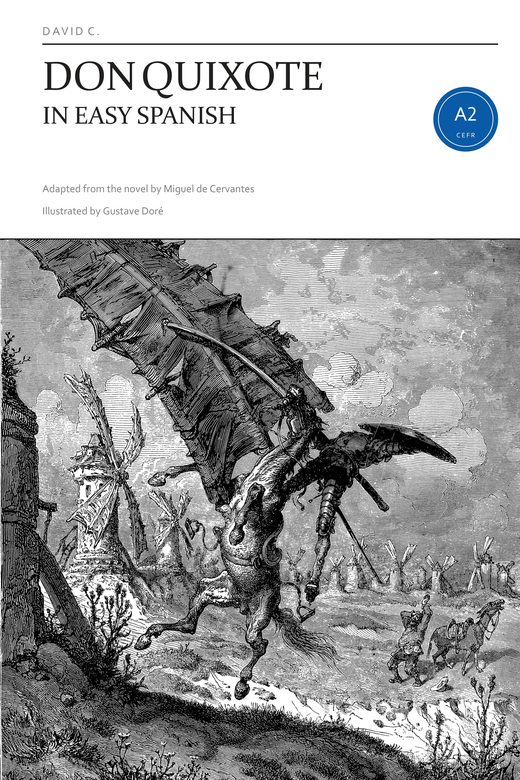
Don Quixote in Easy Spanish: the whole novel retold in Spanish you can actually read, in 58 short episodes, with the hard words glossed in the margin. It is where every Don Quixote sentence on this page comes from.
In EPUB and PDF, with a second novel in the same Spanish. See the books.
Where the course teaches this
3 lessons build it up, each one inside a chapter of the story rather than in the abstract. Free to read, with the vocabulary, the audio and the exercises.
- Reported speech in the pastLesson 51Zoraida’s Letters
- Reporting what someone else saidLesson 40Cardenio’s story
- Reporting what somebody orderedLesson 71Master Pedro’s Puppet Show
Next to this one
The points that sit closest to this one, and that a student usually meets around the same time.