Spanish grammar · B2 · Updated
The Spanish imperfect subjunctive
It is built from the third person plural of the preterite: hablaron gives hablara or hablase, tuvieron gives tuviera. Two sets of endings exist and both are correct. You need it for unreal conditions with si, for orders reported in the past, and after any trigger that has itself moved into the past.
The short answer
The imperfect subjunctive is built from the ellos form of the preterite: take hablaron, drop the -ron, add -ra or -se. It turns up when the trigger verb is in the past (quería que vinieras), after si in an unreal condition, after como si, and on its own to be polite: quisiera.
How to remember it
Third person plural of the preterite, minus -ron
| Step one | take the ellos form of the preterite | hablaron |
|---|---|---|
| Step two | drop the -ron | habla- |
| Step three | add -ra, -ras, -ra, -ramos, -rais, -ran | hablara |
| Or | add -se, -ses, -se, -semos, -seis, -sen, same meaning | hablase |
| Every irregular follows | if the preterite is odd, so is this | tuvieron gives tuviera |
The forms
From the preterite to the imperfect subjunctive
| verb | ellos preterite | imperfect subjunctive |
|---|---|---|
| hablar | hablaron | hablara, hablase |
| comer | comieron | comiera, comiese |
| vivir | vivieron | viviera, viviese |
| tener | tuvieron | tuviera, tuviese |
| ser and ir | fueron | fuera, fuese |
| hacer | hicieron | hiciera, hiciese |
| decir | dijeron | dijera, dijese |
| poder | pudieron | pudiera, pudiese |
20 sentences that show the difference
Everyday Spanish, the kind you would actually say. The label under each one says which part of the rule it shows.
Quería que vinieras.
I wanted you to come.
Past trigger
Me pidió que esperara.
She asked me to wait.
Past trigger
No creía que fuera verdad.
I did not think it was true.
Past denial
Esperaba que llegaras pronto.
I was hoping you would arrive soon.
Past wish
Le dije que se callara.
I told him to be quiet.
A reported order
Fue una pena que no vinieras.
It was a shame you did not come.
Past emotion
Si tuviera dinero, viajaría.
If I had money, I would travel.
Unreal condition
Si fuera más joven, lo haría.
If I were younger, I would do it.
Unreal condition
Habla como si fuera fácil.
He talks as if it were easy.
Como si
Me miró como si no me conociera.
He looked at me as if he did not know me.
Como si
Quisiera pedirle un favor.
I would like to ask you a favour.
Politeness on its own
Debiera darte vergüenza.
You ought to be ashamed.
Softened debería
Ojalá tuviera más tiempo.
I wish I had more time.
Ojalá about now
Ojalá viniera mañana.
I wish he would come tomorrow.
Ojalá, unlikely
Aunque me lo pidiera, no iría.
Even if he asked me, I would not go.
Aunque, hypothetical
Buscaba a alguien que hablara ruso.
I was looking for someone who spoke Russian.
Someone not found
Antes de que llegaran, ya estaba hecho.
Before they arrived, it was already done.
Antes de que
Salí sin que me vieran.
I left without them seeing me.
Sin que
Lo hice para que estuvieras tranquilo.
I did it so that you would not worry.
Para que in the past
Como si nada hubiera pasado.
As if nothing had happened.
The pluperfect version
Where English gets in the way
English had this tense and has nearly finished losing it. What survives is a single form, were, in if I were you and as if he were dead, and even that is retreating in favour of was. Everywhere else English uses the ordinary past and lets context do the work: he asked him to tie the rope, with an infinitive, or he ordered that he tie the rope, which sounds like a legal document. Spanish has no such option. Where B1 taught you that a request forces a subjunctive, this lesson gives you the past version of it, and from here on nearly every past-tense sentence you write with que in the middle will need one. The good news is the arithmetic: one rule, no irregular verbs, and the preterite you already learnt does all the work.
The mistake to avoid
One, and it is the big one: building the stem from the infinitive instead of the preterite. ✗ que estarase, ✗ que tenese, ✗ que hacese → ✓ estuviese, tuviese, hiciese. Go through estuvieron, tuvieron, hicieron every time until it is automatic. Two. Forgetting the accent in the nosotros form: ✗ llevasemos → ✓ llevásemos. Three. Using an indicative after como si: ✗ como si estaba muerto → ✓ como si estuviera muerto. There are no exceptions to that one.
The cases that break the rule
Hablara and hablase
Two full sets of endings, both correct everywhere, both meaning exactly the same. The -ra one is much commoner in speech and the -se one sounds written. No rule chooses between them.
Quisiera
Used on its own as a polite request, with no trigger at all: quisiera un café. Querría means the same and is rarer. This is one of the few subjunctives that stands alone.
Si fuera tú
Never si sería tú. The conditional belongs in the other half of the sentence. It is the same rule as in English, where "if I would be you" is also wrong.
Fuera
Ser and ir share this tense completely, because they share the preterite. Si fuera rico is if I were rich, si fuera a Madrid is if I went to Madrid.
Dijeran, not dijieran
The preterites in j drop the i: dijeron gives dijera, trajeron gives trajera, condujeron gives condujera. It follows the preterite exactly, oddities included.
Ojalá venga / ojalá viniera
With the present subjunctive it is a hope that may come true. With the imperfect it is a wish you do not really expect. The tense is doing the work of English "I hope" against "I wish".
Imperfect subjunctive exercises
8 sentences to fill in. Type your answer and check it, or read them straight through with the answers showing. Accents count here, the way they count in the language.
-
Quería que (venir, tú) ___ conmigo.
I wanted you to come with me.
vinieras · The trigger quería is in the past, so the subjunctive moves back too. From vinieron.
-
Si (tener, yo) ___ más tiempo, aprendería ruso.
If I had more time, I would learn Russian.
tuviera · Unreal condition. From tuvieron, so tuviera. Tuviese would be equally correct.
-
Me pidió que le (esperar) ___ en la puerta.
She asked me to wait for her at the door.
esperara · Pedir que in the past. From esperaron, drop the -ron, add -ra.
-
Habla como si lo (saber) ___ todo.
He talks as if he knew everything.
supiera · Como si always takes this tense. From supieron, so supiera.
-
(Querer, yo) ___ pedirle un favor.
I would like to ask you a favour.
Quisiera · Politeness on its own, with no trigger. Quiero would be blunt and quisiera is what you say.
-
Salí sin que me (ver) ___ nadie.
I left without anyone seeing me.
viera · Sin que always takes the subjunctive, and a past main verb pulls it back to this tense.
-
Ojalá (estar, tú) ___ aquí ahora.
I wish you were here now.
estuvieras · Ojalá with the imperfect is a wish you do not expect to come true. Ojalá estés would be a hope.
-
No creía que (ser) ___ tan tarde.
I did not think it was so late.
fuera · Denial in the past. From fueron, which serves both ser and ir.
More exercises, from Don Quixote
8 more, these ones straight out of the course: the inn, the windmills, Rocinante and the road. Same rule, older Spanish.
-
Don Quijote quería que Sancho lo (acompañar) ___.
Don Quixote wanted Sancho to go with him.
acompañara or acompañase · Past wanting, so the second verb goes into the imperfect subjunctive. Both endings are correct.
-
Si yo (ser) ___ caballero andante, saldría al campo.
If I were a knight errant, I would ride out.
fuera or fuese · An unreal present. Si takes the imperfect subjunctive and the other half takes the conditional.
-
No creía que los molinos (ser) ___ gigantes.
He did not believe the windmills were giants.
fueran or fuesen · The doubt is in the past, so the subjunctive moves back with it.
-
Le pidió al ventero que le (dar) ___ la mano.
He asked the innkeeper to give him his hand.
diera or diese · Pedir que in the past. Notice the stem comes from dieron, not from the infinitive.
-
Salieron antes de que (amanecer) ___.
They left before it grew light.
amaneciera or amaneciese · Antes de que always takes the subjunctive, and here the story is in the past.
-
Si (tener, yo) ___ una ínsula, la gobernaría bien.
If I had an island, I would govern it well.
tuviera or tuviese · Tuviera comes off the preterite tuvieron. Every imperfect subjunctive is built that way.
-
Ojalá Dulcinea (estar) ___ aquí.
I wish Dulcinea were here.
estuviera or estuviese · Ojalá with the imperfect subjunctive is a wish you know will not come true.
-
Hablaba como si (saber) ___ latín.
He talked as if he knew Latin.
supiera or supiese · Como si is never followed by anything but the imperfect subjunctive, because it is a pretence.
Common questions
How is the imperfect subjunctive formed?
Take the ellos form of the preterite, drop the -ron, and add the -ra or -se endings. Hablaron gives hablara, tuvieron gives tuviera, fueron gives fuera. Every irregular preterite carries its irregularity straight in.
Is there any difference between hablara and hablase?
Both are correct and both mean the same. The -ra set is far more common in speech and across Latin America, and the -se set sounds more formal or literary. Only the -ra set can stand in for the conditional.
When do I need it?
For unreal conditions after si, for wishes about things that are not so, for orders reported in the past, and after any trigger that has itself moved into the past: quería que vinieras.
Which is more common, hablara or hablase?
Hablara, by a long way, in speech and in writing, on both sides of the Atlantic. Hablase is not wrong and turns up in formal or literary Spanish. Learn to recognise both and use the -ra form yourself.
How do I say if I were you in Spanish?
Si yo fuera tú, or yo que tú, or yo en tu lugar. The verb after si goes into the imperfect subjunctive and the advice itself goes into the conditional: si yo fuera tú, no iría.
Why can I not say si tendría?
Because si never takes the conditional in Spanish. The pattern is the mirror of English: si carries the imperfect subjunctive and the other half carries the conditional. Si tuviera dinero, viajaría. Putting tendría after si is the single most common mistake with these sentences.
What is the sequence of tenses rule?
A main verb in the past pulls the second half into the imperfect subjunctive. Quiero que vengas becomes quería que vinieras. The trigger has not changed, only the tense, and the second verb follows the first one back in time.
Why is quisiera more polite than quiero?
Because the imperfect subjunctive turns a demand into something hypothetical, which is exactly what politeness is. Quisiera un café is I would like a coffee. The same trick works with pudiera and debiera, and it is why quisiera is what you say in a shop.
The things to remember
- Build it from the ellos form of the preterite, minus -ron. That one step covers every verb in the language.
- The -ra and -se endings are interchangeable. Use -ra and you will sound normal.
- A past trigger pulls the subjunctive back into this tense: quiero que vengas becomes quería que vinieras.
- After si and after como si it is compulsory, whatever the rest of the sentence is doing.
- Quisiera on its own is politeness, not the past. It is how you order in a shop.
The same rule in Don Quixote
Real lines from the course, not invented examples. Each one is the sentence the lesson uses to introduce the point.
Buscó un guía que lo llevase hasta la boca.
He looked for a guide who would take him to the mouth.
Si aquel palacio estuviera en la superficie, sería la maravilla de España.
If that palace stood above ground, it would be the wonder of Spain.
El ventero les dijo que preparasen las monedas.
The innkeeper told them to get their coins ready.
Ojalá no hubiera dejado nunca los caminos.
I wish I had never left the roads.
The book this comes from
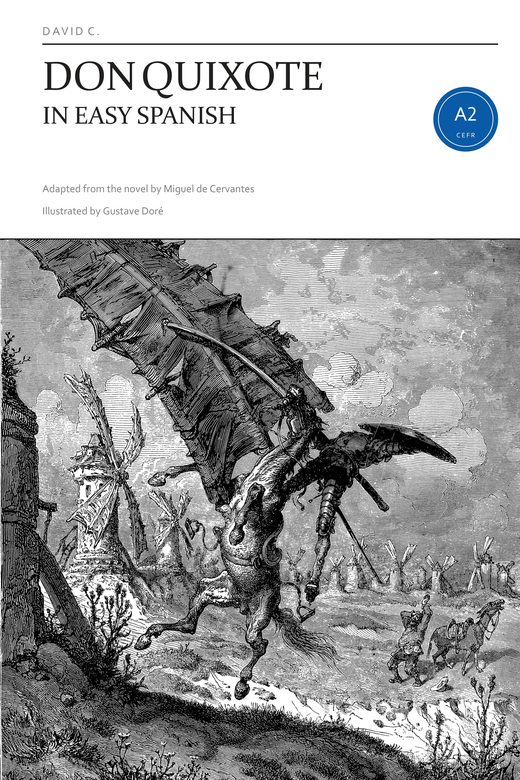
Don Quixote in Easy Spanish: the whole novel retold in Spanish you can actually read, in 58 short episodes, with the hard words glossed in the margin. It is where every Don Quixote sentence on this page comes from.
In EPUB and PDF, with a second novel in the same Spanish. See the books.
Where the course teaches this
4 lessons build it up, each one inside a chapter of the story rather than in the abstract. Free to read, with the vocabulary, the audio and the exercises.
- The imperfect subjunctive: how it is builtLesson 69Down into Montesinos’ Cave
- Si tuviera seis reales, se los daríaLesson 70Dulcinea Asks for Six Reales
- Reporting what somebody orderedLesson 71Master Pedro’s Puppet Show
- Hubiera outside sentences with siLesson 81Sancho Gives Up the Governorship
Next to this one
The points that sit closest to this one, and that a student usually meets around the same time.