Level B2 · Chapter 81
Sancho Gives Up the Governorship
They wake him at night shouting that the island is under attack, lash him between two boards, and by morning he leaves without a penny.
What you will learn
- Talk about a past that did not happen, with ojalá and como si.
- Say how you felt about something that had already happened.
- Recognise hubiera outside sentences with si.
Before you read
Watch for hubiera and hubiese when they are not following si. They appear after ojalá, after como si, and after verbs of feeling and doubt in the past. The form is the same one you met last lesson. The jobs are new.The story in easy Spanish
La séptima noche de su gobierno, Sancho dormía en la cama del gobernador de Barataria.
On the seventh night of his governorship, Sancho was asleep in the governor’s bed in Barataria.
No estaba harto de pan ni de vino, sino de juzgar y de hacer ordenanzas.
He was full neither of bread nor of wine, but of judging and of making by-laws.
De pronto lo despertaron campanas, gritos y trompetas, como si se hundiera la ínsula entera.
Suddenly he was woken by bells, shouts and trumpets, as if the whole island were sinking.
Salió a la puerta del aposento y vio venir más de veinte personas con hachas encendidas.
He came out to the door of his room and saw more than twenty people coming with lit torches.
Traían las espadas desnudas y gritaban que habían entrado enemigos en la ínsula.
They carried drawn swords and were shouting that enemies had got into the island.
Le dijeron que se armara y que saliera a la plaza a ser su capitán y su guía.
They told him to arm himself and go out to the square to be their captain and their guide.
Sancho contestó que él de armas no entendía nada y que aquello era cosa de su amo.
Sancho replied that he understood nothing of arms and that this was his master’s business.
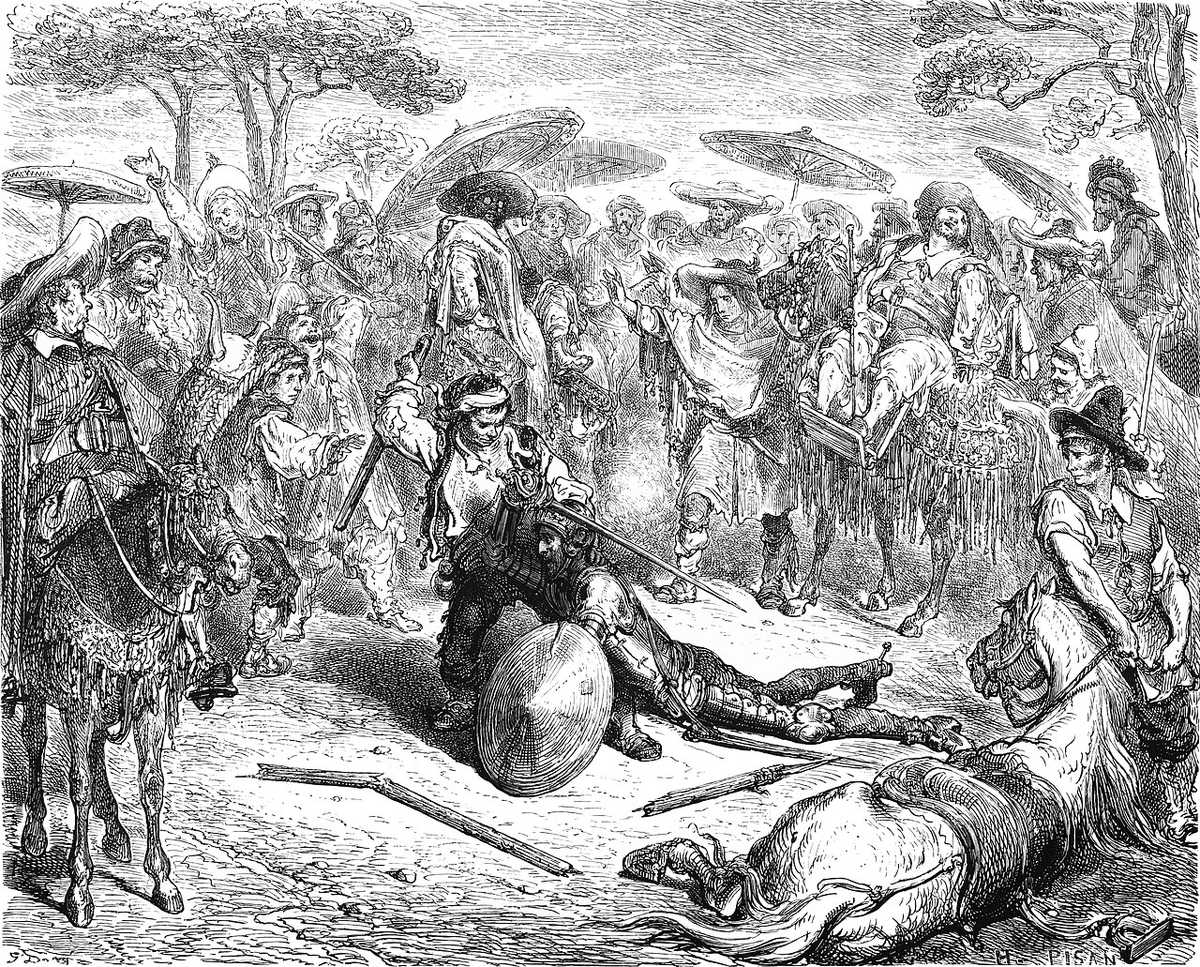
Le trajeron dos paveses grandes y se los pusieron encima de la camisa, uno delante y otro detrás.
They brought him two great shields and put them over his shirt, one in front and one behind.
Se los liaron con unas cuerdas tan apretadas que quedó emparedado entre las dos tablas.
They lashed them with cords so tight that he was walled in between the two boards.
Quedó derecho como un huso, sin poder doblar las rodillas ni dar un solo paso.
He was left straight as a spindle, unable to bend his knees or take a single step.
Le pusieron una lanza en las manos y le mandaron caminar delante de todos.
They put a lance in his hands and ordered him to walk ahead of everyone.
Quiso andar y se cayó al suelo de un golpe tan grande que se creyó hecho pedazos.
He tried to walk and fell to the floor with such a crash that he thought he had broken to pieces.
Allí se quedó, boca abajo dentro de su caparazón, como un galápago entre sus conchas.
There he stayed, face down inside his shell, like a tortoise between its plates.
Apagaron las antorchas y volvieron a gritar más fuerte que antes.
They put out the torches and started shouting louder than before.
Corrían todos por encima de él en la oscuridad y le daban cuchilladas sobre las tablas.
They all ran over him in the darkness and struck at the boards with their swords.
Uno se le subió encima un buen rato y desde allí, como desde una torre, mandaba los ejércitos.
One man stood on him for a good while and from there, as from a tower, commanded the armies.
Gritaba que trincheraran las calles con colchones y que trajeran calderas de aceite ardiendo.
He shouted for the streets to be barricaded with mattresses and for cauldrons of boiling oil.
Sancho, debajo, sudaba y pedía a Dios que se acabase de perder aquella ínsula.
Sancho, underneath, sweated and begged God that the island might finally be lost.
Duró aquello una hora larga, hasta que empezaron a gritar victoria y a llamarlo invencible.
It lasted a good hour, until they began shouting victory and calling him invincible.
Lo desliaron, le dieron un trago de vino y él se desmayó del susto y del trabajo.
They untied him, gave him a draught of wine, and he fainted from shock and exhaustion.
A los burladores ya les pesaba que la burla hubiera salido tan pesada.
The jokers were by now sorry that the joke had turned out so heavy.
Cuando volvió en sí preguntó qué hora era, y le dijeron que ya amanecía.
When he came round he asked what time it was, and they told him dawn was breaking.
Calló, y sin decir una palabra más empezó a vestirse muy despacio.
He said nothing, and without another word began to dress very slowly.
Fue derecho a la caballeriza, donde estaba el rucio, y lo abrazó y le besó la frente.
He went straight to the stable, where his donkey was, and embraced it and kissed its forehead.
Le habló como a un compañero, y le dijo que ojalá no hubiera dejado nunca los caminos.
He spoke to it like a companion, and said he wished he had never left the roads.
Mientras habían andado juntos, su único cuidado había sido remendarle los aparejos.
While they had walked together, his only care had been mending the donkey’s harness.
Desde que había subido a las torres de la ambición y de la soberbia, se le habían metido mil miserias en el alma.
Since he had climbed the towers of ambition and pride, a thousand miseries had got into his soul.
Luego volvió a la sala y habló a todos los que lo habían servido aquella semana.
Then he went back into the hall and spoke to everyone who had served him that week.
Les pidió que le abrieran camino y que lo dejaran volver a su antigua libertad.
He asked them to clear the way and let him go back to his old freedom.
Dijo que él no había nacido para gobernador ni para defender ínsulas de enemigos.
He said he had not been born to be a governor, nor to defend islands from enemies.
Le pidieron que se quedara, y él contestó que se le daba mejor la hoz que el cetro.
They begged him to stay, and he answered that he handled a sickle better than a sceptre.
Prefería hartarse de gazpachos a estar sujeto a un médico impertinente que lo mataba de hambre.
He would rather fill himself with gazpacho than be at the mercy of a doctor who starved him.
El mayordomo le recordó que todo gobernador tiene que dar residencia antes de irse.
The steward reminded him that every governor must submit to an audit before leaving.
Sancho respondió que saliendo desnudo, como salía, no hacía falta otra señal.
Sancho answered that leaving naked, as he was leaving, no other proof was needed.
Salió de la ínsula como había entrado, sin blanca y sin haber tocado un solo cohecho.
He left the island as he had entered it, penniless and without having taken a single bribe.
Si hubiera querido robar, habría podido hacerlo aquella semana sin que nadie lo notara.
If he had wanted to steal, he could have done it that week without anyone noticing.
Solo pidió un poco de cebada para el rucio y medio queso y medio pan para él.
He asked only for a little barley for the donkey and half a cheese and half a loaf for himself.
Se ató las alforjas y se fue por el camino, más ligero que un gobernador y mucho más contento.
He tied on his saddlebags and set off down the road, lighter than a governor and a great deal happier.
Vocabulary
The fake attack
- el pavés
- the body shield
- liar
- to lash
- emparedado
- walled in
- el huso
- the spindle
- el caparazón
- the shell
- el galápago
- the tortoise
- la antorcha
- the torch
- la espada desnuda
- the drawn sword
Saying goodbye to the donkey
- la caballeriza
- the stable
- remendar
- to mend
- los aparejos
- the harness
- la ambición
- ambition
- la soberbia
- pride
- la miseria
- wretchedness
- el compañero
- the companion
- la antigua libertad
- his old freedom
Leaving clean
- la hoz
- the sickle
- el cetro
- the sceptre
- el gazpacho
- gazpacho
- la residencia
- the audit of a term of office
- el cohecho
- the bribe
- sin blanca
- penniless
- la cebada
- barley
- ligero
- light
Hubiera outside sentences with si
Ojalá no hubiera dejado nunca los caminos.
Gritaban como si se hubiera hundido la ínsula entera.
Les pesaba que la burla hubiera salido tan pesada.
You met hubiera in the si half of an impossible conditional. That is only one of its jobs, and probably not the commonest. Its real work is to be the past subjunctive of the compound tenses, which means it turns up wherever a subjunctive is required and the event is already over.
| trigger | example | meaning |
|---|---|---|
| ojalá | Ojalá no hubiera aceptado la ínsula. | I wish I had not, and I did |
| como si | Gritaba como si lo hubieran herido. | as if they had wounded him, and they had not |
| feeling, in the past | Le pesaba que hubieran hecho aquello. | he regretted that they had |
| doubt or denial, in the past | No creía que hubiese robado nada. | he did not think he had |
| an order or wish, in the past | Quería que se hubiera ido antes. | he wanted him to have gone earlier |
| superlative with que | La peor noche que hubiera pasado nunca. | the worst night he had ever spent |
Como si is fixed, and worth memorising
Como si never takes an indicative and never takes a present subjunctive. It takes -ra or -se forms only: como si fuera, como si tuviera, como si hubiera pasado. Even when the main verb is in the present: habla como si hubiera estado allí, he talks as if he had been there.
Ojalá and its three time frames
| form | example | what it means |
|---|---|---|
| ojalá + present subjunctive | Ojalá venga. | I hope he comes, still possible |
| ojalá + imperfect subjunctive | Ojalá viniera. | I wish he would come, unlikely |
| ojalá + hubiera + participle | Ojalá hubiera venido. | I wish he had come, too late now |
The word itself comes from Arabic, law šā llāh, if God should wish, which is why it takes a subjunctive at all.
The audit and the governor who did not steal
The juicio de residencia was not invented for this chapter. It was a real institution of the Spanish empire: at the end of a term, every corregidor, governor and viceroy had to stay in place while a judge heard complaints against him and audited his accounts. The whole American administration ran on it. So when the steward stops Sancho at the door and asks for his residencia, he is applying a genuine rule, and Sancho’s reply is a legal argument rather than a joke. Leaving with nothing is itself the audit.
Cervantes knew this world from the wrong side of it. He spent years as a requisitioner of grain and oil and then as a tax collector in Andalusia, and he was imprisoned at least twice over accounts that did not add up, once because a banker holding the money went bankrupt. The sentence about entering with nothing and leaving with nothing comes from a man who had been made to justify every coin.
Read the ending slowly, because Cervantes has arranged the order deliberately. Sancho does not first announce his resignation and then say goodbye to the donkey. He goes to the stable first, alone, and talks to the animal before he talks to any person. The speech he makes there is the most formal thing he says in the whole book, built on a contrast between the roads and the towers of ambition, and it is addressed to a donkey. Nobody in the household is judged worth it.
Cervantes in the original · «digan al duque mi señor que, desnudo nací…»
digan al duque mi señor que, desnudo nací, desnudo me hallo: ni pierdo ni gano; quiero decir, que sin blanca entré en este gobierno y sin ella salgo
tell my lord the duke that naked I was born and naked I find myself, I neither lose nor gain, by which I mean that I came into this governorship without a penny and without one I leave it
Sancho quotes a proverb and then, in the same breath, explains it, which is something he almost never does. Desnudo nací, desnudo me hallo is a formula that goes back to the book of Job and was current in Spanish as a way of shrugging off loss. Then comes quiero decir, and the second half turns the image into accounting: no money in, no money out. He is doing both registers at once, the proverb of a farmhand and the statement of a man submitting his books. The word that carries the weight is blanca, the smallest coin then in circulation, worth so little that estar sin blanca survives in Spanish today with no memory of the coin attached. And the claim is a serious one in its period. A governor who left office no richer than he entered it was rare enough to be worth reporting, which is exactly why Cervantes has him ask that the message be carried back to the duke.