Spanish grammar · B2 · Updated
Aunque with the indicative or the subjunctive
Aunque with the indicative admits a fact: even though it is raining, and it is. Aunque with the subjunctive concedes a possibility: even if it rains, and I have no idea whether it will. One word, two meanings, and the mood is the only thing that tells them apart.
The short answer
Aunque with the indicative means "although" and states the second half as a fact: aunque llueve, salimos, it is raining and we are going out anyway. With the subjunctive it means "even if" and leaves it open: aunque llueva, whether it rains or not.
How to remember it
Indicative for a fact, subjunctive for a maybe
| Indicative | the thing is true and you both know it | Aunque llueve, salimos |
|---|---|---|
| Subjunctive, unknown | it may or may not be so | Aunque llueva, saldremos |
| Subjunctive, known but dismissed | true, and you are brushing it aside | Aunque sea difícil, lo haré |
| Imperfect subjunctive | clearly not the case | Aunque fuera rico, no lo compraría |
| Same family | a pesar de que, por más que and aun cuando behave the same | Por más que insistas |
The forms
The same sentence, both ways
| Spanish | English | what it says |
|---|---|---|
| aunque llueve, salimos | although it is raining, we are going out | it is raining |
| aunque llueva, saldremos | even if it rains, we will go out | it may or may not |
| aunque es caro, lo compro | although it is expensive, I am buying it | it is expensive |
| aunque sea caro, lo compro | even if it is expensive, I am buying it | dismissed |
| aunque tenía frío, salió | although he was cold, he went out | he was cold |
| aunque tuviera dinero | even if I had money | I do not |
20 sentences that show the difference
Everyday Spanish, the kind you would actually say. The label under each one says which part of the rule it shows.
Aunque llueve, salimos.
Although it is raining, we are going out.
Indicative, a fact
Aunque llueva, saldremos.
Even if it rains, we will go out.
Subjunctive, unknown
Aunque es caro, lo compro.
Although it is expensive, I am buying it.
Indicative
Aunque sea caro, lo compro.
Even if it is expensive, I am buying it.
Subjunctive, brushed aside
Aunque no me creas, es verdad.
Even if you do not believe me, it is true.
Subjunctive
Aunque no me crees, es verdad.
Although you do not believe me, it is true.
Indicative, you clearly do not
Aunque tenía frío, salió sin abrigo.
Although he was cold, he went out without a coat.
Past, indicative
Aunque tuviera dinero, no lo compraría.
Even if I had money, I would not buy it.
Imperfect subjunctive, clearly untrue
Aunque hubiera estudiado, no habría aprobado.
Even if I had studied, I would not have passed.
Pluperfect subjunctive
Aunque parezca mentira.
Believe it or not.
A set phrase
A pesar de que es tarde, seguimos.
Even though it is late, we are carrying on.
A pesar de que, same rule
Por más que insistas, no iré.
However much you insist, I will not go.
Por más que, usually subjunctive
Aun cuando lo supiera, no lo diría.
Even if I knew, I would not say.
Aun cuando
Aun así, no me convence.
Even so, I am not convinced.
Aun así, no verb
Aún no ha llegado.
He has not arrived yet.
Aún with an accent means yet
Aunque quisiera, no puedo.
Even if I wanted to, I cannot.
Common set phrase
Aunque suene raro, funciona.
Odd as it sounds, it works.
Subjunctive, dismissing
Aunque me lo pidas de rodillas.
Even if you beg me on your knees.
Subjunctive, hypothetical
Aunque sea un momento.
Even if only for a moment.
Aunque sea, set phrase
Aunque no lo parezca, es nuevo.
It may not look it, but it is new.
Subjunctive
Where English gets in the way
English marks the difference with two different conjunctions and leaves the verb alone: although for facts, even if for suppositions. Spanish does the opposite. It keeps one conjunction and moves the verb, which means the information English carries in a word you can hear at the start of the clause, Spanish carries in an ending you only reach at the end. That is why concessive sentences feel slippery at first. You cannot decide the mood until you have decided what you are doing with the fact, and English never made you decide that. The one case with no English equivalent at all is the second one above, conceding something both speakers already know. English can only say although and hope the tone carries it. Spanish says aunque fuese, and the subjunctive does the work of the tone.
The mistake to avoid
One. Using the indicative for a concession, because English never marks it: ✗ Aunque la ceremonia era verdadera, la viudez llegaría antes → ✓ Aunque la ceremonia fuese verdadera. The indicative version is not ungrammatical, but it says something else: it tells the listener a fact he did not have. Two. Using the indicative after even if: ✗ Aunque me llaman loco, no cambio for a hypothesis → ✓ Aunque me llamen loco. Three. Writing aún que as two words. It is one word, aunque, and it never carries an accent.
The cases that break the rule
Aunque sea caro, lo compro
The subjunctive here does not mean you are unsure of the price. It means you know it and are brushing it aside. This second use catches people out, because the fact is perfectly well known.
Aún and aunque
Two different words. Aún with an accent means "still" or "yet". Aun without one means "even". Aunque is one word and means "although" or "even if".
Aunque sea
A fixed expression meaning "even if only": llámame, aunque sea un minuto. Very common in speech and always subjunctive.
Por más que
Almost always takes the subjunctive, because it is usually about something that has not worked yet: por más que insistas. A pesar de que, on the other hand, usually takes the indicative.
Aunque quisiera
The imperfect subjunctive marks something clearly not the case. Aunque quisiera, no puedo says that wanting is not the problem, and that you cannot anyway.
Aunque parezca mentira
Fixed and always subjunctive. Literally "even if it seems a lie", used the way English says "believe it or not". Learn it whole.
Aunque exercises
8 sentences to fill in. Type your answer and check it, or read them straight through with the answers showing. Accents count here, the way they count in the language.
-
Aunque (llover) ___ ahora mismo, vamos a salir.
Although it is raining right now, we are going out.
llueve · Indicative, because the rain is a fact we can both see.
-
Aunque (llover) ___ mañana, saldremos igual.
Even if it rains tomorrow, we will go out anyway.
llueva · Subjunctive, because tomorrow is unknown.
-
Aunque (ser) ___ caro, me lo voy a comprar.
Even if it is expensive, I am going to buy it.
sea · Subjunctive to brush the price aside, even though you know perfectly well what it costs.
-
Aunque (tener, él) ___ frío, salió sin abrigo.
Although he was cold, he went out without a coat.
tenía · Indicative in the past, because the cold is stated as a fact.
-
Aunque (tener, yo) ___ dinero, no lo compraría.
Even if I had money, I would not buy it.
tuviera · Imperfect subjunctive, because I do not have the money.
-
Por más que (insistir, tú) ___, no pienso ir.
However much you insist, I am not going.
insistas · Por más que almost always takes the subjunctive.
-
Llámame, aunque (ser) ___ un minuto.
Call me, even if only for a minute.
sea · Aunque sea is a fixed expression meaning "even if only". Always subjunctive.
-
Aunque no lo (parecer) ___, este coche es nuevo.
It may not look it, but this car is new.
parezca · Subjunctive, dismissing the appearance rather than doubting it.
More exercises, from Don Quixote
8 more, these ones straight out of the course: the inn, the windmills, Rocinante and the road. Same rule, older Spanish.
-
Aunque (llover) ___ ahora mismo, vamos a salir.
Although it is raining right now, we are going out.
llueve · It is raining and everybody knows it. A fact takes the indicative, and aunque means although.
-
Aunque (llover) ___ mañana, saldremos.
Even if it rains tomorrow, we will go out.
llueva · Nobody knows yet, so the subjunctive. Now aunque means even if.
-
Aunque (ser) ___ pobre, es un hombre honrado.
Although he is poor, he is an honest man.
es · His poverty is a fact on the table, so the indicative.
-
Aunque (tener, él) ___ razón, no pienso darle las gracias.
Even if he is right, I do not intend to thank him.
tenga · Here you refuse to admit it either way. The subjunctive lets you concede nothing.
-
Aunque (estar) ___ cansado, siguió andando.
Although he was tired, he kept walking.
estaba · A fact in the past takes the imperfect indicative. The rule does not change with the tense.
-
Aunque me lo (jurar, tú) ___, no te creería.
Even if you swore it to me, I would not believe you.
juraras or jurases · Something unreal, so the imperfect subjunctive, and the other half of the sentence goes conditional.
-
Aunque (haber) ___ gigantes, no tengo miedo.
Even if there are giants, I am not afraid.
haya · Haya is the subjunctive of hay. The giants may or may not be there, which is the whole point.
-
Aunque Sancho (querer) ___ marcharse, se quedó.
Although Sancho wanted to leave, he stayed.
quería · He really did want to leave, and the sentence admits it, so the indicative.
Common questions
How do I choose the mood after aunque?
Ask whether the thing is true and known. Aunque llueve, salgo means it is raining and I am going out anyway. Aunque llueva, salgo means even if it rains, and I do not know whether it will.
Does aunque mean although or even if?
Both, and the mood is what tells them apart. With the indicative it is "although". With the subjunctive it is "even if". English needs two different words where Spanish changes one ending.
Which other words work like this?
A pesar de que, aun cuando, por más que and por mucho que all take the same choice. So does cuando: cuando llega with the indicative for a habit, cuando llegue with the subjunctive for an arrival still to come.
Is it aunque es or aunque sea?
Aunque es when you are treating it as a known fact: aunque es caro, lo compro, it is expensive and I am buying it anyway. Aunque sea when you are not committing to it: aunque sea caro, lo compro, even if it turns out expensive. Both are correct and they say different things.
What does aunque sea mean on its own?
At least, or if only: dame algo, aunque sea un poco, give me something, even if it is only a little. It is a fixed expression built from the same aunque, and it is very common in speech.
What is the difference between aunque and a pesar de?
Aunque is followed by a verb: aunque llueve. A pesar de is followed by a noun or an infinitive: a pesar de la lluvia, a pesar de llover. To use a verb with a subject after it you need a pesar de que, and then it takes the same mood choice as aunque.
What is the difference between aunque and pero?
Pero joins two statements as equals: es caro, pero lo compro. Aunque puts one of them underneath the other, and lets it move to the front: aunque es caro, lo compro. That mobility is the practical difference, since pero can never start the sentence.
Which other words take the same mood choice?
A pesar de que, aun cuando, por más que and por mucho que all work exactly like aunque: indicative for a fact, subjunctive for something you are not committing to. Aun así is different, it is a full stop and a fresh start.
The things to remember
- Indicative means "although" and states the fact. Subjunctive means "even if" and leaves it open.
- The subjunctive is also used for a known fact you are dismissing: aunque sea caro.
- The imperfect subjunctive marks something clearly untrue: aunque fuera rico.
- Aún with an accent means "still". Aun without one means "even". Neither is aunque.
- A pesar de que usually takes the indicative, por más que usually takes the subjunctive.
The same rule in Don Quixote
Real lines from the course, not invented examples. Each one is the sentence the lesson uses to introduce the point.
Aunque el prado estaba lleno de gente, se hizo un silencio grande.
Although the meadow was full of people, a great silence fell.
The book this comes from
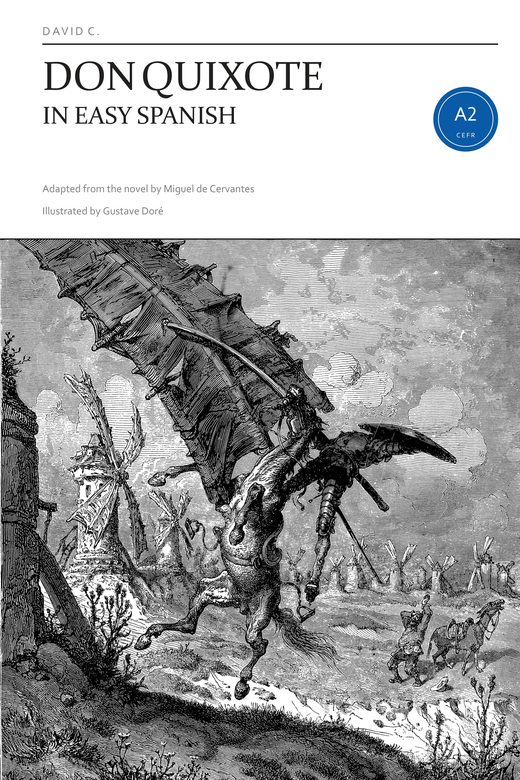
Don Quixote in Easy Spanish: the whole novel retold in Spanish you can actually read, in 58 short episodes, with the hard words glossed in the margin. It is where every Don Quixote sentence on this page comes from.
In EPUB and PDF, with a second novel in the same Spanish. See the books.
Where the course teaches this
One lesson covers it, each one inside a chapter of the story rather than in the abstract. Free to read, with the vocabulary, the audio and the exercises.
- Aunque: one word, two moodsLesson 68Basilio’s Trick
Next to this one
The points that sit closest to this one, and that a student usually meets around the same time.