Spanish grammar · A1 · Updated
Spanish negation and the double negative
No goes straight in front of the verb. Then, unlike English, the negatives stack up: no veo nada, no viene nunca nadie. Two negatives do not cancel each other out here, they reinforce, and leaving one of them out is what makes a sentence sound foreign.
The short answer
No goes in front of the verb and that is the whole basic rule: no hablo. Spanish stacks negatives instead of cancelling them, so no veo nada means I see nothing, not I see something. And there is no do or does: to make a yes-no question, just raise your voice.
How to remember it
No before the verb, and negatives pile up
| One no | straight in front of the verb | No hablo |
|---|---|---|
| Two negatives | they reinforce, they do not cancel | No veo nada |
| Or move it in front | then the no disappears | Nada veo |
| Yes-no question | no auxiliary. Word order does not have to change | ¿Hablas español? |
| Pronouns stay put | no goes before the pronoun too | No lo veo |
The forms
The negative words and their pairs
| positive | negative | example |
|---|---|---|
| algo | nada | no veo nada |
| alguien | nadie | no viene nadie |
| alguno | ninguno | no tengo ninguno |
| siempre | nunca, jamás | no viene nunca |
| también | tampoco | yo tampoco |
| y | ni | ni café ni té |
20 sentences that show the difference
Everyday Spanish, the kind you would actually say. The label under each one says which part of the rule it shows.
No hablo francés.
I do not speak French.
The basic no
No lo veo.
I cannot see it.
No before the pronoun
No veo nada.
I cannot see anything.
Two negatives, one meaning
Nada veo.
I see nothing.
Fronted, so no disappears
No viene nadie.
Nobody is coming.
Nadie after the verb
Nadie viene.
Nobody is coming.
Nadie in front
No voy nunca.
I never go.
Nunca after
Nunca voy.
I never go.
Nunca in front
No tengo ningún problema.
I have no problem at all.
Ningún before a noun
Yo tampoco.
Me neither.
Tampoco on its own
No quiero ni café ni té.
I want neither coffee nor tea.
Ni... ni
No tengo coche.
I do not have a car.
No article after a negative
¿Hablas español?
Do you speak Spanish?
A question, no auxiliary
¿No vienes?
Are you not coming?
A negative question
Sí que vengo.
I certainly am coming.
Sí que to insist
Creo que no.
I do not think so.
Que no at the end
Todavía no.
Not yet.
Set phrase
Ya no vive aquí.
He does not live here any more.
Ya no for "not any more"
No sólo eso.
Not only that.
Set phrase
Ni idea.
No idea.
Set phrase
Where English gets in the way
English builds a whole scaffolding to ask and to deny: do, does, doesn't, plus moving the verb to the front. Spanish has none of it: one no in front of the verb, and for a question, not even that. The flip side is that English forbids the double negative and Spanish demands it.
The mistake to avoid
English speakers translate do and produce ✗ ¿Hace él tiene miedo?, and they avoid the double negative and produce ✗ Él no habla con alguien. The right forms are ✓ ¿Tiene miedo? and ✓ No habla con nadie. Also ✗ Es las cinco: it is ✓ Son las cinco, plural, except for ✓ Es la una.
The cases that break the rule
No veo nada
The double negative is compulsory, not a mistake. Two negative words in Spanish reinforce each other. Veo nada is wrong, and this is the opposite of what English does.
Nada veo
If the negative word comes before the verb, the no disappears: nunca voy and not no nunca voy. Both orders are correct, and putting it in front is a little more emphatic.
Ningún, ninguno
Ninguno shortens to ningún before a masculine singular noun, like uno and bueno. And ninguno is almost always singular: no tengo ningún amigo aquí, even though English would say "no friends".
Ya no and todavía no
Two pairs that sit at opposite ends. Ya no is "not any more", todavía no is "not yet". Mixing them up changes the sentence completely.
No tengo coche
After a negative, Spanish drops the indefinite article where English keeps it. No tengo coche, not no tengo un coche, unless you are counting.
Sí que vengo
To contradict a negative, Spanish adds que after sí: sí que vengo. It is the equivalent of the English stressed "I am coming", and there is no other way to write the stress down.
Spanish negation exercises
8 sentences to fill in. Type your answer and check it, or read them straight through with the answers showing. Accents count here, the way they count in the language.
-
___ hablo francés, sólo español.
I do not speak French, only Spanish.
No · No straight in front of the verb, and no auxiliary anywhere.
-
No veo ___ desde aquí.
I cannot see anything from here.
nada · Two negatives that reinforce each other. Veo nada would be wrong.
-
___ viene nadie a esta hora.
Nobody comes at this hour.
No · With nadie after the verb, the no is compulsory. Nadie viene would drop it.
-
No tengo ___ problema con eso.
I have no problem at all with that.
ningún · Ninguno shortens to ningún before a masculine singular noun.
-
Yo ___ quiero ir.
I do not want to go either.
tampoco · Tampoco is the negative of también, and it needs no extra no in front of yo.
-
___ no vive aquí, se mudó el año pasado.
He does not live here any more, he moved last year.
Ya · Ya no means "not any more". Todavía no would mean "not yet".
-
No quiero ni café ___ té.
I want neither coffee nor tea.
ni · Ni... ni, and the no stays in front of the verb as well.
-
No tengo ___.
I do not have a car.
coche · No article after a negative. No tengo un coche would only be right if you were counting.
More exercises, from Don Quixote
8 more, these ones straight out of the course: the inn, the windmills, Rocinante and the road. Same rule, older Spanish.
-
No he visto ___ en el camino.
I have not seen anything on the road.
nada · Two negatives are compulsory in Spanish: no in front of the verb and nada behind it.
-
No vino ___ a la venta.
Nobody came to the inn.
nadie · No plus nadie. Put nadie first and the no disappears: nadie vino.
-
Sancho no quiere ir, y yo ___.
Sancho does not want to go, and neither do I.
tampoco · Tampoco is the negative of también. Yo también for agreeing with a yes, yo tampoco with a no.
-
No hay ___ molino por aquí.
There is not a single windmill around here.
ningún · Ninguno drops the o in front of a masculine noun: ningún molino, ninguna venta.
-
___ he estado en Barcelona.
I have never been to Barcelona.
Nunca · In front of the verb, nunca stands alone. Behind it you need the no: no he estado nunca.
-
No dijo ___ palabra en toda la noche.
He did not say a single word all night.
ninguna · Feminine noun, so ninguna, with no shortening.
-
No come carne ___ pescado.
He eats neither meat nor fish.
ni · Ni links two negatives. At the start of the sentence it doubles up: ni carne ni pescado.
-
No lo haré ___ de los jamases.
I will never do it, not ever.
jamás · Jamás is nunca with the volume up. Nunca jamás together is even stronger, and both take the no.
Common questions
Is the double negative correct in Spanish?
Yes, and it is required. No veo nada is the normal way to say "I see nothing". Two negatives reinforce each other here instead of cancelling out as they do in English.
Where does nada or nunca go?
Either after the verb with no in front of it, or in front of the verb on its own. No viene nunca and nunca viene both work. What you cannot do is drop the no while leaving nunca after the verb.
What does tampoco mean?
Neither, or not either. It is the negative twin of también. Yo tampoco is the answer to a negative statement, exactly where English says "me neither".
How do I say nobody in Spanish?
Nadie, and it works two ways. In front of the verb it goes alone: nadie vino. After the verb it needs a no as well: no vino nadie. Both are correct and both mean the same thing.
What is the opposite of algo and alguien?
Nada and nadie. The pairs run right through: algo and nada, alguien and nadie, alguno and ninguno, siempre and nunca, también and tampoco. Learning them in pairs is faster than learning them apart.
What does ni ... ni mean?
Neither ... nor: ni café ni té. If the pair comes after the verb you still need the no: no quiero ni café ni té. On its own, ni means not even: ni lo intentó, he did not even try.
How do I say not even?
Ni siquiera, or just ni: ni siquiera me llamó. It follows the same rule as the rest of them, so after the verb the no comes back: no me llamó ni siquiera.
Why is it ningún libro and not ningunos libros?
Because ninguno is almost always singular in Spanish, even where English uses a plural: no tengo ningún libro is I have no books. It also loses its o in front of a masculine noun, exactly like algún and un.
The things to remember
- No goes straight in front of the verb, and in front of any pronoun with it.
- Negatives reinforce, they do not cancel: no veo nada.
- If the negative word goes in front of the verb, the no disappears.
- There is no do or does. A yes-no question is just the same sentence with the voice raised.
- Ya no is "not any more", todavía no is "not yet".
The same rule in Don Quixote
Real lines from the course, not invented examples. Each one is the sentence the lesson uses to introduce the point.
Don Quijote no habla de su plan con nadie.
Don Quixote talks to nobody about his plan.
The book this comes from
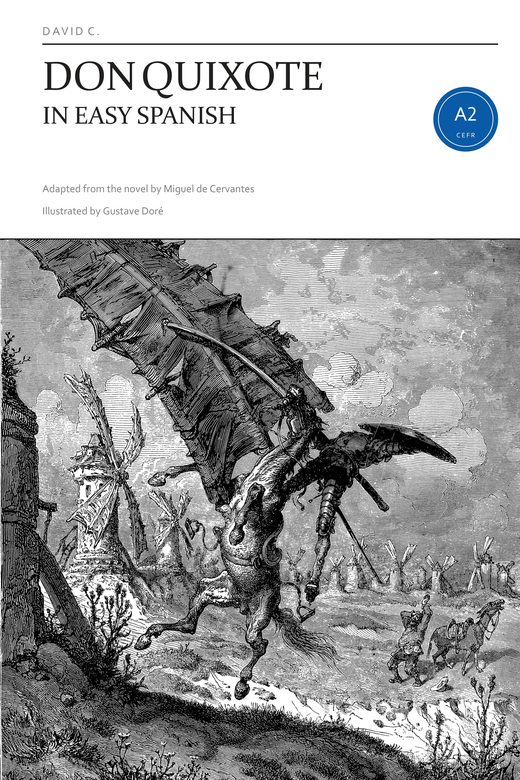
Don Quixote in Easy Spanish: the whole novel retold in Spanish you can actually read, in 58 short episodes, with the hard words glossed in the margin. It is where every Don Quixote sentence on this page comes from.
In EPUB and PDF, with a second novel in the same Spanish. See the books.
Where the course teaches this
One lesson covers it, each one inside a chapter of the story rather than in the abstract. Free to read, with the vocabulary, the audio and the exercises.
- Negation and yes-or-no questionsLesson 10The first ride out
Next to this one
The points that sit closest to this one, and that a student usually meets around the same time.