Level A1 · Chapter 10
The first ride out
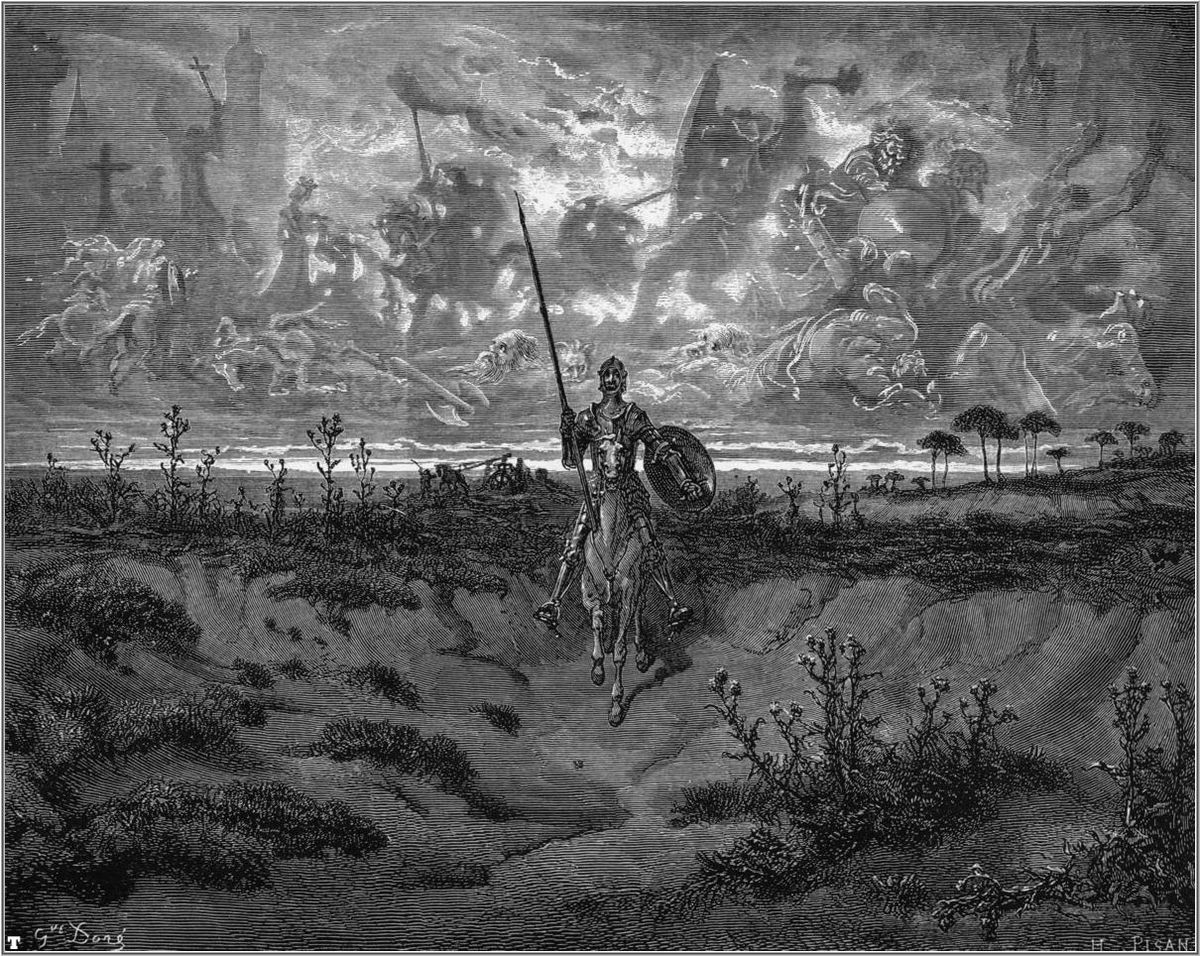
One July day, at four in the morning, Don Quixote leaves home by the back gate. He says goodbye to nobody.
What you will learn
- Make any Spanish sentence negative with a single word.
- Ask yes-or-no questions without changing a single word of the sentence.
- Answer with sí, no, también and tampoco, and tell the time.
Before you read
There are questions in this text. Look at them closely: same words, same order as an ordinary statement. Only the punctuation changes.The story in easy Spanish
Es un día de julio y hace mucho calor en la Mancha.
It is a July day and it is very hot in La Mancha.
Don Quijote no habla de su plan con nadie. El ama no sabe nada. La sobrina tampoco.
Don Quixote talks to nobody about his plan. The housekeeper knows nothing. Neither does the niece.
Se levanta a las cuatro de la madrugada. Todavía no es de día.
He gets up at four in the morning. It is not light yet.
¿Está todo listo? Sí. ¿Tiene miedo? No, no tiene miedo.
Is everything ready? Yes. Is he afraid? No, he is not afraid.
Se viste con sus armas viejas y toma la lanza.
He puts on his old armour and takes up his lance.
A las cinco menos cuarto baja al corral. Rocinante ya está listo y no protesta.
At a quarter to five he goes down to the yard. Rocinante is already waiting and does not complain.
Sale al campo por la puerta de atrás. En el pueblo nadie abre las ventanas.
He rides out into the countryside through the back gate. In the village nobody opens their shutters.
¿Mira alguien por la ventana? No. Los vecinos descansan. El sol tampoco está todavía.
Is anyone looking out of the window? No. The neighbours are resting. The sun is not up yet either.
Don Quijote está contento. Pero hay un problema grande: todavía no es caballero.
Don Quixote is happy. But there is one big problem: he is not a knight yet.
¿Es caballero de verdad? Todavía no. Pero hoy sale igual.
Is he really a knight? Not yet. But today he rides out anyway.
Vocabulary
Yes, no, too, neither
- sí
- yes
- no
- no, not
- también
- too, also
- tampoco
- neither, not either
- nadie
- nobody
- nada
- nothing
- todavía
- still, yet
Time of day
- la madrugada
- the small hours
- menos cuarto
- a quarter to
- y media
- half past
- en punto
- on the dot, sharp
The departure
- el miedo
- fear
- el vecino
- the neighbour
- la ventana
- the window
- descansar
- to rest
- protestar
- to protest, to complain
Negation and yes-or-no questions
Don Quijote no habla de su plan con nadie.
Rocinante ya está listo.
¿Está todo listo? Sí.
Making a sentence negative. Put no in front of the verb. That is the whole rule. There is no do, no does, no don't to build.
| positive | negative |
|---|---|
| Rocinante protesta. | Rocinante no protesta. |
| El ama sabe algo. | El ama no sabe nada. |
| Habla con alguien. | No habla con nadie. |
Notice the last two. Spanish keeps no and adds nada or nadie as well. Your English teacher spent years stamping out "I don't know nothing". In Spanish it is not a mistake, it is the only correct form.
Yes-or-no questions. Same words. Same order. Nothing added, nothing moved. In speech the voice rises at the end. In writing you add ¿ ?.
| statement | question |
|---|---|
| Todo está listo. | ¿Todo está listo? |
| Tiene miedo. | ¿Tiene miedo? |
This is a relief and a fright at the same time. A relief because there is no machinery to learn: no do you…?, no does he…?, no swapping the verb to the front. A fright because the whole question now rests on your voice: say it flat and you have made a statement instead. You may also put the subject after the verb, as in ¿Está listo Rocinante?, and both versions are equally good Spanish.
Answering. Sí or no. If you repeat the sentence, no turns up twice: No, no tiene miedo. The first one answers the question, and the second one negates the verb. English does exactly the same thing with two different words: "No, he isn't."
También and tampoco. También agrees with something positive, and tampoco agrees with something negative. English uses "too" and "either" for this, while Spanish gives each its own word. El ama no sabe nada. La sobrina tampoco.
Telling the time. Ask ¿Qué hora es? The answer is plural, because you are counting hours: Son las cinco. The exception is one o'clock, which is singular: Es la una. Then: las cinco y media (half past five), las cinco y cuarto (quarter past), las cinco menos cuarto (quarter to), las cinco en punto (five sharp). To say when something happens, put a in front: a las cuatro de la madrugada.
Telling the time without a clock
Don Quixote gets up at four in the morning, but he does not look at a clock: in 1605 almost nobody owned one. The village clock was the church bell, and the day was cut up by the hours of prayer: matins in the small hours, prime at daybreak, vespers as the afternoon ended.
The rest was the sun and the animals. The cockerel crowed before dawn, the oxen went out with the first light, and antes del día, "before daylight", was a perfectly precise time to everyone who heard it. Nobody was ever late, because nobody was ever due at an exact hour. Which makes the modern Spanish habit of asking ¿Qué hora es? and getting las cinco y algo ("five and a bit") looks less like vagueness and more like tradition.
Cervantes in the original · «Una mañana, antes del día…»
Una mañana, antes del día, que era uno de los calurosos del mes de julio, se armó de todas sus armas, subió sobre Rocinante, puesta su mal compuesta celada, embrazó su adarga, tomó su lanza y por la puerta falsa de un corral salió al campo.
One morning before daybreak, on one of the hottest days of July, he put on all his armour, mounted Rocinante with his badly made helmet on his head, took up his shield, seized his lance and rode out into the countryside through the back gate of a yard.
Antes del día means before dawn, and la puerta falsa is the back gate: Don Quixote leaves home in secret. The verbs here are all past tense, which you will meet from lesson 15 onwards. For now, read them as the same actions you have just read in the present.