Level A1 · Chapter 10.5
Review 2: lessons 6 to 10
The vocabulary from lessons 6 to 10 that does not come back, the grammar of the block in one table, and two exercises.
What you will learn
- Check how much of the vocabulary from lessons 6 to 10 you remember without looking.
- Talk about somebody’s daily routine with reflexive verbs and with clock times.
- Ask a yes or no question and answer it, using también and tampoco.
The story in easy Spanish
Nuestro hidalgo tiene una celada de cartón.
Our gentleman has a cardboard helmet.
Es su obra y él es un hombre muy paciente.
It is his own work and he is a very patient man.
Da un golpe con la espada y la celada cae en pedazos.
He gives it a blow with his sword and the helmet falls to pieces.
La prepara otra vez con barras de hierro por dentro.
He makes it again with iron bars inside.
Su caballo es flaco, pero su dueño busca un nombre sonoro.
His horse is skinny, but its owner is after a resounding name.
Rocinante significa «antes rocín, ahora el primero».
Rocinante means "once a nag, now the first of them".
Él se llama don Quijote, con su tierra en el nombre.
He calls himself Don Quixote, with his own land in the name.
El «don» es un tratamiento de respeto.
The "don" is a title of respect.
Falta una parte: un caballero necesita una dama.
One part is missing: a knight needs a lady.
En el Toboso existe una labradora guapa y muy lista.
In El Toboso there lives a good-looking and very sharp farm girl.
Él se enamora de ella y se acuerda de su cara.
He falls in love with her and remembers her face.
Le da el nombre musical de Dulcinea.
He gives her the musical name of Dulcinea.
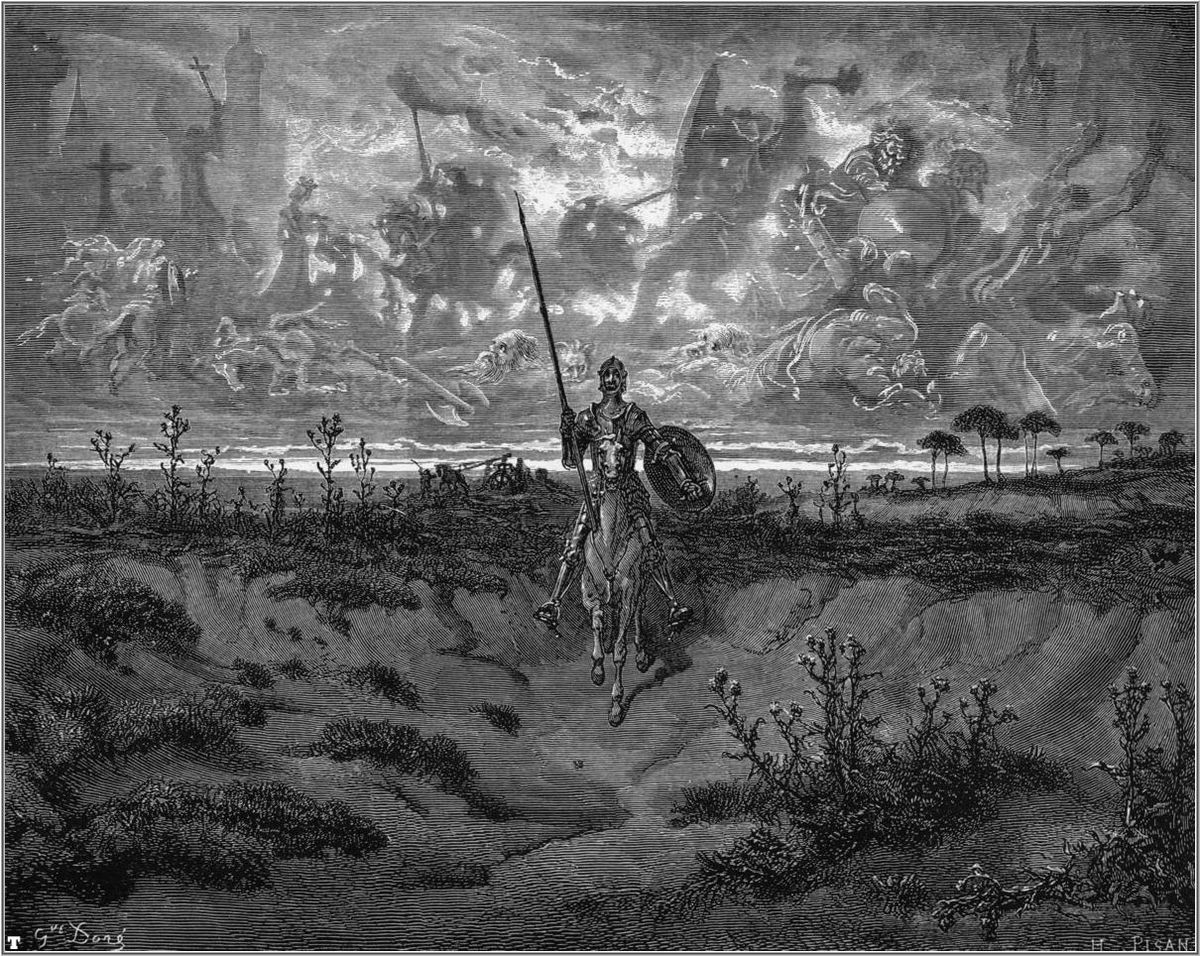
Una madrugada de julio sale sin descansar y con miedo.
One July daybreak he rides out without resting and full of fear.
La vecina duerme y el ama tampoco mira por la ventana.
The neighbour is asleep and the housekeeper is not looking out of the window either.
Nadie protesta en aquella casa.
Nobody complains in that house.
Vocabulary
The helmet (lesson 6)
- el cartón
- the cardboard
- la obra
- the piece of work
- la barra
- the bar
- paciente
- patient
The horse (lesson 7)
- el dueño / la dueña
- the owner
- sonoro / sonora
- resounding, sonorous
- significar
- to mean
The name (lesson 8)
- la tierra
- the land
- el tratamiento
- the form of address
- la parte
- the part
- existir
- to exist
Dulcinea (lesson 9)
- enamorarse de
- to fall in love with
- acordarse de
- to remember
- guapo / guapa
- good-looking
- listo / lista
- clever, sharp
- musical
- musical
The first ride out (lesson 10)
- la madrugada
- the small hours, daybreak
- el miedo
- the fear
- tampoco
- neither, not either
- descansar
- to rest
- protestar
- to complain
Lessons 6 to 10 in one table
Start where you always start in a review, with the vocabulary list above. Cover the English, read the Spanish aloud, mark whatever does not come back in three seconds. Only then read the table.
| point | rule | from the summary above |
|---|---|---|
| possessives | mi, tu, su, nuestro, agreeing with the thing owned and not with the owner | su caballo, nuestro hidalgo |
| adjective position | after the noun, which is the opposite of English | una labradora guapa |
| degree | muy, poco, mucho, bastante | muy paciente |
| numbers | cardinals to count, ordinals to rank | el primero |
| age | built on tener, never on ser | Tiene cincuenta años. |
| the clock | es la una, singular, and son las dos for everything else | a las cinco de la madrugada |
| reflexives | me, te, se in front of the verb | Él se llama don Quijote. |
| negation | a single no in front of the verb, no helper needed | La vecina no mira. |
| yes or no questions | same words, different tune, and two question marks | ¿Sale de casa? |
| también, tampoco | one agrees with a positive, the other with a negative | El ama tampoco protesta. |
The trap is su, which does not tell you whose. Su caballo is his horse, her horse, your horse and their horse all at once, and only the sentence around it decides.