Level A1 · Chapter 11
One July morning
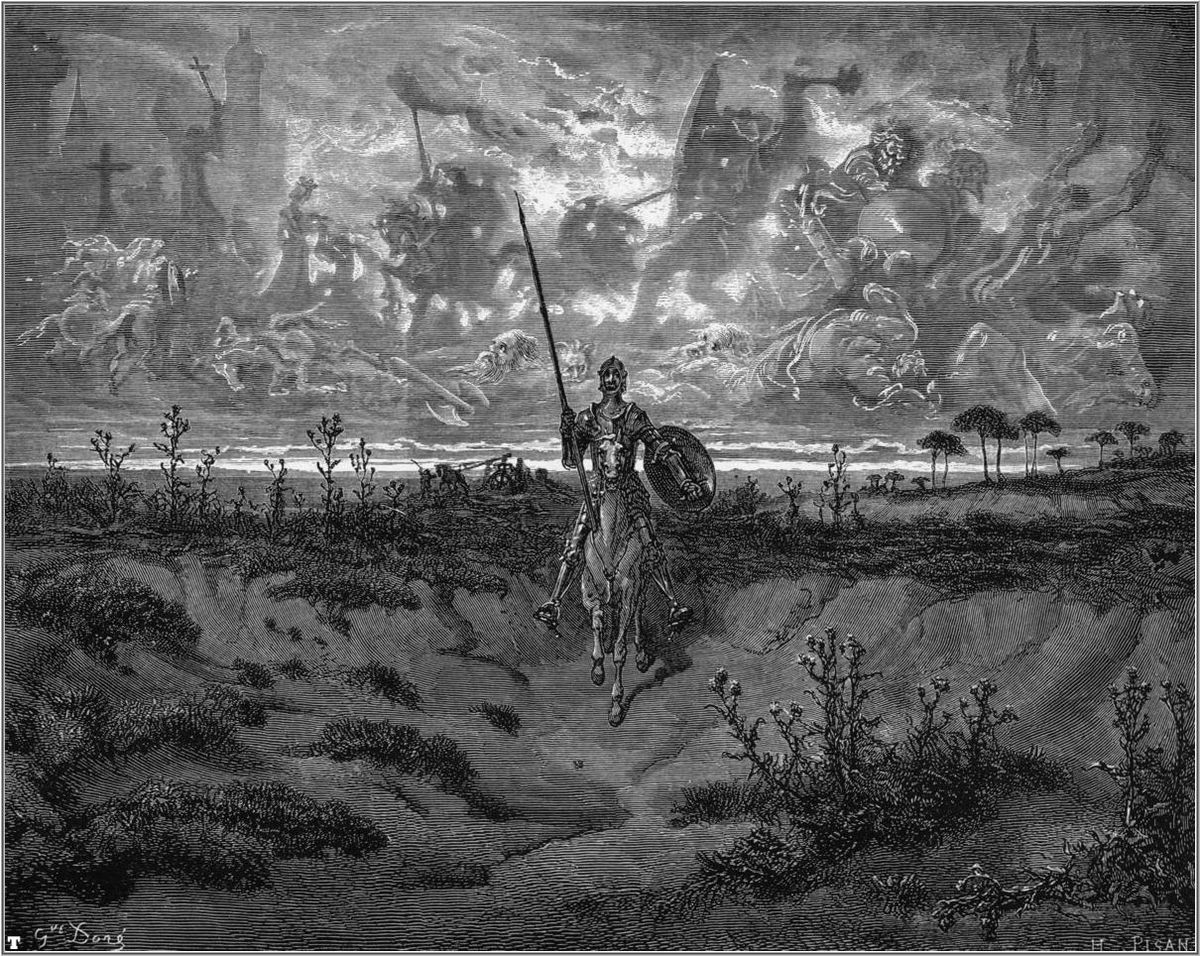
Alone on the plain of Montiel, in terrible heat, Don Quixote asks himself questions. The horse answers none of them.
What you will learn
- Ask for information with qué, quién, dónde, cómo, por qué and cuánto.
- Put the words of a question in the right order.
- Exclaim with ¡qué…! and address someone by name inside a sentence.
Before you read
Count the questions in this text. There are seven of them, and not one gets an answer. Watch the accent on the first word of each.The story in easy Spanish
Es una mañana de julio y hace un calor terrible.
It is a July morning and the heat is terrible.
Don Quijote camina solo por el campo de Montiel. ¿Dónde están los castillos? ¿Dónde están los gigantes?
Don Quixote rides alone across the plain of Montiel. Where are the castles? Where are the giants?
El campo es seco y grande. No hay sombra. ¡Qué calor!
The plain is dry and wide. There is no shade. What heat!
El caballero habla con su caballo: «¿Cuántas horas caminamos hoy, Rocinante?».
The knight talks to his horse: "How many hours are we walking today, Rocinante?"
El caballo no contesta. ¿Por qué? Porque es un caballo.
The horse does not answer. Why? Because he is a horse.
De pronto don Quijote tiene un problema. ¿Quién arma caballero a un caballero?
Suddenly Don Quixote has a problem. Who dubs a knight a knight?
Un caballero sin ceremonia no es un caballero de verdad. ¿Y cómo se hace la ceremonia?
A knight without the ceremony is not a real knight. And how is the ceremony done?
En sus libros la ceremonia es siempre en un castillo. ¿Qué busca entonces? Un castillo.
In his books the ceremony always takes place in a castle. So what is he looking for? A castle.
«¡Qué aventura, amigo Rocinante!», dice. Y el caballo camina despacio hacia el sol.
"What an adventure, friend Rocinante!" he says. And the horse walks slowly towards the sun.
Vocabulary
Asking
- ¿qué?
- what? which?
- ¿quién?
- who?
- ¿dónde?
- where?
- ¿cómo?
- how? what… like?
- ¿por qué?
- why?
- ¿cuánto?
- how much? how many?
- contestar
- to answer
The countryside in July
- la sombra
- the shade
- seco, seca
- dry
- el gigante
- the giant
- hacia
- towards
Words that tie the story together
- de pronto
- suddenly
- entonces
- then, in that case
- despacio
- slowly
- la ceremonia
- the ceremony
Question words
¿Dónde están los gigantes?
¿Quién arma caballero a un caballero?
¿Por qué? Porque es un caballo.
Six words cover almost everything you can ask for:
| word | asks for | example |
|---|---|---|
| qué: what | a thing | ¿Qué busca? |
| quién / quiénes: who | a person | ¿Quién arma caballero? |
| dónde: where | a place | ¿Dónde están los castillos? |
| cómo: how | a manner | ¿Cómo se hace la ceremonia? |
| por qué: why | a reason | ¿Por qué no contesta? |
| cuánto / cuánta / cuántos / cuántas: how much, how many | a quantity | ¿Cuántas horas caminamos? |
The accent is the question. Every one of these carries a written accent when it is asking or exclaiming. Drop the accent and the word changes job: por qué asks, porque answers. English hides this difference in the space between "why" and "because." Spanish hides it in one small mark. It is the only case in the language where a tilde changes a question into an answer.
Word order. Question word first, then the verb, then the subject: ¿Dónde está el castillo?, never ¿Dónde el castillo está? The subject is often left out altogether, exactly as in a statement.
Prepositions stay put. English happily leaves them stranded at the end, as in "What is he talking about?" Spanish never does. The preposition goes first, dragging the question word with it: ¿De qué habla?, ¿Con quién habla?, ¿Hacia dónde va?
Exclaiming with qué. ¡Qué calor! = What heat! / How hot it is. ¡Qué aventura! = What an adventure! Note what Spanish does not put there: no article. English needs "what an adventure." Spanish needs nothing between qué and the noun.
Calling someone by name. When you address a person (or a horse) inside a sentence, the name is fenced off with commas: ¿Cuántas horas caminamos hoy, Rocinante? This is called the vocative, and Spanish uses it far more than English does.
The plain of Montiel, and the heat
The campo de Montiel is a plateau in the southern part of La Mancha: cereal, vines, stone, and remarkably few trees. In July it passes forty degrees without effort, and the air shivers over the road until things at a distance stop holding a fixed shape.
Half the joke of the book lives there. Don Quixote is wearing an iron breastplate, a cardboard visor, and an entire morning of sun. Under those conditions a windmill can look like a giant and an inn like a castle without your having to be altogether mad. Cervantes never lets you decide how much of the madness is the books and how much is the heat. He sets the whole first sally on one of the hottest days of the year on purpose.
Cervantes in the original · «una mañana, antes del día…»
una mañana, antes del día, que era uno de los calurosos del mes de julio
one morning, before daybreak, on one of the hottest days of the month of July
This is the opening of the same sentence you saw in lesson 10, now on its own. Cervantes says antes del día where we would say muy temprano. The July heat is not scene-setting: it explains the bad temper of the whole chapter.