A1 · Updated
Spanish prepositions a, en, de, con, por
Five short words do most of the work in Spanish: a, en, de, con, por. They rarely match English one to one, so the best way in is by what they do: a for where to, en for where, de for from and of.
The short answer
A marks direction and time: voy a Madrid, a las tres. En marks where something is and means in, on or at: en casa, en la mesa. De is from, of and possession: soy de Leeds, el coche de Ana. A + el becomes al, de + el becomes del.
How to remember it
A goes, en is, de comes from
| A | direction, time, the personal a | Voy al cine |
|---|---|---|
| En | in, on, at a place, and transport | Estoy en el tren |
| De | from, of, made of, possession | La casa de mi madre |
| Con | with | Café con leche |
| Contractions | a + el = al, de + el = del | Vengo del trabajo |
The forms
Which preposition for which idea
| idea | Spanish | example |
|---|---|---|
| going somewhere | a | voy a la playa |
| being somewhere | en | estoy en la playa |
| coming from | de | vengo de la playa |
| on a surface | en / encima de | las llaves están en la mesa |
| transport | en (a pie, a caballo) | voy en tren |
| made of | de | una mesa de madera |
| owner | de | el perro de Luis |
| company | con | vivo con mi novia |
| through, along | por | paseo por el parque |
16 sentences that show the difference
Everyday Spanish, the kind you would actually say. The label under each one says which part of the rule it shows.
Voy a Madrid.
I am going to Madrid.
A, direction
Vivo en Madrid.
I live in Madrid.
En, place
Soy de Madrid.
I am from Madrid.
De, origin
Vamos al cine.
We are going to the cinema.
A + el = al
Salgo del trabajo a las cinco.
I leave work at five.
De + el = del
El libro está en la mesa.
The book is on the table.
En for on
Estoy en casa.
I am at home.
En for at
Voy a casa.
I am going home.
A casa, no article
Voy en coche.
I am going by car.
En for transport
Voy a pie.
I am going on foot.
A pie
Es el móvil de mi hermano.
It is my brother's phone.
De for possession
Una camiseta de algodón.
A cotton T-shirt.
De, made of
Un vaso de agua.
A glass of water.
De, contents
Té con limón.
Tea with lemon.
Con
Paseamos por el centro.
We walk around the centre.
Por, through
Llego el lunes.
I arrive on Monday.
No preposition for days
Where English gets in the way
English splits place into in, on and at. Spanish usually uses one word, en, for all three. English marks possession with 's, Spanish turns the phrase round with de. And English uses to for many things where Spanish uses a only for movement towards something.
The mistake to avoid
Voy en Madrid and estoy a casa. The two get swapped because English to and at feel close. Movement is a, being there is en: voy a Madrid, estoy en casa.
The cases that break the rule
En la mesa
En covers English in, on and at. En la caja, in the box, en la mesa, on the table, en el trabajo, at work. Encima de only if you want to stress on top of.
Al, del
A and de fuse with el and only with el: al parque, del parque. Never with la, los or las, and never with the pronoun él: de él.
El coche de Ana
Spanish has no possessive 's. It always turns round: el coche de Ana, the car of Ana. La casa de mis padres, my parents' house.
Conmigo, contigo
Con plus mí and ti fuse into one word: conmigo, contigo. With the others it is regular: con él, con usted.
Pienso en ti
Some verbs choose a preposition that English would not: pensar en, think about, soñar con, dream of, depender de, depend on, casarse con, marry.
Entrar en
Spain says entrar en and Latin America mostly entrar a. Both are correct.
Spanish prepositions exercises
8 sentences to fill in. Type your answer and check it, or read them straight through with the answers showing. Accents count here, the way they count in the language.
-
Mañana vamos ___ la playa.
Tomorrow we are going to the beach.
a · Movement towards a place, a.
-
Mis padres viven ___ Valencia.
My parents live in Valencia.
en · Where something is, en.
-
Ana es ___ Colombia.
Ana is from Colombia.
de · Origin, de.
-
Esta noche vamos ___ cine.
Tonight we are going to the cinema.
al · A + el fuse into al.
-
Vuelvo ___ trabajo a las seis.
I get back from work at six.
del · De + el fuse into del.
-
Siempre voy a la oficina ___ bici.
I always go to the office by bike.
en · Transport takes en.
-
Es la casa ___ mi abuela.
It is my grandmother's house.
de · Possession with de, no 's in Spanish.
-
¿Quieres venir ___ nosotros?
Do you want to come with us?
con · Company, con.
More exercises, from Don Quixote
8 more, these ones straight out of the course: the inn, the windmills, Rocinante and the road. Same rule, older Spanish.
-
Don Quijote vive ___ un pueblo de la Mancha.
Don Quixote lives in a village in La Mancha.
en · Where he is, en.
-
Sancho va ___ burro.
Sancho goes by donkey.
en · Riding an animal can also be a caballo. With burro, en is usual.
-
Don Quijote sale ___ su casa al amanecer.
Don Quixote leaves his house at dawn.
de · Coming out of somewhere, de.
-
Llegan ___ la venta por la noche.
They reach the inn at night.
a · Llegar a, the end of a movement.
-
Es el caballo ___ don Quijote.
It is Don Quixote's horse.
de · Possession, de.
-
Don Quijote sueña ___ Dulcinea.
Don Quixote dreams of Dulcinea.
con · Soñar con, to dream of.
-
Caminan ___ los campos de Montiel.
They walk across the plains of Montiel.
por · Through or across, por.
-
El yelmo es ___ oro, dice don Quijote.
The helmet is made of gold, says Don Quixote.
de · Made of, de.
Common questions
What is the difference between a and en in Spanish?
A is for movement towards a place: voy a Roma. En is for where something already is: estoy en Roma.
How do you say in, on and at in Spanish?
Mostly with one word, en: en la caja, en la mesa, en la parada. For times, at is a: a las cinco.
When do you use al and del?
Whenever a or de comes before el: al médico, del banco. Not before la, los, las or él.
How do you say Ana's car in Spanish?
El coche de Ana. Spanish has no 's, so the owner goes after de.
Is it en tren or por tren?
En tren, en coche, en avión. The exceptions are a pie and a caballo.
How do you say with me in Spanish?
Conmigo, one word. With you is contigo. The rest are regular: con él, con nosotros.
Is it voy a casa or voy a la casa?
Voy a casa, without the article, means going home. Voy a la casa de Pedro needs it because it is a particular house.
Why is it pensar en and not pensar sobre?
Because the verb chooses its preposition: pienso en ti. Pensar sobre exists and means to reflect on a subject.
The things to remember
- A for going somewhere, en for being somewhere, de for coming from somewhere.
- En covers in, on and at.
- A + el is al, de + el is del.
- Possession is de: el libro de Ana, never Ana's libro.
- Transport is en: en tren, en avión. But a pie and a caballo.
The book this comes from
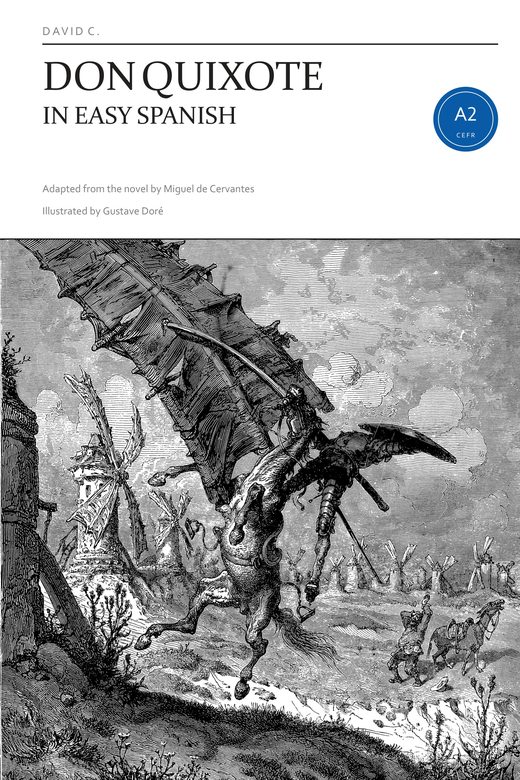
Don Quixote in Easy Spanish: the whole novel retold in Spanish you can actually read, in 58 short episodes, with the hard words glossed in the margin. It is where every Don Quixote sentence on this page comes from.
In EPUB and PDF with its audiobook, and a second novel in the same Spanish. See the books.
Where the course teaches this
2 lessons build it up, each one inside a chapter of the story rather than in the abstract. Free to read, with the vocabulary, the audio and the exercises.
- The present tense of -AR verbsLesson 3A day in the village
- Question wordsLesson 11One July morning
Next to this one
The points that sit closest to this one, and that a student usually meets around the same time.