Spanish grammar · A2 to B2 · Updated
Hay, está or es: describing a place in Spanish
Hay says that something exists and introduces it for the first time: hay una venta. Está says where a thing already known about is: la venta está allí. Es says what the place is, as a fact that does not change. Pulling those three apart fixes most of the mistakes in a description.
The short answer
Hay brings something new into the scene and is followed by un, una, dos, mucho or nothing at all: hay un banco. Está says where something you both already know about is: el banco está allí. Es identifies what a thing is. Hay never takes el, la, mi or este.
How to remember it
What comes after the verb decides which verb it is
| Hay | followed by un, una, dos, mucho, algo, nada, or a bare noun | Hay un banco |
|---|---|---|
| Está | followed by el, la, mi, este, or a name | El banco está allí |
| Es | says what the thing is, not where | Es un banco |
| Hay never changes | one form for one thing or a hundred | Hay dos bancos |
| Events take ser | a party happens, it is not located | La fiesta es aquí |
The forms
Which verb, and what follows it
| verb | what follows | example |
|---|---|---|
| hay | un, una, dos, mucho, nada | hay un problema |
| hay | a bare plural noun | hay problemas |
| está | el, la, los, las | el problema está aquí |
| está | mi, tu, su, este, ese | mi coche está fuera |
| está | a proper name | Madrid está en España |
| es | what the thing is | Madrid es una ciudad |
20 sentences that show the difference
Everyday Spanish, the kind you would actually say. The label under each one says which part of the rule it shows.
Hay un banco en la esquina.
There is a bank on the corner.
New in the scene
El banco está en la esquina.
The bank is on the corner.
Already known
Hay dos sillas.
There are two chairs.
Hay never goes plural
Las sillas están en la cocina.
The chairs are in the kitchen.
Está does go plural
Hay mucha gente.
There are a lot of people.
Mucho after hay
No hay nadie.
There is nobody.
Nadie after hay
Hay pan.
There is bread.
A bare noun
El pan está en la mesa.
The bread is on the table.
El, so está
Mi coche está fuera.
My car is outside.
Mi, so está
Madrid está en España.
Madrid is in Spain.
A name, so está
Madrid es la capital.
Madrid is the capital.
What it is, so es
Es un banco muy antiguo.
It is a very old bank.
What it is
La fiesta es en mi casa.
The party is at my place.
An event, so ser
La reunión es a las cinco.
The meeting is at five.
An event
Había mucha gente.
There were a lot of people.
Hay in the imperfect
Hubo un accidente.
There was an accident.
Hay in the preterite
Habrá tormenta.
There will be a storm.
Hay in the future
¿Hay wifi?
Is there wifi?
A question
¿Dónde está el baño?
Where is the toilet?
Dónde takes está
Hay que salir pronto.
We need to leave soon.
Hay que plus infinitive
Where English gets in the way
English covers the first two jobs with one construction, there is and there are, and it does change for number. Spanish splits the job in two and then refuses to change the number of the verb that does half of it, which is exactly backwards from what an English speaker expects. Worse, English word order hides the distinction: there was a table in the room and the table was in the room look like the same sentence with the same verb, so nothing in the English pushes you to choose. The habit to build is to ask, before you open your mouth, whether the thing has been mentioned yet. If it has not, hay. If it has, estar. There is a third English trap here as well, the verb to be covering ser and estar: it was the sea is era, identity, while the galleys were on the water is estaban, location. English gives you one word for both and Spanish will not let you get away with it.
The mistake to avoid
One. ✗ Habían muchas galeras. ✓ Había muchas galeras. Hay and había never take a plural. Two. ✗ Hay la cabeza en la mesa. ✓ La cabeza está en la mesa. A definite article means estar. Three. ✗ El mar era muy grande que las lagunas. ✓ El mar era mucho mayor que las lagunas. Before a comparative it is mucho. Four. ✗ más mayor, ✗ más mejor. Mayor and mejor are already comparatives. Five. Using estar to identify. ✗ Estaba el mar when you mean it was the sea. ✓ Era el mar.
The cases that break the rule
Hay dos sillas
Hay has one form for any number of things. Han dos sillas does not exist, and habían muchos in the past is a mistake even native speakers make. It is había, always.
Hay el banco
Never. Hay refuses el, la, mi, tu, este and proper names, because those all announce something already known, and hay is for what is new.
La fiesta es en mi casa
An event takes ser, not estar, even though the sentence looks like a location. If you could say "takes place", it is ser. La silla está en mi casa is a thing, so estar.
Hay que salir
A completely different use: hay que plus infinitive means "one must". It has no subject at all and is how Spanish gives an impersonal instruction.
Está claro
Estar plus adjective is a state, and ser plus adjective is a quality. Está claro is it is obvious, es claro is it is a clear colour or a clear argument.
Habían muchos
Very common in speech and still not standard. In the past it is había muchos, singular, because muchos is the object and not the subject.
Hay vs está vs es exercises
8 sentences to fill in. Type your answer and check it, or read them straight through with the answers showing. Accents count here, the way they count in the language.
-
___ un banco en la esquina.
There is a bank on the corner.
Hay · Un after the verb, so hay. It is being brought into the scene for the first time.
-
El banco ___ en la esquina.
The bank is on the corner.
está · El after the article means we both know the bank, so está.
-
En la nevera ___ dos botellas de agua.
There are two bottles of water in the fridge.
hay · Hay never goes plural, however many bottles there are.
-
Mis llaves ___ encima de la mesa.
My keys are on the table.
están · Mis announces something known, so están, and it does agree in the plural.
-
Madrid ___ en el centro de España.
Madrid is in the centre of Spain.
está · A proper name, so estar. Madrid es la capital would be what it is.
-
La fiesta ___ en casa de Ana.
The party is at Ana's place.
es · An event takes ser, because a party happens rather than sits somewhere.
-
Ayer ___ mucha gente en el mercado.
There were a lot of people at the market yesterday.
había · The imperfect of hay, and it stays singular. Habían is a very common mistake.
-
___ que salir antes de las ocho.
We need to leave before eight.
Hay · Hay que plus infinitive: an impersonal instruction with no subject at all.
More exercises, from Don Quixote
8 more, these ones straight out of the course: the inn, the windmills, Rocinante and the road. Same rule, older Spanish.
-
En el campo ___ treinta molinos.
There are thirty windmills in the field.
hay · Hay says something exists. It never changes for number: hay un molino, hay treinta molinos.
-
La venta ___ en el camino de Puerto Lápice.
The inn is on the road to Puerto Lapice.
está · Está, because the inn is a known thing and this says where it is.
-
___ una venta cerca de aquí.
There is an inn near here.
Hay · Hay introduces something new. Once it is introduced, it switches to está.
-
¿Dónde ___ Sancho?
Where is Sancho?
está · A named person is already known, so never hay. Dónde hay Sancho is not Spanish.
-
Esto ___ una ínsula, no un pueblo.
This is an island, not a village.
es · Es identifies what something is. Está would say where it is, and hay that it exists.
-
No ___ nadie en la venta.
There is nobody at the inn.
hay · Hay with nadie, nada and ningún. No está nadie is possible but says something narrower.
-
El vino ___ en la mesa.
The wine is on the table.
está · The wine is already known, so está. Hay vino en la mesa would be announcing that wine exists.
-
Aquel hombre ___ el ventero.
That man is the innkeeper.
es · Saying who somebody is takes ser, always.
Common questions
What is the difference between hay and está?
Hay introduces something for the first time and takes an indefinite article or none at all: hay una venta. Está locates something already known and takes the definite article: la venta está allí.
Does hay ever go plural?
No. Hay covers singular and plural alike: hay un libro and hay muchos libros. The other tenses behave the same way, so había, hubo and habrá stay singular however many things there are.
When do I use es for a place?
For what the place is, as a stable fact: es una venta pequeña. Also for where an event happens: la boda es en Barcelona, but Barcelona está en Cataluña.
How do I say there was and there will be?
All from haber, and always singular: había for a scene that was there, hubo for something that happened, habrá for the future, ha habido for the perfect. Hubo un accidente, había mucha gente. The plural habían is very common in speech and still considered a mistake.
Why is it hay un libro and not está un libro?
Because hay introduces something the listener does not know about yet, and está places something you have both already mentioned. Hay un libro en la mesa tells you it exists. El libro está en la mesa tells you where the one you know about is.
Can I say hay el libro?
No, and this is the fastest test between the two. Hay never takes el, la, mi or este: it goes with un, a number, or nothing at all. The moment the noun is definite you need está.
How do I ask where something is?
¿Dónde está el baño? if you assume there is one, which is the normal question. ¿Dónde hay un baño? asks where you might find any at all, and it is what you say in the street rather than in a building.
What is the difference between es aquí and está aquí?
Está aquí says a thing is in this place. Es aquí says an event happens in this place, and it is also what you say when you have found the right door: es aquí, this is the one. Same three letters of difference as la boda es en Barcelona.
The things to remember
- Look at the word after the verb. Un, una, dos, mucho, nada mean hay; el, la, mi, este mean está.
- Hay never changes for number. One chair or fifty, it is hay.
- Hay introduces, está locates, es identifies.
- Events take ser: la fiesta es aquí. Things take estar: la silla está aquí.
- Hay que plus infinitive is a separate structure meaning "one must".
The same rule in Don Quixote
Real lines from the course, not invented examples. Each one is the sentence the lesson uses to introduce the point.
En una sala apartada había una mesa de jaspe.
In a private room there was a jasper table.
La maleta estaba cerrada con una cadena.
The bag was locked shut with a chain.
The book this comes from
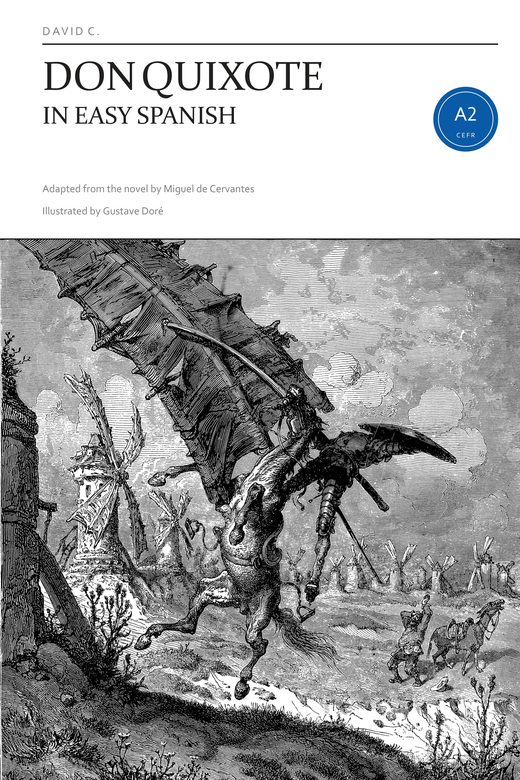
Don Quixote in Easy Spanish: the whole novel retold in Spanish you can actually read, in 58 short episodes, with the hard words glossed in the margin. It is where every Don Quixote sentence on this page comes from.
In EPUB and PDF, with a second novel in the same Spanish. See the books.
Where the course teaches this
2 lessons build it up, each one inside a chapter of the story rather than in the abstract. Free to read, with the vocabulary, the audio and the exercises.
- Hay, está and es for describing a placeLesson 84Arriving in Barcelona
- Describing a place, and estar plus a participleLesson 39The suitcase in Sierra Morena
Next to this one
The points that sit closest to this one, and that a student usually meets around the same time.