Level A2 · Chapter 39
The suitcase in Sierra Morena
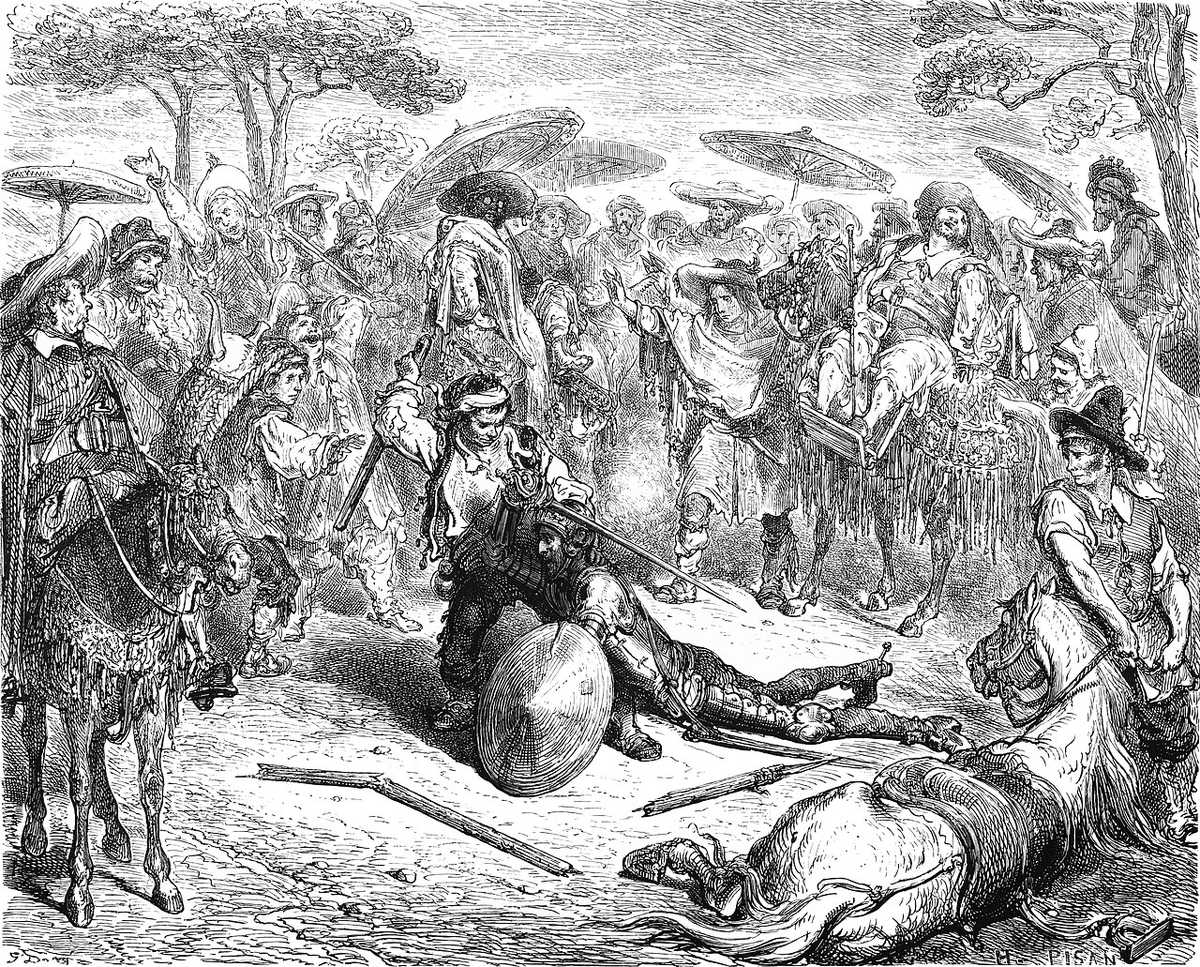
Don Quixote and Sancho hide in the mountains. Among the rocks they find a cushion, a broken suitcase full of gold and a notebook full of sad verses.
What you will learn
- Describe a landscape: what is in it and what it is like.
- Say what state a thing is in with estar plus a past participle.
- Make the participle agree with the word it describes.
Before you read
This lesson describes a place. Watch for the verb estar followed by a word ending in -ado or -ido. That pairing tells you the state a thing is in, the result of something that happened to it earlier. Count how many you find as you read, and notice that the ending changes with the noun it follows.The story in easy Spanish
Don Quijote y Sancho subieron a Sierra Morena aquella tarde.
Don Quixote and Sancho climbed up into Sierra Morena that afternoon.
Querían esconderse de la Santa Hermandad durante unos días.
They wanted to hide from the Holy Brotherhood for a few days.
La sierra estaba llena de peñas altas y de riscos pardos.
The range was full of high crags and brown cliffs.
Entre las piedras crecían alcornoques viejos y matas espesas.
Among the rocks grew old cork oaks and thick bushes.
Un arroyo pequeño bajaba por el fondo del valle.
A small stream ran down along the floor of the valley.
No había camino ni senda. Todo estaba escondido y cerrado.
There was no road and no path. Everything was hidden and closed in.
A don Quijote se le alegró el corazón en aquel sitio.
Don Quixote’s heart lifted in that place.
Un lugar así estaba hecho para las aventuras de sus libros.
A place like that was made for the adventures in his books.
Sancho solo pensaba en la comida que llevaba en el costal.
Sancho was only thinking about the food he had in his sack.
De pronto vio a su amo parado delante de un bulto.
Suddenly he saw his master stopped in front of a shape on the ground.
En el suelo había un cojín y una maleta de cuero.
On the ground lay a cushion and a leather travelling bag.
Los dos estaban medio podridos y cubiertos de barro seco.
Both of them were half rotten and covered in dry mud.
La maleta estaba cerrada con una cadena y un candado.
The bag was locked shut with a chain and a padlock.
Pero el cuero estaba roto por un lado y se veía todo.
But the leather was torn down one side and everything showed through.
Dentro había cuatro camisas finas y otras cosas de lienzo.
Inside there were four fine shirts and other linen things.
En un pañuelo estaba escondido un buen montón de escudos.
Wrapped up in a handkerchief was hidden a good pile of gold coins.
«Bendito sea el cielo», dijo Sancho con los ojos abiertos.
"Heaven be praised," said Sancho with his eyes wide open.
Don Quijote le dejó el dinero y se quedó un librillo.
Don Quixote let him keep the money and took a small notebook.
El cuaderno estaba escrito con muy buena letra.
The notebook was written in a very good hand.
La primera hoja estaba llena de versos tristes de amor.
The first page was full of sad love poems.
La segunda era una carta para una mujer llamada Fili.
The second was a letter to a woman called Fili.
«El dueño de esto está enamorado y está desesperado.»
"The owner of this is in love and in despair."
Los dos siguieron por la sierra buscando a aquel hombre.
The two of them went on through the mountains looking for that man.
Cerca del arroyo encontraron una mula caída entre las piedras.
Near the stream they found a mule lying dead among the stones.
La mula estaba ensillada, pero el dueño no aparecía.
The mule was still saddled, but the owner was nowhere to be seen.
Un cabrero viejo bajó de la montaña con sus cabras.
An old goatherd came down the mountain with his goats.
Dijo que la mula estaba allí desde hacía seis meses.
He said the mule had been there for six months.
De pronto apareció un joven roto y descalzo entre las matas.
Suddenly a young man appeared among the bushes, in rags and barefoot.
Tenía la barba negra y la ropa hecha pedazos.
He had a black beard and his clothes were torn to pieces.
Don Quijote bajó del caballo y lo abrazó como a un amigo.
Don Quixote got off his horse and embraced him like a friend.
Vocabulary
The mountain landscape
- la sierra
- the mountain range
- la peña
- the crag
- el risco
- the steep rock
- el valle
- the valley
- el arroyo
- the stream
- el alcornoque
- the cork oak
- la mata
- the bush
- la senda
- the path
- la cueva
- the cave
What it is like and how it is
- alto
- high, tall
- áspero
- rough, harsh
- espeso
- thick, dense
- pardo
- brown, dull brown
- escondido
- hidden
- roto
- broken, torn
- podrido
- rotten
- cubierto
- covered
The find
- la maleta
- the travelling bag
- el cojín
- the cushion
- la cadena
- the chain
- el candado
- the padlock
- la camisa
- the shirt
- el escudo
- the gold coin
- el librillo
- the little notebook
- el dueño
- the owner
Describing a place, and estar plus a participle
La maleta estaba cerrada con una cadena.
El cuero estaba roto por un lado.
En un pañuelo estaba escondido un montón de escudos.
This lesson does two jobs at once, because the mountains are the first real landscape in the book and you need the words for it.
Part one: the three verbs of description
Spanish splits between three verbs what English does mostly with there is and to be.
| verb | job | example |
|---|---|---|
| hay | something exists there, first mention | Hay un arroyo en el valle. |
| ser | a permanent quality | La sierra es áspera. |
| estar | location, and current state | El arroyo está seco. |
Rule of thumb: hay introduces a thing, estar then places it. Hay una cueva en la peña. La cueva está detrás del alcornoque.
Part two: estar plus a participle
The participle is the -ed form of the verb: cerrar gives cerrado, esconder gives escondido, romper gives the irregular roto. You met it in lesson 18 and again in lesson 37 with he cerrado, I have closed.
Put it after estar and it stops being a tense and becomes a description. It names the state a thing is in now, as the result of something that happened to it before. Somebody closed the bag, and so the bag is closed.
| the event | the resulting state |
|---|---|
| Alguien cerró la maleta. | La maleta está cerrada. |
| Alguien escondió el dinero. | El dinero está escondido. |
| Alguien rompió el cuero. | El cuero está roto. |
| La lluvia cubrió el cojín de barro. | El cojín está cubierto de barro. |
The agreement is the part that trips people up
After haber the participle never changes: he cerrado la maleta, never he cerrada. After estar it always changes, exactly like an adjective, because that is what it has become.
| masculine | feminine | |
|---|---|---|
| singular | el libro está abierto | la puerta está abierta |
| plural | los libros están abiertos | las puertas están abiertas |
The eight irregulars worth memorising now
| verb | participle | with estar |
|---|---|---|
| romper | roto | La silla está rota. |
| abrir | abierto | La maleta está abierta. |
| escribir | escrito | El libro está escrito. |
| hacer | hecho | La comida está hecha. |
| poner | puesto | La mesa está puesta. |
| ver | visto | Eso ya está visto. |
| decir | dicho | Todo está dicho. |
| cubrir | cubierto | Las peñas están cubiertas de nieve. |
Words for the land
Cervantes describes Sierra Morena with a handful of nouns you will meet again in every Spanish landscape: la peña a crag, el risco a steep rock face, el valle the valley, el arroyo a stream, la senda a footpath as opposed to el camino a road, la mata a low bush, la cueva a cave. Two more are worth having because they are everywhere in Spain: la aspereza, rough broken ground, and la ladera, a hillside.
Sierra Morena, the hiding place of Spain
Sierra Morena is the long dark wall of hills that separates the plain of La Mancha from Andalusia. The name means the dark range, and from a distance the cork oaks and holm oaks really do make it look almost black against the pale wheat country below.
In 1605 a single royal road crossed it, through the pass at Despeñaperros, and everything to either side was broken ground with no path at all. That made it the standard hiding place of the Spanish south. Bandits worked the pass, army deserters lived in the caves, and anyone with a reason to disappear went up into the asperezas and stayed there. The Holy Brotherhood, the rural police force that Sancho is so afraid of, did not follow people in. This is exactly why Sancho steers his master into the hills after the business with the galley slaves.
It also matters for the book. Up to this point Cervantes has given us roads, inns, a windmill and flat open country described in a line or two. Sierra Morena is the first place in the novel that gets a real landscape: crags, cork oaks, a stream, a dead mule rotting in a gully, a man leaping from rock to rock. The scenery slows down and starts to matter. Almost everything for the next hundred pages happens here, and the characters who arrive one by one, Cardenio, Dorotea, the priest and the barber in disguise, all end up tangled together in the same few valleys.
The cork oak, el alcornoque, is the tree of the place. Its bark is stripped every nine years and it is still the backbone of a whole industry in southern Spain and Portugal. Cervantes puts the mad young man asleep inside the hollow trunk of one. As an insult, incidentally, alcornoque means blockhead, which is worth knowing before somebody calls you one.
Cervantes in the original · «Apostaré que está mirando la mula de alquiler que…»
Apostaré que está mirando la mula de alquiler que está muerta en esa hondonada.
I will bet you are looking at the hired mule that is lying dead in that hollow.
The goatherd says this the moment he comes down the hill, and it is the first thing we hear from him. He does not greet anyone. He bets. Cervantes gives country people this kind of speech throughout the book: direct, concrete, faintly amused at the strangers. The line happens to carry both halves of this lesson. Está mirando is the state of the person, está muerta is the state of the mule, and the feminine -a on muerta is doing exactly the agreement work you have just practised. The last word is the landscape one. A hondonada is a dip in the ground, a hollow between rises, and it is the sort of word you only use if you have spent your life walking that ground. The mule has been rotting in it for six months, which is how long the mad young man has been living up here, and the goatherd measures time the same way he measures distance: by what he has passed on his way.