Level A2 · Chapter 38
Ginés de Pasamonte and the stones
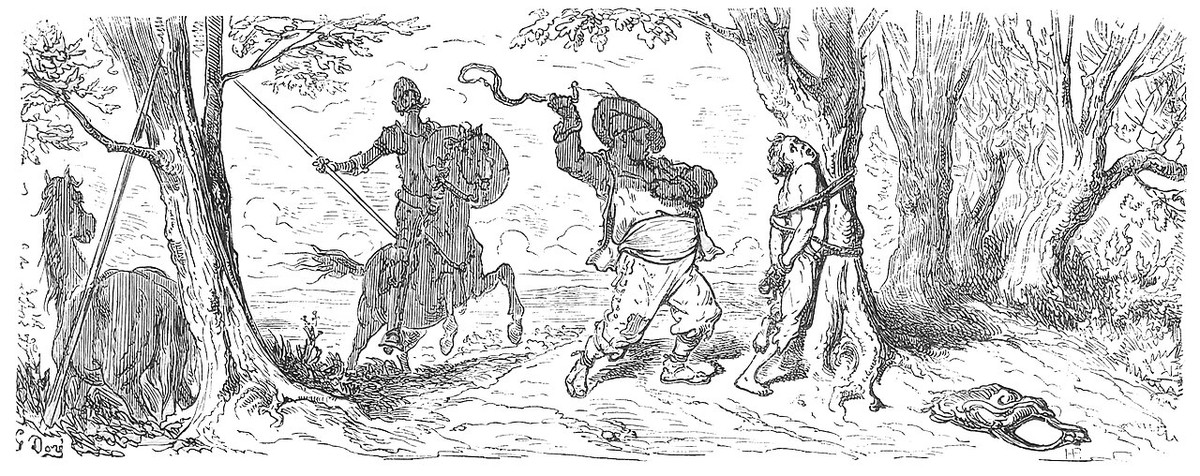
Don Quixote breaks the chain and sets the twelve prisoners free. He asks them for one thing in return, and they pay him for it with a rain of stones.
What you will learn
- Put two pronouns together in one sentence: se lo, me la, te los.
- Change le and les into se in front of lo, la, los, las.
- Attach both pronouns to the end of an infinitive or an imperative.
Before you read
In this lesson everybody is giving something to somebody or taking it away from them, so the pronouns come in pairs. Watch for se la pidió, se lo dije, nos los puede quitar, contárselo. Two rules govern every one of them: the person always comes first, and the pair never splits.The story in easy Spanish
El último preso de la cadena llevaba más hierros que los demás.
The last prisoner in the chain wore more irons than the rest.
Se llamaba Ginés de Pasamonte y tenía muchos delitos.
His name was Ginés de Pasamonte and he had many crimes behind him.
«Estoy escribiendo mi vida en un libro», dijo.
"I am writing my life in a book," he said.
«Es tan bueno que no puedo contároslo entero aquí.»
"It is so good that I cannot tell you all of it here."
«¿Y está acabado ese libro?», preguntó don Quijote.
"And is that book finished?" Don Quixote asked.
«¿Cómo va a estarlo, si mi vida no está acabada?»
"How can it be, when my life is not finished?"
Don Quijote pidió a los guardias la libertad de los presos.
Don Quixote asked the guards for the prisoners’ freedom.
Se la pidió con buenas palabras y se la pidió dos veces.
He asked them for it politely, and he asked twice.
«Vaya vuestra merced por su camino», contestó el comisario.
"Go on your way, sir," the officer replied.
«Son presos del rey y nadie nos los puede quitar.»
"They are the king’s prisoners and nobody can take them from us."
El caballero no esperó más y atacó al comisario.
The knight waited no longer and attacked the officer.
Lo tiró al suelo antes de decírselo otra vez.
He knocked him to the ground before saying it to him again.
Los presos rompieron la cadena y los guardias huyeron.
The prisoners broke the chain and the guards fled.
Sancho lo miraba todo y no se lo creía.
Sancho watched it all and could not believe it.
Don Quijote reunió a los galeotes y les pidió una cosa.
Don Quixote gathered the galley slaves together and asked one thing of them.
Tenían que ir al Toboso y contárselo todo a Dulcinea.
They had to go to El Toboso and tell Dulcinea the whole story.
«Eso es imposible, señor», dijo Ginés de Pasamonte.
"That is impossible, sir," said Ginés de Pasamonte.
«Nos buscan por los caminos y no podemos ir juntos.»
"They are hunting us along the roads and we cannot travel together."
«Pues iréis vos solo», contestó don Quijote muy enfadado.
"Then you will go alone," Don Quixote answered, very angry.
Ginés hizo una señal a los otros presos.
Ginés made a sign to the other prisoners.
Entonces empezó una lluvia de piedras sobre el caballero.
Then a rain of stones began to fall on the knight.
Rocinante cayó al suelo y su amo cayó detrás.
Rocinante fell to the ground and his master fell after him.
Un galeote le quitó la bacía y se la rompió en las espaldas.
One galley slave took his basin and broke it over his back.
A Sancho le quitaron el gabán y lo dejaron en camisa.
They took Sancho’s coat off him and left him in his shirt.
«Yo se lo dije antes, señor», murmuró el escudero.
"I told you so before, sir," the squire muttered.
«Aquella gente no era de fiar y no me hizo caso.»
"Those people were not to be trusted and you paid me no heed."
Vocabulary
The chain breaks
- el comisario
- the officer in charge
- los hierros
- the irons
- la libertad
- the freedom
- soltar
- to let go, to set free
- huir
- to flee
- la señal
- the sign, the signal
- la piedra
- the stone
Verbs of giving and taking
- dar
- to give
- quitar
- to take away
- pedir
- to ask for
- contar
- to tell
- decir
- to say, to tell
- prestar
- to lend
- romper
- to break
The pronoun pairs
- se lo
- it to him, to her, to them
- se la
- it to him, to her, to them
- se los
- them to him, to her, to them
- me lo
- it to me
- te la
- it to you
- nos los
- them to us
- os las
- them to you all
Two pronouns together
Se la pidió con buenas palabras.
Nadie nos los puede quitar.
Yo se lo dije antes, señor.
Spanish uses object pronouns far more than English does, and once you have two of them in the same sentence they behave like a single block. Learn the block and this stops being difficult.
Rule one: the person comes first
The indirect object, the person who receives, always goes in front of the direct object, the thing received. There is no choice and no exception.
| first: the person | second: the thing |
|---|---|
| me, te, se, nos, os | lo, la, los, las |
So me lo dio, he gave it to me, and never the other way round. English puts the thing first and the person last, with a preposition: he gave it to me. Spanish reverses the order and drops the preposition entirely.
Rule two: le and les turn into se
Spanish refuses to say two l pronouns in a row. Le lo and les las do not exist. Whenever le or les meets lo, la, los, las, it becomes se.
| full sentence | wrong | right |
|---|---|---|
| Pidió la libertad a los guardias. | Les la pidió. | Se la pidió. |
| Quitaron el gabán a Sancho. | Le lo quitaron. | Se lo quitaron. |
| Contó la aventura a Dulcinea. | Le la contó. | Se la contó. |
This se has nothing to do with the reflexive se of se llama. It is a disguise that le and les put on, and it is deliberately vague: se lo dije can mean I said it to him, to her, to you or to them. When the vagueness matters, Spanish adds the person again at the end: se lo dije a Sancho.
Rule three: the pair never splits
Both pronouns travel together, in front of the conjugated verb, with the negative outside them.
| Spanish | English |
|---|---|
| Se lo dije antes. | I told him so before. |
| No se lo dije antes. | I did not tell him so before. |
| Nunca se lo he dicho. | I have never told him so. |
Where the pair goes with two verbs
With an infinitive or a gerund you may put the pair in front of the first verb or stick it onto the end of the second. Both are correct and both are common.
| in front | attached |
|---|---|
| Nadie nos los puede quitar. | Nadie puede quitárnoslos. |
| Se lo voy a contar. | Voy a contárselo. |
| Te la estoy pidiendo. | Estoy pidiéndotela. |
With an affirmative command there is no choice: the pair is attached to the end. Cuéntaselo. Dámela. With a negative command it goes in front. No se lo cuentes.
The accent that appears from nowhere
Attaching two pronouns adds two syllables, which moves the stress. Spanish keeps the stress where it was by writing an accent: contar becomes contárselo, decir becomes decírselo, cuenta becomes cuéntasela. If you attach two pronouns, expect an accent almost every time.
The Holy Brotherhood
The moment the guards run away, Sancho stops worrying about the fight and starts worrying about something else entirely: the Santa Hermandad, the Holy Brotherhood. Foreign readers usually skip the name. Cervantes expected his readers to feel a small chill at it.
The Brotherhood was a rural police force paid for by the towns and reorganised by the Catholic Monarchs in 1476. Cities had their own watch, but the open road belonged to nobody, and bandits worked it freely. The Brotherhood existed to hunt them: mounted archers riding out from town to town, funded by a local tax, with authority to arrest anywhere in Castile.
What made it feared was that it judged as well as arrested. It had its own courts, its own summary procedure and its own punishment. A man convicted of robbery on the highway was tied to a post in open country and shot to death with arrows. The phrase Cervantes uses, a campana herida, means the alarm bell being struck to call the men out.
So when Don Quixote frees twelve of the king’s convicts, he has not played a prank. He has committed a serious crime against royal justice in front of four witnesses who are now riding off to report it. Sancho understands this at once, which is why he begs his master to hide in the mountains, and it is the reason the next stretch of the book takes place in the wilds of Sierra Morena.
Cervantes in the original · «Vuestra merced llegue y se lo pregunte a ellos…»
Vuestra merced llegue y se lo pregunte a ellos mesmos, que ellos lo dirán si quisieren.
Let your worship come over and ask them about it themselves, and they will tell you if they choose to.
A guard tells Don Quixote to go and ask the convicts himself, and in doing so hands you the whole grammar of this lesson in five words. Se lo pregunte: the se is the men in the chain, the lo is the question, person first and thing second, exactly as the rule says. Because se on its own is famously vague, Cervantes does what Spanish still does today and names the person again at the end, a ellos mesmos, which is not a repetition but a repair. Two small points of old spelling: mesmos is the seventeenth century form of mismos, and vuestra merced, your worship, is the courtesy title that wore down over the following century into the modern usted. The guard is being polite and dismissive at the same time, which is the tone of every official in this chapter.