Level A2 · Chapter 37
The king’s prisoners
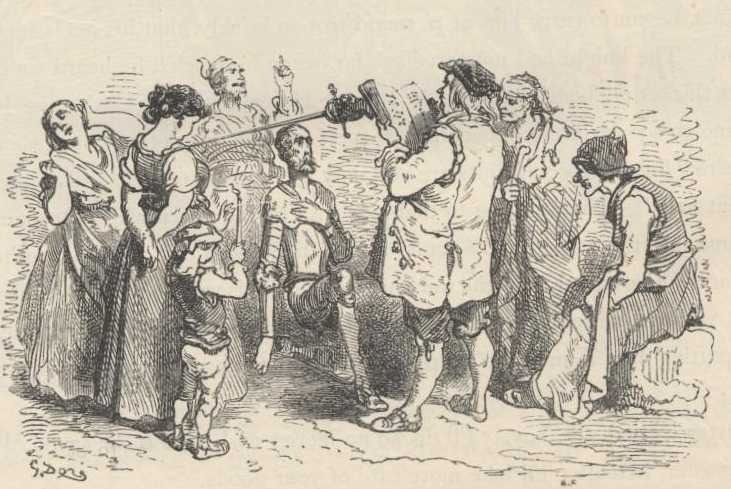
Twelve men chained together by the neck are marched off to the galleys. Don Quixote stops them and asks each one what he has done to end up like this.
What you will learn
- Say what you have done today with the present perfect.
- Form the participle of regular verbs and of the eight irregular ones.
- Tell he hablado apart from hablé.
Before you read
Every prisoner tells his story in a tense you have not met yet. He estado, ha cantado, han hecho. As you read, count how many times a form of haber is followed by a second word ending in -ado or -ido. There are more than a dozen. That pair of words is the whole lesson.The story in easy Spanish
Por el camino venían doce hombres atados por el cuello.
Along the road came twelve men chained together by the neck.
Una cadena larga de hierro los unía a todos.
One long iron chain joined them all together.
Con ellos iban cuatro guardias con espadas y escopetas.
Four guards walked with them, carrying swords and guns.
«Es gente forzada del rey», explicó Sancho.
"They are the king’s forced men," Sancho explained.
«Van a las galeras a remar durante muchos años.»
"They are going to the galleys to row for many years."
Don Quijote se acercó y preguntó a cada uno por sus culpas.
Don Quixote came closer and asked each one about his offences.
Quería oírlo de su boca y no del papel de los guardias.
He wanted to hear it from their own mouths, not from the guards’ paper.
«¿Por qué vas así, hermano?», preguntó al primero.
"Why are you going along like this, brother?" he asked the first man.
«Porque he estado enamorado», contestó el mozo.
"Because I have been in love," the young man answered.
«He querido demasiado una cesta de ropa blanca.»
"I loved a basket of white linen far too much."
El segundo iba callado y muy triste.
The second man walked along silent and very sad.
«Este ha cantado», dijeron los otros presos.
"This one has sung," said the other prisoners.
«Ha confesado en el tormento que era ladrón de bestias.»
"He confessed under torture that he was a cattle thief."
«Yo voy por diez ducados», dijo el tercero llorando.
"I am going for the sake of ten ducats," said the third, weeping.
«Nunca los he tenido y por eso me llevan.»
"I have never had them, and that is why they are taking me."
«He pedido ayuda a mucha gente y nadie me la ha dado.»
"I have asked plenty of people for help and nobody has given me any."
El cuarto era un viejo con la barba blanca hasta el pecho.
The fourth was an old man with a white beard down to his chest.
No contestó nada y se puso a llorar.
He answered nothing and began to cry.
Sancho sacó un real del pecho y le dio una limosna.
Sancho pulled a coin out of his shirt and gave him alms.
Don Quijote los escuchó a todos con mucha atención.
Don Quixote listened to them all very carefully.
Después miró a los guardias con la cara muy seria.
Then he looked at the guards with a very grave face.
«Estos hombres han hecho cosas malas, pero van a la fuerza.»
"These men have done bad things, but they are going by force."
«Yo he salido al mundo para ayudar a los que sufren.»
"I have come out into the world to help those who suffer."
«Nunca he visto una cadena tan triste como esta.»
"I have never seen a chain as sad as this one."
Vocabulary
The chain and its men
- el galeote
- the galley slave
- la galera
- the galley
- la cadena
- the chain
- el hierro
- the iron
- el preso
- the prisoner
- el guardia
- the guard
- remar
- to row
Crime and punishment
- la culpa
- the offence, the blame
- el delito
- the crime
- el ladrón
- the thief
- confesar
- to confess
- el tormento
- the torture
- condenar
- to sentence
- la limosna
- the alms
The eight irregular participles
- hacer, hecho
- to do, done
- decir, dicho
- to say, said
- ver, visto
- to see, seen
- escribir, escrito
- to write, written
- poner, puesto
- to put, put
- volver, vuelto
- to return, returned
- abrir, abierto
- to open, opened
- romper, roto
- to break, broken
The present perfect
Porque he estado enamorado.
Este preso ha cantado en el tormento.
Estos hombres han hecho cosas malas.
Spanish builds this tense exactly as English does: an auxiliary verb plus a past participle. He hablado is I have spoken, word for word. This is one of the few places where the two languages line up almost perfectly, so learn the machinery once and it will serve you for the rest of the course.
The auxiliary is always haber
Never tener. Tener means to own something. Haber exists only to build this tense and its relatives, and you already know one of its forms: the hay of hay una venta.
| person | haber | example | English |
|---|---|---|---|
| yo | he | He pedido ayuda. | I have asked for help. |
| tú | has | ¿Qué has hecho? | What have you done? |
| él, ella, usted | ha | Ha cantado en el tormento. | He has sung under torture. |
| nosotros | hemos | Hemos visto la cadena. | We have seen the chain. |
| vosotros | habéis | Me habéis dicho la verdad. | You have told me the truth. |
| ellos, ustedes | han | Han hecho cosas malas. | They have done bad things. |
The participle never moves
In Spanish the participle in this tense is frozen. Ella ha hablado, ellos han hablado: the ending is -o and stays -o, whoever is speaking. Do not make it agree with the subject.
| verb type | participle | example |
|---|---|---|
| -ar | -ado | hablar, hablado |
| -er | -ido | comer, comido |
| -ir | -ido | salir, salido |
The eight you have to memorise
They are the commonest verbs in the language, so you will meet them constantly. Learn them as a chant: hecho, dicho, visto, escrito, puesto, vuelto, abierto, roto.
| infinitive | participle | English |
|---|---|---|
| hacer | hecho | done, made |
| decir | dicho | said |
| ver | visto | seen |
| escribir | escrito | written |
| poner | puesto | put |
| volver | vuelto | returned |
| abrir | abierto | opened |
| romper | roto | broken |
When to use it instead of the preterite
In Spain the rule is about the stretch of time you are standing in. If the period is still open, use this tense. If the period is closed and gone, use the preterite you learned in lesson 15.
| still open | closed |
|---|---|
| Hoy he visto una cadena. | Ayer vi una cadena. |
| Esta semana he remado mucho. | La semana pasada remé mucho. |
| Este año han condenado a diez hombres. | En 1604 condenaron a diez hombres. |
| Nunca he estado en galeras. | Estuve en galeras cuatro años. |
The markers that pull this tense are hoy, esta mañana, esta semana, este año, ya, todavía no, nunca, alguna vez and siempre. The ones that pull the preterite are ayer, anoche, el año pasado and any date.
Nothing goes between the two words
English happily says I have never seen or I have not seen. Spanish does not split the pair. The no goes in front of haber, and so does the pronoun: no lo he visto, nunca he visto, me lo ha dado.
The king’s galleys
A galley was a long, low warship driven by oars, and Spain kept dozens of them in the Mediterranean to fight the Ottoman fleet and the corsairs of North Africa. Sails were useless in a calm and useless for ramming, so the empire needed muscle, and it found the muscle in its own courts.
Each oar was worked by four or five men chained to the bench. They ate ship’s biscuit and drank water cut with vinegar, they slept where they rowed, and an overseer walked the gangway with a whip. A sentence of three years was common, six for a serious crime, ten for a man like Ginés de Pasamonte, which the guard in this chapter calls a civil death.
This was not prison as we understand it. It was forced labour with a term attached, and the crown treated convicts as a resource. Judges were told to send able bodied men to the oar rather than to a cell, and by 1600 the shortage of rowers was so bad that sentences were routinely extended when a ship put to sea short handed.
Cervantes knew these ships from the inside. He fought aboard the galley Marquesa at Lepanto in 1571, took three shots and lost the use of his left hand, and was later held five years as a captive in Algiers. When he puts twelve chained men on a road in La Mancha, he is not inventing a picturesque detail. He is describing a machine he had lived in.
Cervantes in the original · «De todo cuanto me habéis dicho, hermanos carísimos…»
De todo cuanto me habéis dicho, hermanos carísimos, he sacado en limpio que, aunque os han castigado por vuestras culpas, las penas que vais a padecer no os dan mucho gusto.
From everything you have told me, dearest brothers, I have gathered that, although you have been punished for your offences, the penalties you are going to suffer do not please you much.
Three present perfects in one sentence: habéis dicho, he sacado, han castigado. That is not decoration. Don Quixote is summing up a conversation that has only just finished, so the tense that keeps the past touching the present is the natural one, exactly as it would be in English. Notice too the courtesy and the irony sitting together. He calls twelve convicts hermanos carísimos, dearest brothers, addressing them as an equal would, and then says their punishments no os dan mucho gusto, do not please them much, which is the mildest possible way of saying they are being marched off to years at the oar. The understatement is deliberate, and it is the sentence that sets up everything he does next.