Spanish grammar · A1 to A2 · Updated
Spanish object pronouns: lo, la, le, se lo
Lo, la, los and las stand for the thing. Me, te, le, nos, os and les stand for the person it is done to. When both turn up, the person goes first: te lo doy and never lo te doy. And le in front of lo becomes se lo, which is why se lo dije can mean I said it to him, to her, or to them.
The short answer
Spanish object pronouns go in front of the conjugated verb, not after it: lo veo, I see it. Direct objects are lo, la, los, las and indirect ones are le and les. When both turn up together the indirect goes first, and le turns into se in front of lo: se lo doy.
How to remember it
Indirect first, direct second, both in front
| Direct | what the verb acts on: lo, la, los, las | Lo veo |
|---|---|---|
| Indirect | who gets it: me, te, le, nos, os, les | Le doy el libro |
| Order | indirect always before direct | Me lo da |
| Le becomes se | le or les in front of lo, la, los, las | Se lo doy |
| Where | in front of the verb, or stuck on an infinitive or a gerund | Voy a dárselo |
The forms
The two sets of pronouns
| direct | indirect | |
|---|---|---|
| me | me | me |
| you | te | te |
| him, her, it, you formal | lo, la | le |
| us | nos | nos |
| you all | os | os |
| them, you all formal | los, las | les |
20 sentences that show the difference
Everyday Spanish, the kind you would actually say. The label under each one says which part of the rule it shows.
Lo veo.
I see it.
Direct, masculine
La veo.
I see her.
Direct, feminine
Los compro.
I am buying them.
Direct, plural
Le doy el libro.
I give him the book.
Indirect
Les escribo.
I write to them.
Indirect, plural
Me lo da.
He gives it to me.
Both together
Te la mando hoy.
I will send it to you today.
Both together
Se lo doy.
I give it to him.
Le turns into se
Se las llevo mañana.
I will take them to her tomorrow.
Le turns into se
No lo sé.
I do not know.
Lo for a whole idea
Voy a comprarlo.
I am going to buy it.
Stuck on the infinitive
Lo voy a comprar.
I am going to buy it.
Or in front, both correct
Estoy leyéndolo.
I am reading it.
Stuck on the gerund
Dámelo.
Give it to me.
Stuck on a positive order
No me lo des.
Do not give it to me.
In front on a negative order
Quiero dártelo.
I want to give it to you.
Two on an infinitive
A él le gusta.
He likes it.
Doubling with a él
A María la vi ayer.
I saw María yesterday.
Doubling a fronted object
Me lo comí todo.
I ate the whole lot.
The extra me of eating up
Se me cayó.
I dropped it.
The accidental se
Where English gets in the way
English orders these words the opposite way round. He gave it to me: verb, thing, preposition, person. Spanish says me lo dio: person, thing, verb, and no preposition anywhere. Worse, English can drop the pronouns altogether where Spanish keeps them. Asked whether you told Sancho, an English speaker answers yes, I told him, while Spanish answers sí, se lo dije, with both objects present. The habit to build is this: whenever you are about to leave out a small word because English would leave it out, put it in. Spanish sentences carry their objects with them.
The mistake to avoid
Four to watch. First, forgetting the disguise: ✗ Le lo dije and ✗ Les las quitaron → ✓ Se lo dije, ✓ Se las quitaron. Second, the order: ✗ Lo me dio → ✓ Me lo dio, because the person is always first. Third, splitting the pair: ✗ Se no lo dije → ✓ No se lo dije. Fourth, the missing accent when you attach them: ✗ contarselo → ✓ contárselo.
The cases that break the rule
Le vi / lo vi
Central Spain says le vi about a man, which is called leísmo and is accepted by the Academy for male people only. Everywhere else, and for objects, it is lo. Both will be understood.
Se lo di
Se here is not reflexive at all: it is le in disguise, because Spanish will not say "le lo". The one drawback is that se lo can mean to him, to her, to them or to you formal, and only context sorts it out.
A María la vi
The pronoun is repeated even though María is right there. This doubling is compulsory when the object comes first in the sentence, and normal with people.
Lo voy a hacer / voy a hacerlo
With an infinitive or a gerund you may put the pronoun in front of the whole thing or stick it on the end. Both are correct and equally common. What you may not do is split the pair.
Dámelo, no me lo des
A positive order takes the pronouns stuck on the end and often an accent to keep the stress. A negative order puts them back in front. Same verb, two positions.
Me lo comí
A me that means nothing grammatically and everything in tone: it says you finished it, with relish. Comí la tarta is a fact, me comí la tarta is a confession.
Spanish object pronoun exercises
8 sentences to fill in. Type your answer and check it, or read them straight through with the answers showing. Accents count here, the way they count in the language.
-
¿Ves la casa? Sí, ___ veo.
Do you see the house? Yes, I see it.
la · La, because casa is feminine and it is the direct object of veo.
-
El libro es para Ana. Se ___ doy mañana.
The book is for Ana. I will give it to her tomorrow.
lo · Lo for the book. Le has already turned into se in front of it.
-
¿Me prestas el coche? Sí, te ___ presto.
Will you lend me the car? Yes, I will lend it to you.
lo · Indirect te first, direct lo second. That order never changes.
-
A mis padres ___ escribo todas las semanas.
I write to my parents every week.
les · Les, plural indirect, and it stays even with a mis padres right there.
-
No ___ sé.
I do not know.
lo · Lo standing in for a whole idea. Spanish will not leave saber bare here, and English will.
-
Voy a comprar___ mañana.
I am going to buy it tomorrow.
lo · Stuck on the infinitive. Lo voy a comprar is equally correct.
-
Dá___ el dinero, por favor.
Give me the money, please.
me · A positive order takes the pronoun on the end, and dá keeps its accent to hold the stress.
-
A María ___ vi ayer en el mercado.
I saw María yesterday at the market.
la · La is compulsory because the object comes first. Spanish names her twice and English once.
More exercises, from Don Quixote
8 more, these ones straight out of the course: the inn, the windmills, Rocinante and the road. Same rule, older Spanish.
-
Don Quijote ve los molinos y ___ ataca.
Don Quixote sees the windmills and attacks them.
los · Los, because molinos is masculine and plural. The pronoun copies the gender and the number of the thing.
-
Sancho tiene la carta y ___ lleva al Toboso.
Sancho has the letter and takes it to El Toboso.
la · La, because carta is feminine and singular. English says it for everything, Spanish never does.
-
¿Ves a Sancho? Sí, ___ veo.
Do you see Sancho? Yes, I see him.
lo or le · Lo is the direct object. Le is also accepted for a man in most of Spain, and both are correct Spanish.
-
A Sancho ___ duelen las costillas.
Sancho's ribs hurt.
le · Le, the indirect object: the ribs hurt to him. This one never becomes lo.
-
Dio la carta a Sancho y él ___ dio a Dulcinea.
He gave the letter to Sancho and he gave it to Dulcinea.
se la · Le plus la becomes se la. Two l sounds in a row is the one thing Spanish refuses here.
-
Quiero (dar + se + lo) ___ ahora mismo.
I want to give it to him right now.
dárselo · On an infinitive the pronouns stick to the end, in this order: indirect, then direct. The accent keeps the stress where it was.
-
No ___ digas nada a Sancho.
Do not say anything to Sancho.
le · Le, because he is who you would be saying it to. And with a negative command the pronoun goes in front.
-
Te ___ digo otra vez: son molinos.
I am telling you again: they are windmills.
lo · Lo stands for a whole idea, not for a thing. It is neuter, so it never becomes la or los.
Common questions
What is the order when two pronouns meet?
The person comes before the thing, always: te lo doy and never lo te doy. Both go in front of the conjugated verb, or both stick onto the end of an infinitive or a positive command.
Why does le lo become se lo?
Spanish refuses two pronouns in a row starting with l, so le and les turn into se in front of lo, la, los and las. That is why se lo dije can mean I said it to him, to her, to them or to you.
What is leísmo?
Using le for a male person where the plain rule asks for lo: le vi instead of lo vi. It is normal in central Spain and the Academy accepts it for a masculine person, but not for a thing and not for a woman.
What is the difference between lo and le?
Lo is the direct object, the thing the verb acts on: lo veo, I see it or I see him. Le is the indirect object, the person it goes to: le doy el libro, I give him the book. If you can ask what, you want lo. If you can ask to whom, you want le.
Do I have to say a él as well as le?
Not for the sentence to be correct, but Spanish adds it very often to make clear who or to insist: a él le gusta, a ella no. With le and les it is nearly compulsory the first time you introduce the person, because le on its own could be him, her or you.
Where do pronouns go with an infinitive or a gerund?
Either in front of the first verb or stuck on the end of the second, and both are equally correct: lo voy a hacer or voy a hacerlo, lo estoy leyendo or estoy leyéndolo. When you attach it to a gerund an accent appears to keep the stress where it was.
What is loísmo and laísmo?
Using lo or la where the grammar asks for le: la dije instead of le dije. Both are regional, both are considered mistakes by the Academy, and unlike leísmo neither is accepted in careful writing.
When do I need the personal a?
In front of a direct object that is a person you have in mind: veo a María, but veo la casa. Pets that are family get it too. It disappears after tener: tengo dos hermanos, with no a.
The things to remember
- The pronoun goes in front of the conjugated verb. English puts it after, Spanish does not.
- Direct is lo, la, los, las. Indirect is le, les. Me, te, nos, os do both jobs.
- When two meet, the indirect one goes first: me lo da.
- Le and les become se in front of lo, la, los, las. Spanish will not say le lo.
- With an infinitive, a gerund or a positive order you may stick them on the end instead.
The same rule in Don Quixote
Real lines from the course, not invented examples. Each one is the sentence the lesson uses to introduce the point.
Se la pidió con buenas palabras.
He asked them for it politely.
Al ventero no le gusta nada la idea.
The innkeeper does not like the idea at all.
The book this comes from
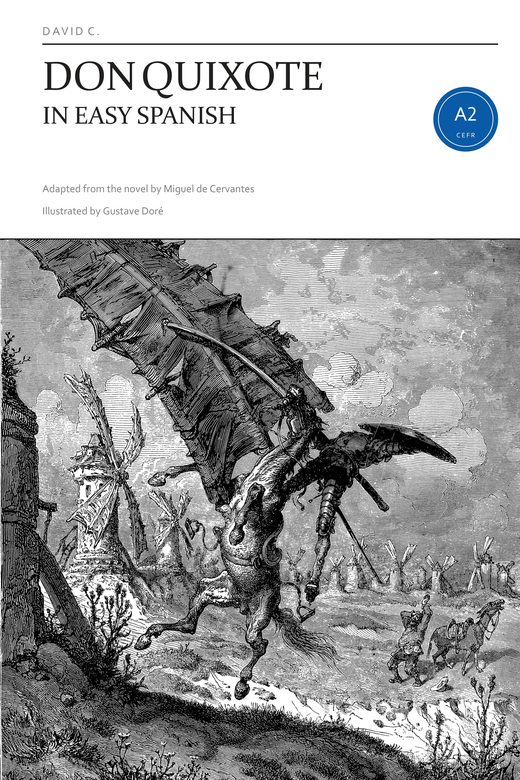
Don Quixote in Easy Spanish: the whole novel retold in Spanish you can actually read, in 58 short episodes, with the hard words glossed in the margin. It is where every Don Quixote sentence on this page comes from.
In EPUB and PDF, with a second novel in the same Spanish. See the books.
Where the course teaches this
2 lessons build it up, each one inside a chapter of the story rather than in the abstract. Free to read, with the vocabulary, the audio and the exercises.
- Two pronouns togetherLesson 38Ginés de Pasamonte and the stones
- GUSTAR and the pronouns me / te / leLesson 13The night of the armour vigil
Next to this one
The points that sit closest to this one, and that a student usually meets around the same time.