Level A1 · Chapter 13
The night of the armour vigil
Don Quixote keeps watch over his armour in the inn yard, cracks two heads and comes out of it a knight.
What you will learn
- Say what you like and do not like, and ask someone else.
- Say how much you like something: a lot, quite a lot, a little, not at all.
- Understand why Spanish says «me gusta» and never «yo gusto».
Before you read
In this text almost nobody "likes" anything. Instead, things please somebody. Watch the word order: first me, te or le, and the verb after it.The story in easy Spanish
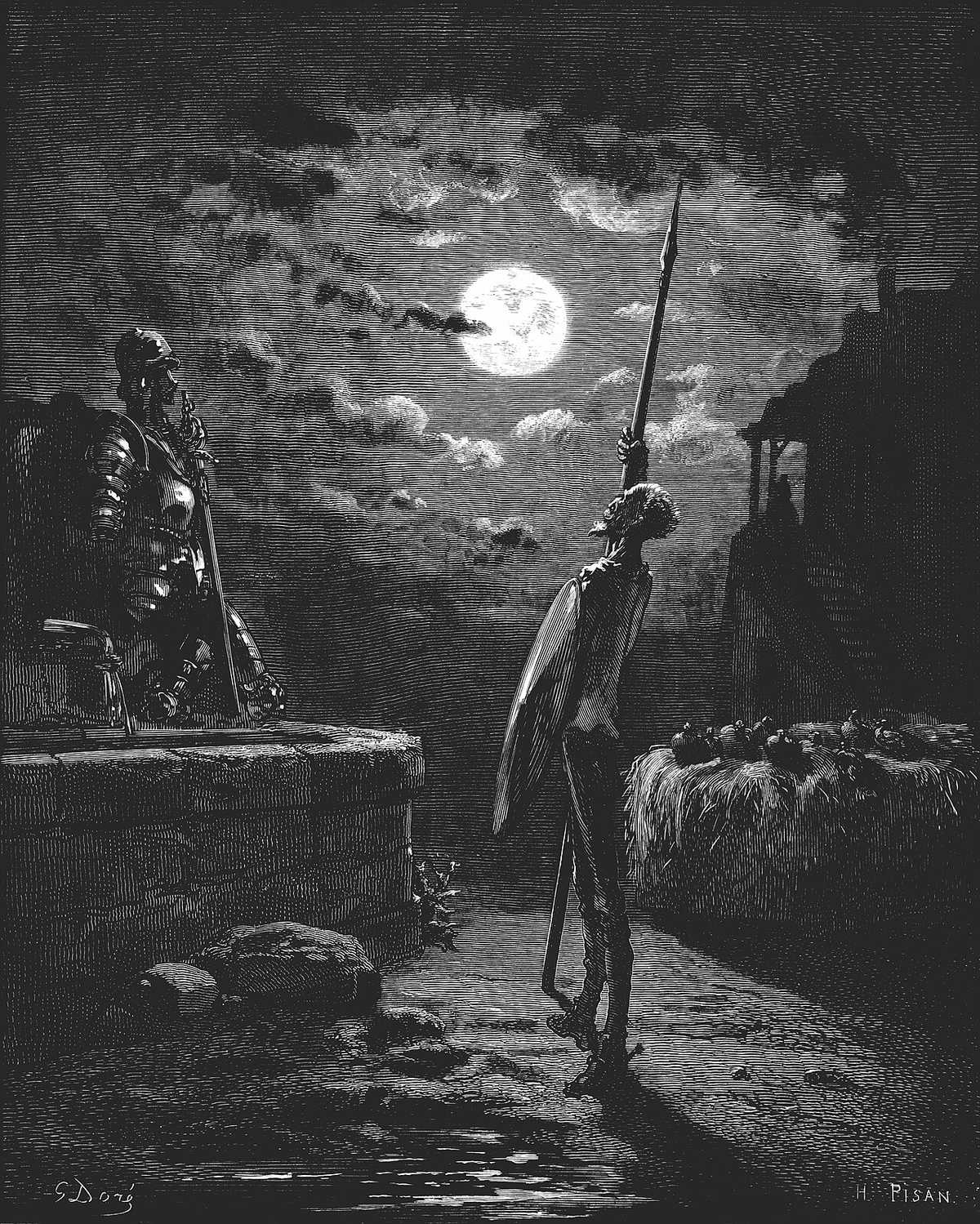
Don Quijote quiere ser caballero esta misma noche. Antes tiene que velar sus armas.
Don Quixote wants to be a knight this very night. First he has to keep vigil over his armour.
Pone la armadura encima de una pila de agua, en el corral.
He lays the armour on a water trough, out in the inn yard.
Al ventero no le gusta nada la idea, pero calla.
The innkeeper does not like the idea at all, but he says nothing.
A medianoche un arriero aparta la armadura: quiere agua para sus mulas.
At midnight a muleteer shoves the armour aside: he wants water for his mules.
«A mí no me gustan los ladrones», grita don Quijote, y le golpea la cabeza.
"I do not like thieves," shouts Don Quixote, and cracks him on the head.
Llega un segundo arriero. «¿Te gusta mi lanza?», pregunta el caballero.
A second muleteer turns up. "Do you like my lance?" asks the knight.
A los compañeros les gusta poco el espectáculo y tiran piedras.
Their companions like the show very little and start throwing stones.
El ventero abre su libro de la paja y la cebada con cara de sacerdote.
The innkeeper opens his straw-and-barley ledger with the face of a priest.
Lee unas palabras y da dos golpes en el hombro.
He reads out a few words and gives him two taps on the shoulder.
Una moza le pone la espada en el cinturón. Ya es caballero andante.
One of the girls buckles the sword onto his belt. He is now a knight-errant.
A don Quijote le gusta mucho la ceremonia. Al ventero le gusta más el final.
Don Quixote likes the ceremony a lot. The innkeeper likes the end of it even more.
Vocabulary
The inn at night
- el corral
- the yard
- la pila
- the water trough
- la paja
- the straw
- la cebada
- the barley
- el arriero
- the muleteer
- la mula
- the mule
The ceremony
- velar
- to keep watch (all night)
- el hombro
- the shoulder
- el cinturón
- the belt
- el golpe
- the blow, the tap
- largo / larga
- long
How much: adverbs of quantity
- mucho
- a lot
- bastante
- quite a lot, fairly
- poco
- little, not much
- nada
- not at all
GUSTAR and the pronouns me / te / le
Al ventero no le gusta nada la idea.
¿Te gusta mi lanza?
A don Quijote le gusta mucho la ceremonia.
Gustar does not mean to like. It means to please. Get that one idea and you will never build these sentences backwards again.
Me gustan los libros is not "I like books" word for word. It is the books please me. The books are the subject and do the pleasing, while the person merely receives it.
| Spanish | Word for word | Natural English |
|---|---|---|
| Me gusta el libro. | The book pleases me. | I like the book. |
| Me gustan los libros. | The books please me. | I like the books. |
| Te gusta la lanza. | The lance pleases you. | You like the lance. |
| Le gusta la ceremonia. | The ceremony pleases him/her. | He/she likes the ceremony. |
So in practice the verb has only two forms: gusta for one thing, gustan for several. With another verb after it, always gusta: Me gusta leer (reading pleases me).
To make clear whose taste we mean, Spanish adds a mí, a ti, al ventero, a don Quijote in front. The pronoun does not drop out: A don Quijote le gusta la ceremonia.
Amount goes after the verb: me gusta mucho / bastante / poco, and for none at all, no me gusta nada.
How a man was dubbed a knight
The real ceremony had three parts: a bath, a whole night standing beside your weapons in a chapel, and in the morning the espaldarazo, two taps of a sword on the shoulder given by another knight or by the king.
Don Quixote has no chapel: he has an inn yard. No altar: he has the trough the mules drink from. No king: he has a fat innkeeper who wants him gone. And the sacred book from which the innkeeper reads the solemn words is the ledger of the straw and barley he sells.
By 1605 that ceremony had not been performed in Spain for over a hundred years. Cervantes does not point at the joke or laugh: he writes it down with a completely straight face and moves on.
Cervantes in the original · «velase las armas en un corral grande que a un lado…»
velase las armas en un corral grande que a un lado de la venta estaba
that he should keep watch over his armour in a large yard at one side of the inn
Three words from this lesson are in it: armas, corral and venta. Velase is an old form of the verb velar. Cervantes puts the verb at the end, as Latin did.