Level A1 · Chapter 12
The castle with four towers
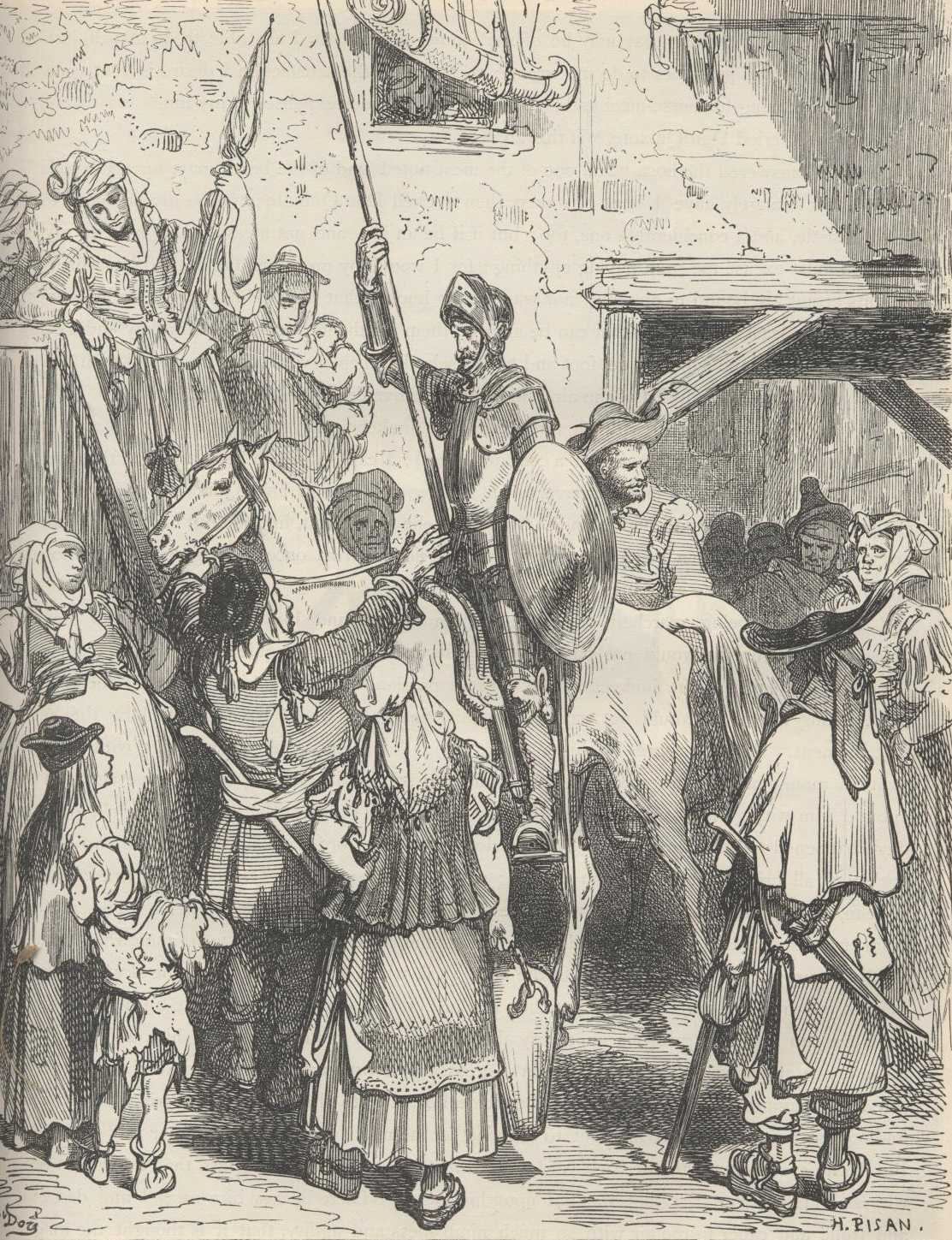
At the end of the afternoon an inn appears on the road. It is a poor house, but Don Quixote sees four silver towers.
What you will learn
- Join two ideas with y, ni, o and pero.
- Contrast two things with uno… otro.
- Order a story with primero, luego, después and al final.
Before you read
Nearly every sentence here has two halves held together by a short word: y, ni, o, pero. Four words, four different jobs.The story in easy Spanish
Primero don Quijote camina todo el día. Va de un lado a otro, pero no hay aventuras.
First Don Quixote rides all day. He goes from one place to another, but there are no adventures.
El caballero no come ni bebe desde la mañana. Rocinante también está cansado.
The knight has neither eaten nor drunk since the morning. Rocinante is tired too.
Luego, al final de la tarde, ve una casa en el camino.
Then, at the end of the afternoon, he sees a house on the road.
Es una venta: no es un castillo, pero él ve cuatro torres de plata.
It is an inn: it is not a castle, but he sees four silver towers.
Espera delante de la puerta. ¿Sale un enano con una trompeta o no sale nadie?
He waits in front of the gate. Will a dwarf come out with a trumpet, or will nobody come out?
Un porquero toca un cuerno para sus cerdos y el caballero está contento.
A swineherd blows a horn to call his pigs, and the knight is delighted.
Para él la señal es del castillo, y entra muy serio.
To him the signal comes from the castle, and he rides in very solemnly.
En la puerta hay dos mujeres. Una es alta y la otra es baja.
At the door there are two women. One is tall and the other is short.
Don Quijote saluda a las dos mujeres como grandes damas, pero ellas se ríen.
Don Quixote greets the two women as great ladies, but they burst out laughing.
Después llega el ventero. Es gordo y tranquilo, pero no es un señor de castillo.
Then the innkeeper arrives. He is fat and easy-going, but he is no lord of a castle.
Vocabulary
The inn
- la venta
- the roadside inn
- el ventero
- the innkeeper
- la torre
- the tower
- la plata
- silver
At the door
- el enano
- the dwarf
- la trompeta
- the trumpet
- el porquero
- the swineherd
- el cuerno
- the horn
- la señal
- the signal
- saludar
- to greet
- reírse
- to laugh
Putting events in order
- primero
- first
- luego
- then, next
- después
- afterwards, then
- al final
- in the end, at the end
Joining sentences: y, ni, o, pero
Es una venta: no es un castillo, pero él ve cuatro torres de plata.
El caballero no come ni bebe desde la mañana.
¿Sale un enano con una trompeta o no sale nadie?
Four words, four jobs:
| word | what it does | example |
|---|---|---|
| y: and | adds | Es gordo y tranquilo. |
| ni: nor, or | adds inside a negative | No come ni bebe. |
| o: or | chooses | ¿Sale un enano o no sale nadie? |
| pero: but | contrasts | Es una venta, pero él ve un castillo. |
The one that catches English speakers is ni. English says "he doesn't eat or drink". Spanish cannot use o there: once the sentence is negative, y and o both turn into ni. No come ni bebe. You can also double it up at the front, as in Ni el ama ni la sobrina saben nada, the everyday way of saying "neither… nor". English keeps "nor" for solemn occasions, but Spanish uses ni at breakfast.
Two small sound changes. Y becomes e before a word starting with i- or hi-, so that two i-sounds do not collide: castillos e historias, padre e hijo. O becomes u before o- or ho-: siete u ocho. Nobody decides this: your mouth does.
Uno… otro. To contrast two members of the same pair: Una es alta y la otra es baja. Both parts agree in gender, uno / una, el otro / la otra, and Spanish puts the article on the second one where English says a bare "the other".
Ordering a story. Primero (first), luego (then), después (afterwards), al final (in the end). They almost always come at the head of the sentence, with a comma if the sentence continues. Four words, and a list of events turns into a story.
What a venta was
A venta was not a town inn and certainly not a hotel. It was a lone house in the middle of the road, a day's travel from the last one, with a yard for the animals, a well, a kitchen with one pot, and a big room where you slept on the floor, on straw, among muleteers. You ate whatever there was. Innkeepers had a bad reputation and mostly earned it.
Don Quixote arrives at one of these houses after an entire day of sun and sees four silver towers, a drawbridge and a moat. He is not lying: he is reading. In his books, a knight who reaches a castle at dusk is announced by a dwarf with a trumpet, and here is a swineherd with a horn. The scene fits closely enough.
That is the engine of the whole novel. Not the world against a madman, but two versions of the same place, both built out of the same stones. Cervantes describes the inn plainly, lets Don Quixote describe the castle, and never tells you which paragraph to believe.
Cervantes in the original · «Estaban acaso a la puerta dos mujeres mozas…»
Estaban acaso a la puerta dos mujeres mozas, destas que llaman del partido
and at the door stood two young women, of the sort they call women of the road
Mozas del partido was the polite phrase of the day for prostitutes. Don Quixote addresses them as vuestras mercedes, the form reserved for great ladies. That is where the joke is, and also the tenderness. Note destas: Cervantes writes de estas run together, as people spoke.