A1 · Updated
Spanish stem-changing verbs: e-ie, o-ue, e-i
Some of the most common Spanish verbs change a vowel in the middle when the stress falls on it: quiero, puedo, pido. The change follows one rule, it skips nosotros and vosotros, and once you see the shape you stop learning them one by one.
The short answer
In the present, the stressed vowel of the stem changes: e becomes ie (querer, quiero), o becomes ue (poder, puedo), e becomes i (pedir, pido). Nosotros and vosotros never change, because the stress moves to the ending: queremos, podéis.
How to remember it
The boot: everyone changes except nosotros and vosotros
| e to ie | querer, pensar, empezar, preferir | Quiero un café |
|---|---|---|
| o to ue | poder, dormir, volver, costar | No puedo |
| e to i | only -ir verbs: pedir, repetir, servir | Pido la cuenta |
| u to ue | only jugar | Juego al fútbol |
| Nosotros, vosotros | no change | Podemos, queréis |
The forms
The three patterns in the present
| person | querer (e-ie) | poder (o-ue) |
|---|---|---|
| yo | quiero | puedo |
| tú | quieres | puedes |
| él, ella, usted | quiere | puede |
| nosotros | queremos | podemos |
| vosotros | queréis | podéis |
| ellos, ustedes | quieren | pueden |
| pedir (e-i) | pido, pides, pide | pedimos, pedís, piden |
16 sentences that show the difference
Everyday Spanish, the kind you would actually say. The label under each one says which part of the rule it shows.
Quiero un café, por favor.
I would like a coffee, please.
e to ie
¿Puedes ayudarme?
Can you help me?
o to ue
Pido la cuenta.
I ask for the bill.
e to i
¿Qué piensas?
What do you think?
Pensar
La película empieza a las nueve.
The film starts at nine.
Empezar
Duermo ocho horas.
I sleep eight hours.
Dormir
Vuelvo a casa a las siete.
I get home at seven.
Volver
¿Cuánto cuesta?
How much is it?
Costar
Prefiero el té.
I prefer tea.
Preferir
Juegan al tenis los domingos.
They play tennis on Sundays.
Jugar, u to ue
No entiendo.
I do not understand.
Entender
¿Me lo repites?
Can you repeat that?
Repetir
Podemos ir mañana.
We can go tomorrow.
Nosotros, no change
¿Queréis algo de beber?
Do you want something to drink?
Vosotros, no change
Siempre pierdo las llaves.
I always lose my keys.
Perder
Llueve mucho en abril.
It rains a lot in April.
Llover
Where English gets in the way
English has nothing quite like this, because its irregular verbs change in the past, not the present: sing, sang. Spanish changes inside the present tense itself. The good news is that the endings stay completely regular: quier-o, quier-es. Only the vowel in the middle moves.
The mistake to avoid
Quero, podo, and on the other side queremos turned into quieremos. The change belongs to the four stressed forms of the boot, never to nosotros and vosotros.
The cases that break the rule
Podemos
Nosotros and vosotros never change because the stress moves to the ending: po-DE-mos. The change only happens on a stressed syllable. Draw a line round the four that change and it looks like a boot.
Pedir, pido
The e to i change only exists in -ir verbs: pedir, servir, repetir, seguir, vestir. No -ar or -er verb has it.
Juego
Jugar is the only u to ue verb in Spanish. Always jugar a before a game: juego al fútbol.
Tengo, vengo
Tener and venir are stem-changing too, tienes, vienes, but their yo form is -go instead: tengo, not tieno.
Huelo
Oler adds an h because Spanish words do not start with ue: huelo, hueles, huele. Same with errar in Spain: yerro.
Comer, como
Not every verb with an e or o changes. Comer, beber, vivir, comprar never do, and the dictionary will not warn you. Learn the common changers as a list.
Stem-changing verbs exercises
8 sentences to fill in. Type your answer and check it, or read them straight through with the answers showing. Accents count here, the way they count in the language.
-
¿Tú ___ venir al cine? (querer)
Do you want to come to the cinema?
quieres · e to ie in the stressed syllable.
-
Yo no ___ ir hoy. (poder)
I cannot go today.
puedo · o to ue.
-
Nosotros ___ salir a las ocho. (poder)
We can leave at eight.
podemos · Nosotros never changes: the stress is on the ending.
-
El camarero ___ la comida. (servir)
The waiter serves the food.
sirve · e to i, an -ir verb.
-
Mis hijos ___ al fútbol. (jugar)
My children play football.
juegan · Jugar, the only u to ue verb.
-
¿A qué hora ___ la clase? (empezar)
What time does the class start?
empieza · e to ie.
-
Vosotros ___ mucho. (dormir)
You sleep a lot.
dormís · Vosotros keeps the o.
-
¿Cuánto ___ estos zapatos? (costar)
How much are these shoes?
cuestan · o to ue, plural because the shoes are the subject.
More exercises, from Don Quixote
8 more, these ones straight out of the course: the inn, the windmills, Rocinante and the road. Same rule, older Spanish.
-
Don Quijote ___ ser caballero. (querer)
Don Quixote wants to be a knight.
quiere · e to ie.
-
Sancho no ___ dormir en el suelo. (poder)
Sancho cannot sleep on the ground.
puede · o to ue.
-
Don Quijote ___ en Dulcinea día y noche. (pensar)
Don Quixote thinks about Dulcinea day and night.
piensa · e to ie, and pensar en for thinking about.
-
Sancho ___ más comida. (pedir)
Sancho asks for more food.
pide · e to i.
-
Los dos ___ a casa muy cansados. (volver)
The two of them come home very tired.
vuelven · o to ue.
-
Nosotros ___ seguir el camino. (querer)
We want to follow the road.
queremos · Nosotros, no change.
-
La aventura ___ en la venta. (empezar)
The adventure starts at the inn.
empieza · e to ie.
-
Sancho ___ en el camino como un tronco. (dormir)
Sancho sleeps on the road like a log.
duerme · o to ue.
Common questions
What is a stem-changing verb?
A verb whose stem vowel changes in some forms of the present: querer, quiero, poder, puedo. The endings stay regular.
Why is it called the boot verb?
Write the six forms in two columns. The four that change, yo, tú, él and ellos, form the shape of a boot. Nosotros and vosotros stay outside it.
How do I know if a verb changes its stem?
You cannot tell from the infinitive: pensar changes, pasar does not. Good dictionaries mark it, often as pensar (ie). The twenty or so common ones are worth learning as a list.
Do stem-changing verbs change in the preterite?
-ar and -er verbs do not: pensé, pudo is irregular for other reasons. -ir verbs change in the third person: pidió, durmió.
Which verbs change e to i?
Only -ir verbs: pedir, servir, repetir, seguir, vestir, medir, reír. Decir also follows it, dice, with an irregular yo form, digo.
Is jugar a stem-changing verb?
Yes, and the only one with u to ue: juego, juegas, juega, jugamos, jugáis, juegan.
Do stem changes appear in the subjunctive?
Yes, in the same four persons: quiera, pueda. -ir verbs also change in nosotros and vosotros: durmamos, pidáis.
What are the most common stem-changing verbs?
e to ie: querer, pensar, empezar, entender, preferir, cerrar. o to ue: poder, volver, dormir, costar, encontrar, recordar. e to i: pedir, servir, repetir, seguir.
The things to remember
- e becomes ie, o becomes ue, e becomes i in some -ir verbs.
- The change happens only where the stress falls on the stem.
- Nosotros and vosotros never change.
- Jugar is the only u to ue verb.
- Not all verbs change: comer and vivir do not. Learn the common changers.
The book this comes from
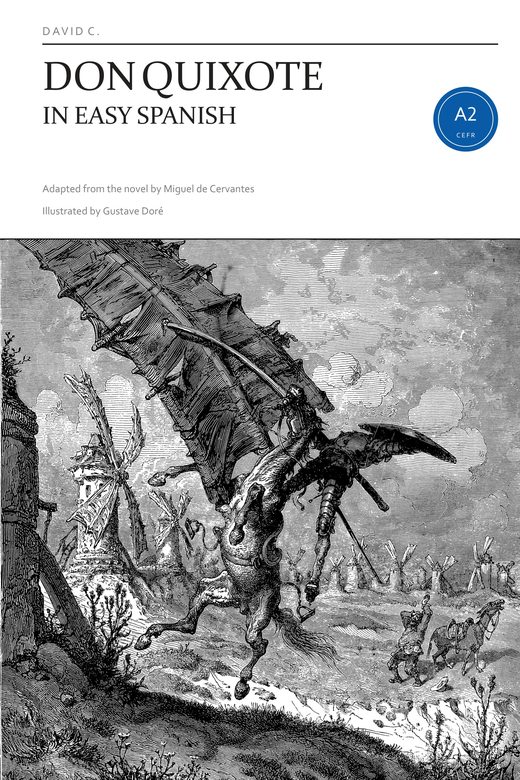
Don Quixote in Easy Spanish: the whole novel retold in Spanish you can actually read, in 58 short episodes, with the hard words glossed in the margin. It is where every Don Quixote sentence on this page comes from.
In EPUB and PDF with its audiobook, and a second novel in the same Spanish. See the books.
Where the course teaches this
2 lessons build it up, each one inside a chapter of the story rather than in the abstract. Free to read, with the vocabulary, the audio and the exercises.
- GUSTAR and the pronouns me / te / leLesson 13The night of the armour vigil
- Mi, tu, su, nuestroLesson 6The cardboard helmet
Next to this one
The points that sit closest to this one, and that a student usually meets around the same time.