Level A1 · Chapter 6
The cardboard helmet
The gentleman builds himself a helmet out of cardboard, tests it with his sword, and learns not to test the second one.
What you will learn
- Say whose something is: mi, tu, su, nuestro.
- Make the possessive agree with the object, not with the owner.
- Know when Spanish prefers the plain article to a possessive.
Before you read
Two voices in this text, and both are showing off possessives. The narrator says nuestro hidalgo, "our gentleman", pulling you into the joke. And the gentleman himself talks to the helmet as if it could answer: tu cartón, mi espada. Watch those small words.The story in easy Spanish
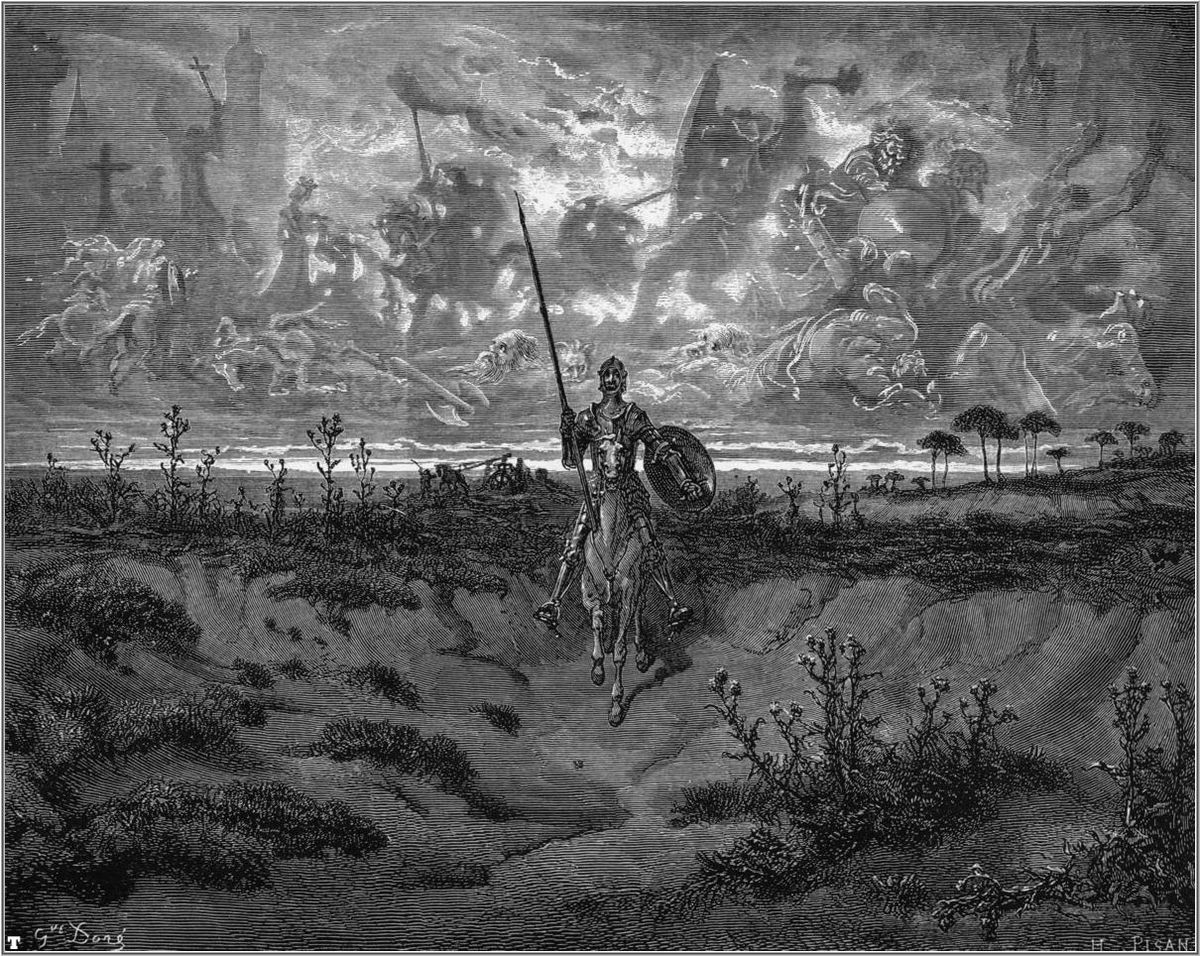
Nuestro hidalgo tiene un problema serio: su celada no está entera. Para él, un caballero sin celada no es un caballero.
Our gentleman has a serious problem: his helmet is not complete. To his mind, a knight without a helmet is not a knight.
Trabaja una semana entera con las manos, con cartón y con hierro. Al final, sobre la mesa, está su media celada nueva.
He works for a whole week with his hands, with cardboard and with iron. At the end, there on the table, sits his new half-helmet.
El hidalgo mira su obra y habla con ella. «Tu cartón es fuerte y mi espada es dura.»
The gentleman looks at his handiwork and talks to it. "Your cardboard is strong and my sword is hard."
«Tu cartón contra mi espada. Ahora es la hora de la verdad.»
"Your cardboard against my sword. Now comes the moment of truth."
Toma su espada y da dos golpes rápidos. Su celada nueva está en el suelo, en pedazos pequeños.
He takes his sword and strikes two quick blows. His new helmet is on the floor, in small pieces.
El trabajo de una semana es ahora cartón roto.
A week of work is now broken cardboard.
Pero nuestro hidalgo es un hombre paciente. Hace otra celada, con unas barras de hierro dentro.
But our gentleman is a patient man. He makes another helmet, with iron bars inside it.
Esta vez no da más golpes con su espada. Para él, su celada es finísima y muy segura.
This time he strikes no more blows with his sword. As far as he is concerned, his helmet is superb and perfectly safe.
Vocabulary
The workshop
- el cartón
- the cardboard
- la barra
- the bar
- la mesa
- the table
- la obra
- the piece of work
- la mano
- the hand
The disaster
- el golpe
- the blow
- el suelo
- the floor, the ground
- el pedazo
- the piece, the fragment
- roto / rota
- broken
What it is like
- entero / entera
- whole, complete
- seguro / segura
- safe, sure
- paciente
- patient
- la semana
- the week
Mi, tu, su, nuestro
Su celada no está entera.
Tu cartón es fuerte y mi espada es dura.
Nuestro hidalgo es un hombre paciente.
With the thing. This is the single fact to take away, and it is the opposite of the English habit. In English the word changes with the owner: his hands, her hands. In Spanish it changes with what is owned: su mano, sus manos. Both work for a man, a woman or a whole family.
| owner | one thing | several things |
|---|---|---|
| yo: I | mi espada | mis armas |
| tú: you | tu cartón | tus golpes |
| él / ella / usted | su celada | sus manos |
| nosotros: we | nuestro hidalgo / nuestra casa | nuestros libros / nuestras armas |
| vosotros: you (pl., Spain) | vuestro caballo / vuestra lanza | vuestros días |
| ellos / ustedes | su pueblo | sus libros |
Notice the shape of the table. mi, tu and su have only two forms each, singular and plural: no masculine or feminine to worry about. Only nuestro and vuestro have all four endings, because they behave like ordinary adjectives.
su is the busy one. It means his, her, its, their, and also your when you are speaking to somebody as usted. Spanish tolerates the ambiguity because the context nearly always settles it, and when it does not, you say la celada de él or la celada de ella.
Where Spanish does not use a possessive. With parts of the body and with clothes, Spanish uses the plain article: trabaja con las manos, not con sus manos. If a man works with hands, they are obviously his own. Saying sus manos there sounds as if he had borrowed somebody else’s.
The parts of a suit of armour
A suit of armour is an iron jigsaw, and each piece has its own name: the peto over the chest, the espaldar at the back, brazales on the arms, guanteletes on the hands, quijotes on the thighs, grebas on the shins, and the celada on the head.
The celada is the expensive piece: it closes over the face and has a visor that lifts. A morrión is the cheap open headpiece a foot soldier wears. Our gentleman owns the cheap one and needs the expensive one, and that gap is what a week of cardboard is trying to bridge.
Keep quijote in mind (the thigh piece). It is a real word in a real armoury, and in two lessons it will turn out to be the name he chooses for himself. A grown man naming himself after a knee-high strip of metal is the sort of joke Cervantes never bothers to point out.
Cervantes in the original · «Y sin querer hacer nueva experiencia della…»
Y sin querer hacer nueva experiencia della, la diputó y tuvo por celada finísima de encaje.
And without caring to test it again, he judged it and held it to be a helmet of the finest workmanship.
Cervantes never says the man is fooling himself. He just reports that the second test never happened, and lets you do the arithmetic. Della is de ella written as one word, normal in 1605. Finísima is fina pushed to the top: superb, exquisite.