Level A1 · Chapter 7
The name of the horse
A skinny old horse receives, after four days of hard thought, the most sonorous name in the world.
What you will learn
- Describe a thing or an animal with two or three adjectives.
- Put the adjective where Spanish puts it.
- Turn the volume up and down with muy, poco, mucho and bastante.
Before you read
This text is stuffed with adjectives, and every one of them comes after its noun: un caballo flaco, un nombre sonoro. English does the opposite, so read the pairs slowly and let the order sink in.The story in easy Spanish
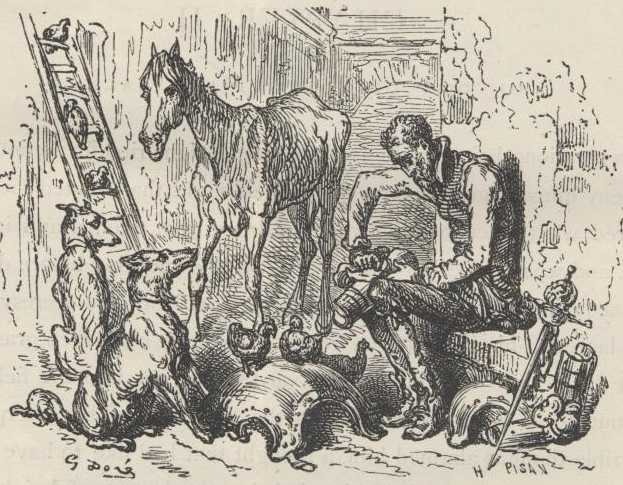
Un caballero andante necesita un caballo fuerte y hermoso. En el corral del hidalgo hay un caballo flaco y viejo.
A knight-errant needs a strong, handsome horse. In the gentleman's yard there is a skinny old horse.
Este caballo tiene poca carne, mucha piel y bastantes años.
This horse has little flesh, plenty of skin and a fair few years behind him.
Pero para su dueño es un animal magnífico y muy noble.
But to his owner he is a magnificent and most noble animal.
Un caballo famoso necesita también un nombre alto y sonoro.
A famous horse also needs a lofty, resounding name.
El hidalgo pasa cuatro días enteros delante del corral. Escribe nombres largos, mira nombres raros y tira nombres feos.
The gentleman spends four whole days in front of the yard. He writes down long names, looks at odd names and throws away ugly names.
Al final tiene un nombre muy bueno: Rocinante.
In the end he has a very good name: Rocinante.
«Rocín» es un caballo malo y poco elegante. «Ante» significa «antes» y también «primero».
"Rocín" is a bad horse, not an elegant one. "Ante" means "before" and also "first".
Rocinante es el primero de todos los rocines del mundo. Es un nombre bastante largo, pero para su dueño es perfecto.
Rocinante is the first of all the nags in the world. It is a fairly long name, but to his owner it is perfect.
Vocabulary
The horse
- el corral
- the yard
- el rocín
- the nag
- el animal
- the animal
- la carne
- the flesh, the meat
- la piel
- the skin, the hide
- el dueño
- the owner
What it is like
- flaco / flaca
- skinny
- hermoso / hermosa
- handsome, beautiful
- noble
- noble
- raro / rara
- odd, strange
- feo / fea
- ugly
- sonoro / sonora
- resounding
Words from the text
- significar
- to mean
- tirar
- to throw away
The adjective goes after. Muy, poco, mucho, bastante
un caballo flaco y viejo
un nombre alto y sonoro
un animal magnífico y muy noble
Spanish leads with the noun and lets the adjective follow: un caballo flaco, a horse — skinny one. English does it the other way round, and this is the single most visible habit to unlearn. Say the noun first, then decide what it is like.
Once it is in place, the adjective has to agree with the noun in gender and number:
| singular | plural | |
|---|---|---|
| masculine | un caballo flaco | unos caballos flacos |
| feminine | una celada rota | unas celadas rotas |
| ending in -e or a consonant | un nombre grande, un caballo noble | unos nombres grandes, unos caballos nobles |
Adjectives ending in -e or in a consonant do not change for gender at all: un caballo noble, una idea noble. Only the plural -s or -es is added.
Turning the volume up. English uses very for adjectives and much / a lot of for nouns, and Spanish makes exactly the same split — but the words look alike, which is where the trouble starts.
| with an adjective | with a noun |
|---|---|
| muy noble — never changes | mucha piel, muchos años — agrees |
| poco elegante | poca carne, pocos libros |
| bastante largo | bastantes años |
bastante is worth a second look. It does not mean "enough" in the grudging English sense; it sits between poco and muy, roughly at "quite" or "fairly". Un nombre bastante largo is a name of respectable length, and the narrator is being polite.
Who got to own a horse
The word says it: caballero is a man who owns a caballo. A trained war horse cost as much as a small farm, and unlike a farm it ate every single day whether or not there was a war on. Owning one was the boundary between a knight and everybody else, which is why the language turned "horseman" into "gentleman" and English did the same with chivalry, from the French cheval.
Spain had a whole vocabulary for the gap. A corcel or a caballo de batalla was the expensive animal, bred and trained for the charge. A rocín was the other thing entirely: the working horse that pulled the cart and carried the sacks, thin, patient and cheap.
Our gentleman has a rocín, and he knows it. His solution is not to buy a better horse — he has no money — but to give this one a name so grand that the animal will have to live up to it. It is the same move as the cardboard helmet, and it will not be the last.
Cervantes in the original · «Vino a llamar Rocinante: nombre, a su parecer, alto…»
Vino a llamar Rocinante: nombre, a su parecer, alto, sonoro y significativo de lo que había sido cuando fue rocín, antes de lo que ahora era, que era antes y primero de todos los rocines del mundo.
He came to call him Rocinante, a name that seemed to him lofty, sonorous and expressive of what he had been when he was a common nag, before he became what he now was: first and foremost of all the nags in the world.
Look at the adjectives, all three of them behind the noun exactly as in your text: nombre alto, sonoro y significativo. And note a su parecer, "in his opinion" — four words that quietly hand the whole judgement back to the man who made it up.