A1 · Updated
Spanish plurals and adjective agreement
In Spanish everything around a noun copies it: the article, the adjective and even some numbers take its gender and its number. Making plurals is easy. Remembering to make everything else plural with it is the real skill.
The short answer
Add -s after a vowel: casa, casas. Add -es after a consonant: ciudad, ciudades. A final z becomes c: lápiz, lápices. Then make the article and every adjective match: las casas blancas. Adjectives in -e or a consonant do not change for gender: verde, azul.
How to remember it
Noun first, then everything copies it
| Ends in a vowel | add -s | libro, libros |
|---|---|---|
| Ends in a consonant | add -es | flor, flores |
| Ends in -z | z becomes c, then -es | luz, luces |
| Adjective in -o | four forms: -o, -a, -os, -as | alto, alta, altos, altas |
| Adjective in -e or consonant | two forms, only number | grande, grandes |
The forms
How each adjective agrees
| adjective | masculine | feminine |
|---|---|---|
| in -o | el coche rojo, los coches rojos | la casa roja, las casas rojas |
| in -e | el chico inteligente, los chicos inteligentes | la chica inteligente, las chicas inteligentes |
| in a consonant | el bolso azul, los bolsos azules | la falda azul, las faldas azules |
| nationality | el vino español, los vinos españoles | la comida española, las comidas españolas |
| in -dor | el chico trabajador | la chica trabajadora |
| mixed group | el padre y la madre son altos | masculine plural wins |
16 sentences that show the difference
Everyday Spanish, the kind you would actually say. The label under each one says which part of the rule it shows.
Las manzanas son rojas.
The apples are red.
Everything feminine plural
Los coches nuevos.
The new cars.
Masculine plural
Una ciudad bonita.
A pretty town.
Ciudad is feminine
Dos ciudades bonitas.
Two pretty towns.
-es after a consonant
Tres lápices.
Three pencils.
Z becomes c
Una mesa grande.
A big table.
Grande does not change for gender
Unas mesas grandes.
Some big tables.
Only number
Un jersey azul.
A blue jumper.
Azul, two forms
Unos ojos azules.
Blue eyes.
Azules
Mi amiga es inglesa.
My friend is English.
Nationalities have a feminine
Mis padres son simpáticos.
My parents are nice.
Padres, mixed
El lunes y el martes.
Monday and Tuesday.
No plural form
Las vacaciones.
The holidays.
Always plural
Los jóvenes.
Young people.
The accent moves
Un examen, dos exámenes.
One exam, two exams.
Accent added
Una canción, dos canciones.
One song, two songs.
Accent dropped
Where English gets in the way
English adjectives never change: a red car, red cars, a red house. Spanish adjectives agree with the noun in gender and in number, so one English word can be four Spanish ones: rojo, roja, rojos, rojas. English marks the plural once, on the noun. Spanish marks it on every word of the group.
The mistake to avoid
Las casas blanco and los coches nuevo. The plural reaches the noun and stops there, as in English. In Spanish it has to reach every adjective: las casas blancas.
The cases that break the rule
Joven, jóvenes
Adding a syllable can move the stress rule, so the written accent appears or disappears: examen, exámenes, canción, canciones. The spoken stress stays on the same syllable.
El lunes, los lunes
Words that end in an unstressed vowel plus -s do not change in the plural: el lunes, los lunes, la crisis, las crisis. Only the article tells you.
Inglés, inglesa
Adjectives of nationality and those in -dor, -ón and -án take an -a even though they end in a consonant: español, española, hablador, habladora.
Los padres
A mixed group takes the masculine plural: los padres is the parents, los hermanos can be brothers and sisters. Adjectives follow: Juan y Ana son altos.
Las gafas
Some nouns live in the plural even for one object: las gafas, las tijeras, las vacaciones. Their adjectives are plural too.
Naranja, rosa
Colours named after things often stay as they are: camisetas naranja, flores rosa. The agreeing forms, naranjas and rosas, are also accepted and common.
Spanish plurals and agreement exercises
8 sentences to fill in. Type your answer and check it, or read them straight through with the answers showing. Accents count here, the way they count in the language.
-
Tengo dos ___. (ciudad)
I have two cities.
ciudades · Ends in a consonant, so -es.
-
Necesito tres ___. (lápiz)
I need three pencils.
lápices · Z changes to c before -es.
-
Las flores son ___. (amarillo)
The flowers are yellow.
amarillas · Flores is feminine plural, so the adjective is too.
-
Mis hermanos son muy ___. (alto)
My brothers are very tall.
altos · Masculine plural.
-
Una casa ___. (grande)
A big house.
grande · Grande ends in -e and does not change for gender.
-
Mi profesora es ___. (inglés)
My teacher is English.
inglesa · Nationalities take -a in the feminine and lose the accent.
-
Tengo dos ___ mañana. (examen)
I have two exams tomorrow.
exámenes · The extra syllable makes the written accent appear.
-
Ana y Pedro son ___. (simpático)
Ana and Pedro are nice.
simpáticos · A mixed group takes the masculine plural.
More exercises, from Don Quixote
8 more, these ones straight out of the course: the inn, the windmills, Rocinante and the road. Same rule, older Spanish.
-
Don Quijote tiene muchos ___. (libro)
Don Quixote has a lot of books.
libros · Ends in a vowel, so -s.
-
Los molinos son ___. (enorme)
The windmills are enormous.
enormes · Enorme has only two forms, singular and plural.
-
Rocinante es un caballo ___. (flaco)
Rocinante is a skinny horse.
flaco · Masculine singular, like caballo.
-
Dulcinea es una dama ___. (hermoso)
Dulcinea is a beautiful lady.
hermosa · Dama is feminine, so -a.
-
Hay dos ___ en la venta. (mujer)
There are two women at the inn.
mujeres · Ends in a consonant, so -es.
-
Las ovejas son ___. (blanco)
The sheep are white.
blancas · Feminine plural noun, feminine plural adjective.
-
Los ___ de Toledo vuelven a casa. (mercader)
The merchants from Toledo go home.
mercaderes · Consonant ending, -es.
-
Don Quijote y Sancho están ___. (cansado)
Don Quixote and Sancho are tired.
cansados · Two men, masculine plural.
Common questions
How do you make a noun plural in Spanish?
Add -s after a vowel, perro, perros, and -es after a consonant, papel, papeles. A final z becomes c: vez, veces.
Do adjectives have to agree in Spanish?
Yes, in gender and number with the noun they describe: el gato negro, las gatas negras. Even when the adjective comes after ser: las gatas son negras.
Which adjectives do not change for gender?
Those that end in -e, grande, verde, inteligente, and most that end in a consonant, azul, fácil, joven. They still change for number: verdes, azules.
What happens with a mixed group?
Masculine plural: el niño y la niña son altos. That is why los hijos can mean sons and daughters together.
Why does the accent change in the plural?
Because the stress stays on the same syllable, but adding one can change whether it needs marking: joven, jóvenes gains an accent, canción, canciones loses one.
Are there nouns with no plural form?
Words ending in an unstressed vowel plus s stay the same: el lunes, los lunes, la tesis, las tesis. The article shows the number.
Is it gente or gentes?
La gente is singular in Spanish, even though it means people: la gente es simpática, never la gente son.
Do colours agree in Spanish?
Most do: blanco, blancas. Colours named after things, like naranja, rosa or violeta, may stay unchanged, and compound colours never change: camisas azul claro.
The things to remember
- Vowel, add -s. Consonant, add -es. Z becomes c.
- The article and every adjective copy the noun.
- Adjectives in -o have four forms. Those in -e or a consonant have two.
- Nationalities take a feminine even when they end in a consonant: inglesa.
- A mixed group is masculine plural.
The book this comes from
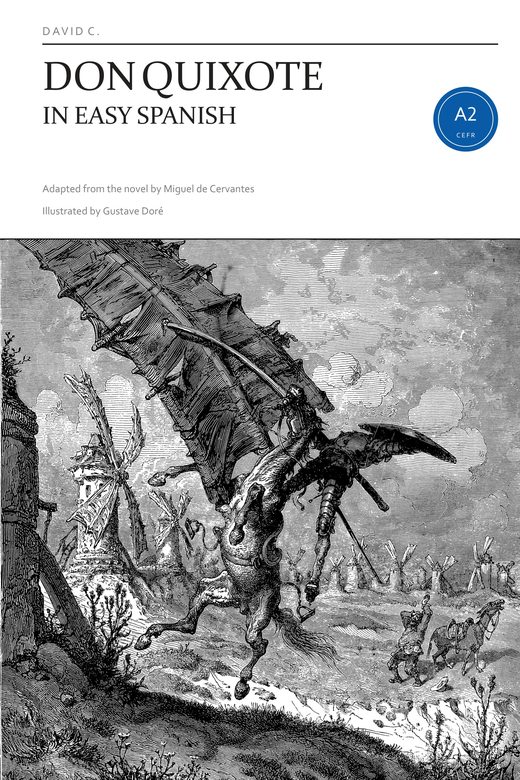
Don Quixote in Easy Spanish: the whole novel retold in Spanish you can actually read, in 58 short episodes, with the hard words glossed in the margin. It is where every Don Quixote sentence on this page comes from.
In EPUB and PDF with its audiobook, and a second novel in the same Spanish. See the books.
Where the course teaches this
3 lessons build it up, each one inside a chapter of the story rather than in the abstract. Free to read, with the vocabulary, the audio and the exercises.
- SER + what you are. Gender and numberLesson 1The gentleman of La Mancha
- The adjective goes after. Muy, poco, mucho, bastanteLesson 7The name of the horse
- UN, UNA, and when you use nothing at allLesson 2The gentleman’s house
Next to this one
The points that sit closest to this one, and that a student usually meets around the same time.