Spanish grammar · A1 · Updated
Spanish gender, and el, la, un, una
Every noun is masculine or feminine and there is no logic underneath it to find, so the word is learned with the article stuck to the front: el libro, la casa. Everything around the noun then has to match it. Spanish also drops the article where English keeps it and keeps it where English drops it, and that is a separate habit to build.
The short answer
Every Spanish noun is masculine or feminine, and the article and any adjective must match it. Words ending in -o are almost always masculine and take el; words ending in -a are almost always feminine and take la. Four endings are reliable beyond that: -ción, -sión, -dad and -tad are all feminine.
How to remember it
The endings that can be trusted
| -o | masculine, el | el libro |
|---|---|---|
| -a | feminine, la | la casa |
| -ción, -sión | feminine, always | la canción |
| -dad, -tad | feminine, always | la ciudad |
| -ma from Greek | masculine despite the -a | el problema |
The forms
The four articles, and the two for the indefinite
| the | a, some | |
|---|---|---|
| masculine singular | el | un |
| feminine singular | la | una |
| masculine plural | los | unos |
| feminine plural | las | unas |
| a plus el | al | |
| de plus el | del |
20 sentences that show the difference
Everyday Spanish, the kind you would actually say. The label under each one says which part of the rule it shows.
El libro es nuevo.
The book is new.
Masculine in -o
La casa es grande.
The house is big.
Feminine in -a
Los libros son nuevos.
The books are new.
Everything goes plural
Las casas son grandes.
The houses are big.
Everything goes plural
La canción es bonita.
The song is pretty.
-ción, feminine
La ciudad es antigua.
The city is old.
-dad, feminine
El problema es difícil.
The problem is difficult.
-ma, masculine
El día es largo.
The day is long.
Masculine in -a
La mano derecha.
The right hand.
Feminine in -o
El agua está fría.
The water is cold.
El but feminine
Voy al mercado.
I am going to the market.
a plus el is al
Vengo del trabajo.
I am coming from work.
de plus el is del
Me gusta el café.
I like coffee.
Article where English has none
Los lunes no trabajo.
I do not work on Mondays.
Days take the article
Son las tres.
It is three o clock.
The clock takes las
Es profesor.
He is a teacher.
No article with a profession
No tengo coche.
I do not have a car.
No article after a negative
Me duele la cabeza.
My head hurts.
The article, not the possessive
Un chico y una chica.
A boy and a girl.
The indefinite
Unos amigos míos.
Some friends of mine.
The plural indefinite
Where English gets in the way
English says “an old house” and “old houses” with the same word. Spanish changes the adjective twice over, once for gender and once for number, so one English word can hide four Spanish ones: viejo, vieja, viejos, viejas.
The mistake to avoid
English speakers say ✗ Las armas son antiguos. The right form is ✓ Las armas son antiguas. Armas is feminine plural, so the adjective has to be too. Same trap here: ✗ La casa es viejo → ✓ La casa es vieja.
The cases that break the rule
El problema, el día, el mapa
Words in -ma that came from Greek are masculine: problema, tema, sistema, programa, idioma, clima. Día and mapa join them. There are about twenty and they are all common.
La mano, la foto, la moto
Feminine despite the -o. Mano is the odd one out; foto and moto are short for fotografía and motocicleta, so they kept the gender of the long word.
El agua fría
A feminine noun starting with a stressed a takes el, purely so the two a sounds do not run together. It is still feminine, so the adjective is fría. The same goes for el aula and el hambre.
Me gusta el café
Spanish uses the article where English uses nothing: for things in general, for days, for the clock and for parts of the body. Leaving it out is one of the commonest learner mistakes.
Es profesor
The other way round: no article before a profession after ser, unless you add an adjective. Es profesor, but es un buen profesor.
El estudiante, la estudiante
A group of nouns has one form for both genders and only the article tells you which: el estudiante, la estudiante, el artista, la artista, el joven, la joven.
Spanish gender and article exercises
8 sentences to fill in. Type your answer and check it, or read them straight through with the answers showing. Accents count here, the way they count in the language.
-
___ libro que me prestaste es muy bueno.
The book you lent me is very good.
El · Libro ends in -o, so masculine, so el.
-
___ ciudad más bonita de España.
The prettiest city in Spain.
La · Any noun in -dad is feminine, without exception.
-
___ problema no tiene solución fácil.
The problem has no easy solution.
El · Problema comes from Greek, so masculine despite the -a.
-
Levanta ___ mano derecha.
Raise your right hand.
la · Mano is feminine despite the -o, and Spanish says la mano and not tu mano.
-
___ agua de esta fuente está muy fría.
The water from this fountain is very cold.
El · El because agua starts with a stressed a. It is still feminine: fría, not frío.
-
Vengo ___ trabajo ahora mismo.
I am coming from work right now.
del · De plus el runs together into del. The only other contraction is al.
-
Mi hermana es ___ profesora de inglés.
My sister is an English teacher.
· No article at all before a profession after ser. Es una profesora would need an adjective.
-
Me gusta ___ café por la mañana.
I like coffee in the morning.
el · The article is compulsory for things in general, where English uses none.
More exercises, from Don Quixote
8 more, these ones straight out of the course: the inn, the windmills, Rocinante and the road. Same rule, older Spanish.
-
___ agua de la venta está fría.
The water at the inn is cold.
El · Agua is feminine, but a feminine noun starting with a stressed a takes el to avoid two a sounds. Toda el agua fría, still feminine.
-
___ mano de Sancho estaba sucia.
Sancho's hand was dirty.
La · Mano ends in o and is feminine anyway. The ending is a good guess, not a rule.
-
___ problema es el vino.
The problem is the wine.
El · Words ending in ma that came from Greek are masculine: problema, tema, sistema, poema.
-
___ día siguiente salieron muy temprano.
The next day they set out very early.
El · Día ends in a and is masculine. It is the commonest exception of all.
-
___ ciudad de Barcelona está junto al mar.
The city of Barcelona is by the sea.
La · Nouns ending in dad, tad, ción and sión are feminine, with no exceptions worth learning.
-
___ mapa está en la venta.
The map is at the inn.
El · Another masculine word ending in a. Mapa, planeta and día travel together.
-
___ mujeres de la venta se reían.
The women at the inn were laughing.
Las · The article agrees in gender and number: la mujer, las mujeres.
-
Don Quijote es ___ caballero andante.
Don Quixote is a knight errant.
un · A profession after ser normally drops the article, but with an adjective attached it comes back: es caballero, but es un caballero andante.
Common questions
How do I know if a noun is masculine or feminine?
Learn it with its article. As a rule -o is masculine and -a is feminine, and -ción, -sión, -dad and -tad are always feminine. The rest is memory, so el libro and la casa go in as one word each.
Why is it el agua when agua is feminine?
Because a feminine noun starting with a stressed a takes el for the sound alone. The noun stays feminine, so it is el agua fría and las aguas. The same goes for el hambre and el águila.
Which words end in -a but are masculine?
The Greek ones ending in -ma: el problema, el sistema, el tema, el idioma. Plus el día and el mapa. And la mano ends in -o and is feminine.
Which nouns ending in -e are feminine?
A short list worth memorising, because -e gives you no clue: la gente, la clase, la noche, la tarde, la llave, la calle, la carne, la sangre, la nieve, la muerte, la fuente, la parte. Most other -e nouns are masculine.
When do I leave the article out?
After ser with a plain profession: soy profesor. After tener with things you would normally have one of: tengo coche. And after con, sin and de when the noun is generic: café con leche. Put an adjective in and the article comes back: soy un buen profesor.
What is the neuter lo for?
For anything with no gender because it is not a thing: an idea, a quality, a situation. Lo bueno is the good part, lo importante is what matters. It never goes in front of a noun, which is what separates it from el and la.
Do countries and languages take the article?
Languages take el, except right after hablar, en and de: el español es difícil but hablo español. Most countries take no article at all: voy a España, vivo en Francia. A handful allow one and it sounds old-fashioned.
Why is it el día and la mano?
Because the ending is a good guide and not a rule. El día, el mapa, el problema and the other Greek words in -ma are masculine despite the a. La mano, la foto and la moto are feminine despite the o, and the last two because they are short for fotografía and motocicleta.
The things to remember
- Every noun has a gender, and the article and adjective must follow it.
- -o is masculine and -a feminine almost always. -ción, -sión, -dad and -tad are feminine without exception.
- The -ma words from Greek are masculine: el problema, el tema, el sistema.
- El agua is feminine. The el is only there so two a sounds do not collide.
- Spanish puts an article where English leaves one out, and leaves one out before a profession.
The same rule in Don Quixote
Real lines from the course, not invented examples. Each one is the sentence the lesson uses to introduce the point.
Alonso Quijano es alto y delgado.
Alonso Quijano is tall and thin.
Hay un ama de más de cuarenta años.
There is a housekeeper of over forty.
The book this comes from
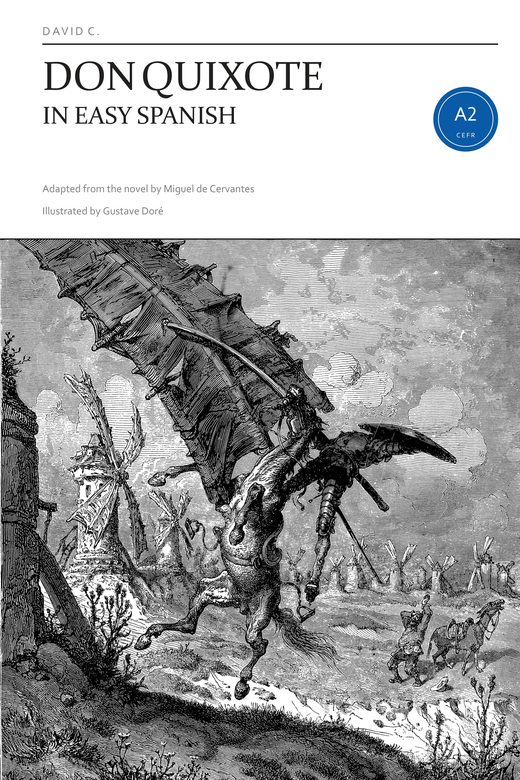
Don Quixote in Easy Spanish: the whole novel retold in Spanish you can actually read, in 58 short episodes, with the hard words glossed in the margin. It is where every Don Quixote sentence on this page comes from.
In EPUB and PDF, with a second novel in the same Spanish. See the books.
Where the course teaches this
2 lessons build it up, each one inside a chapter of the story rather than in the abstract. Free to read, with the vocabulary, the audio and the exercises.
- SER + what you are. Gender and numberLesson 1The gentleman of La Mancha
- UN, UNA, and when you use nothing at allLesson 2The gentleman’s house
Next to this one
The points that sit closest to this one, and that a student usually meets around the same time.