Spanish grammar · B1 · Updated
Spanish comparatives and superlatives
Más and menos with que for the comparison, and el más for the top of the list. Four words go their own way and have to be learned: mejor, peor, mayor and menor. Tanto como is the one for things that are equal, and it agrees when it sits in front of a noun.
The short answer
More is más, less is menos, and than is que: más alto que yo. Adjectives never change shape the way English adds -er. The superlative is the same thing with an article in front: el más alto. Four words go their own way: mejor, peor, mayor, menor.
How to remember it
Más, menos, que, and an article for the superlative
| More than | más plus adjective plus que | Más alto que yo |
|---|---|---|
| Less than | menos plus adjective plus que | Menos caro que ese |
| As as | tan plus adjective plus como | Tan alto como yo |
| The most | the article plus más | El más alto |
| Very, absolutely | the -ísimo ending, stronger than muy | Altísimo |
The forms
The four irregular pairs
| plain | comparative | superlative |
|---|---|---|
| bueno | mejor | el mejor |
| malo | peor | el peor |
| grande, viejo | mayor | el mayor |
| pequeño, joven | menor | el menor |
| bien | mejor | |
| mal | peor |
20 sentences that show the difference
Everyday Spanish, the kind you would actually say. The label under each one says which part of the rule it shows.
Es más alto que yo.
He is taller than me.
More than
Este coche es menos caro.
This car is cheaper.
Less than
Es tan alto como su padre.
He is as tall as his father.
As as
Tengo tantos libros como tú.
I have as many books as you.
Tanto agrees
Es el más alto de la clase.
He is the tallest in the class.
Superlative with de
La ciudad más bonita de España.
The prettiest city in Spain.
De, not en
Este vino es mejor.
This wine is better.
Irregular
Fue peor de lo que esperaba.
It was worse than I expected.
De lo que before a clause
Mi hermano mayor.
My older brother.
Mayor for age
Mi hermana menor.
My younger sister.
Menor for age
Es más grande que la mía.
It is bigger than mine.
Más grande for size
Tengo más de veinte.
I have more than twenty.
De before a number
Es más caro de lo que parece.
It is dearer than it looks.
De lo que before a clause
Cuanto más como, más quiero.
The more I eat, the more I want.
The more the more
Es guapísima.
She is absolutely gorgeous.
The -ísimo ending
Está riquísimo.
It is delicious.
The -ísimo ending
Es el peor día del año.
It is the worst day of the year.
Superlative, irregular
Cada vez mejor.
Better and better.
Set phrase
No hay nada mejor.
There is nothing better.
Set phrase
Es la mejor de todas.
She is the best of the lot.
Feminine superlative
Where English gets in the way
English gets by with a single word, than, in every kind of comparison: more than twelve thousand, faster than he ran, better than I expected. Spanish splits that one word into three, and which one you need depends on what comes next rather than on the meaning. Before a plain noun or pronoun it is que. Before a number it is de. Before a clause with a verb in it, it is de lo que, or one of its agreeing variants. Because English gives no clue, this has to be checked deliberately for a while. There is also a superlative trap: English says the most beautiful in the world and Spanish says la más hermosa del mundo. The preposition is de, and en there is one of the most recognisable English-speaker mistakes in the language.
The mistake to avoid
Four. One, que before a clause. ✗ Corrió más deprisa que corría el otro → ✓ más deprisa de lo que corría el otro. Two, que before a number. ✗ Más que doce mil → ✓ Más de doce mil. Three, en in a superlative. ✗ La más hermosa en el mundo → ✓ La más hermosa del mundo. Four, doubling the comparative. ✗ Más mejor, ✗ más peor → ✓ mejor, ✓ peor.
The cases that break the rule
Más de veinte
Before a number, than is de and not que: más de veinte, menos de la mitad. Que before a number is one of the most audible learner mistakes.
Más de lo que parece
Before a whole clause, than is de lo que: es más caro de lo que parece. Que would need a plain noun or pronoun after it.
El más alto de la clase
In a superlative, "in" is de and not en. La ciudad más bonita de España, never en España. English gets this wrong every time.
Mayor and más grande
Mayor is about age and importance; más grande is about physical size. Mi hermano mayor is the older one, una casa más grande is a bigger house.
Guapísimo
The -ísimo ending is stronger than muy and very common in speech. Watch the spelling changes: rico gives riquísimo, largo gives larguísimo, feliz gives felicísimo.
Es mejor que vengas
Mejor before a que clause takes the subjunctive, because it is advice and not a comparison. Do not confuse it with es mejor que el otro.
Spanish comparative exercises
8 sentences to fill in. Type your answer and check it, or read them straight through with the answers showing. Accents count here, the way they count in the language.
-
Mi hermano es más alto ___ yo.
My brother is taller than me.
que · Que before a pronoun or a noun. De is only used before a number.
-
Es la ciudad más bonita ___ España.
It is the prettiest city in Spain.
de · De and not en, after a superlative. English says "in" and Spanish does not.
-
Tengo más ___ veinte libros de historia.
I have more than twenty history books.
de · De before a number. Más que veinte would be wrong.
-
Este vino es (bueno) ___ que el otro.
This wine is better than the other one.
mejor · Mejor, one of the four irregulars. Más bueno exists but is about moral goodness.
-
Es tan alto ___ su padre.
He is as tall as his father.
como · Tan goes with como, never with que. That pair never breaks.
-
Fue peor ___ lo que esperaba.
It was worse than I expected.
de · De lo que before a whole clause. Que would need a plain noun after it.
-
Mi hermana (pequeño) ___ tiene doce años.
My younger sister is twelve.
menor · Menor for age. Más pequeña would be about physical size.
-
La paella estaba (rico) ___.
The paella was delicious.
riquísima · The -ísimo ending, stronger than muy rica. Note the c turning into qu.
More exercises, from Don Quixote
8 more, these ones straight out of the course: the inn, the windmills, Rocinante and the road. Same rule, older Spanish.
-
Rocinante es ___ flaco que un galgo.
Rocinante is thinner than a greyhound.
más · Spanish has no thinner. It is always más plus the adjective plus que.
-
Sancho es menos alto ___ don Quijote.
Sancho is less tall than Don Quixote.
que · Que is the word for than, in both más and menos comparisons.
-
Don Quijote es el ___ loco de todos.
Don Quixote is the maddest of them all.
más · The superlative is the article plus más. And the group takes de, not en.
-
Este vino es ___ que el otro.
This wine is better than the other one.
mejor · Four adjectives have their own comparative: mejor, peor, mayor, menor. Más bueno is not it.
-
Sancho come más ___ su amo.
Sancho eats more than his master.
que · Comparing with somebody takes que. Compare the next one, where a number changes it.
-
Tiene más ___ cien libros de caballerías.
He has more than a hundred books of chivalry.
de · In front of a number it is de, not que. Más que cien libros is wrong.
-
Es tan valiente ___ Amadís de Gaula.
He is as brave as Amadis of Gaul.
como · Equals take tan plus adjective plus como. With a noun it becomes tanto: tanta hambre como.
-
La cena estaba (rica) ___.
The supper was absolutely delicious.
riquísima · The isimo ending is stronger than muy. Watch the spelling: the c turns into qu.
Common questions
How do I make a comparison in Spanish?
Más or menos, then the adjective, then que: más alto que Sancho. For things that are equal, tan plus the adjective plus como. With a noun it turns into tanto and it agrees: tantos libros como.
Which comparatives are irregular?
Four. Bueno gives mejor, malo gives peor, grande gives mayor and pequeño gives menor. Never más bueno or más malo for quality. About people, mayor and menor usually mean older and younger.
How do I say the most or the least?
El or la plus más plus the adjective, and de where English says "in": el más alto de la clase. The ending -ísimo is a different thing, an intensifier rather than a comparison: altísimo means extremely tall.
What is the difference between más que and más de?
De goes in front of a number: más de veinte. Que goes in front of anything else: más alto que yo. The one exception is a negative, where no más que means only: no tengo más que diez euros is I have just ten.
What does -ísimo mean?
Very, but stronger, and it goes on the end of the adjective: guapísimo, facilísimo, muchísimo. The final vowel drops first, and spelling changes to keep the sound: rico gives riquísimo, largo gives larguísimo. It is not a comparison, it is an intensifier.
How do I say as tall as?
Tan alto como. With an adjective or an adverb you use tan ... como. With a noun you use tanto, which has to agree: tanto dinero como, tantas casas como. With a verb on its own it is tanto como: trabaja tanto como tú.
Is it mayor or más grande?
Mayor is about age: mi hermano mayor, my older brother. Más grande is about size: una casa más grande. The same split works for menor and más pequeño. Using mayor for a building is not wrong but it sounds formal, closer to greater.
How do I say more than I expected?
Más de lo que, when the comparison is with a whole clause rather than a thing: es más difícil de lo que pensaba. English hides the of, Spanish does not, and leaving it out is one of the commonest slips at this level.
The things to remember
- Más, menos and que. Spanish adjectives never change shape the way English adds -er.
- The superlative is just the article plus más, and "in" after it is de.
- Before a number, than is de: más de veinte.
- Four irregulars: mejor, peor, mayor, menor. Mayor is age, más grande is size.
- The -ísimo ending is stronger than muy and is what people actually say.
The same rule in Don Quixote
Real lines from the course, not invented examples. Each one is the sentence the lesson uses to introduce the point.
Sus alforjas estaban mejor provistas que las de Sancho.
His saddlebags were better stocked than Sancho’s.
The book this comes from
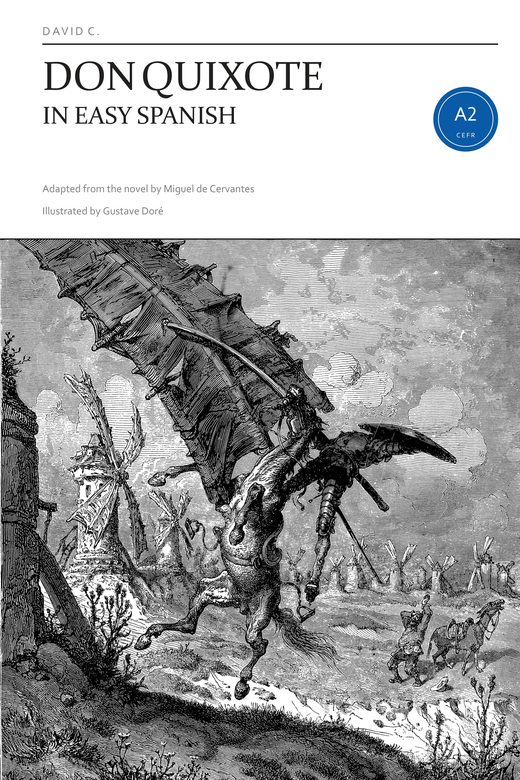
Don Quixote in Easy Spanish: the whole novel retold in Spanish you can actually read, in 58 short episodes, with the hard words glossed in the margin. It is where every Don Quixote sentence on this page comes from.
In EPUB and PDF, with a second novel in the same Spanish. See the books.
Where the course teaches this
One lesson covers it, each one inside a chapter of the story rather than in the abstract. Free to read, with the vocabulary, the audio and the exercises.
- Comparatives and superlativesLesson 64The Knight of the Mirrors
Next to this one
The points that sit closest to this one, and that a student usually meets around the same time.