Spanish grammar · B2 · Updated
Spanish diminutives and suffixes: -ito, -ón, -azo
The endings -ito and -illo make a thing small or affectionate, -ón and -azo make it big or blunt, and -ada makes an event out of a thing. These are not decoration: they are how Spanish manufactures new words, and the ending carries the speaker's attitude as much as the size.
The short answer
Spanish changes the end of a word to change its tone. -ito makes it small or affectionate, -ón makes it big, -azo is a blow or something impressive, and -ucho is contempt. Very little of this is about size: most of it is about how you feel towards the thing.
How to remember it
The ending carries the feeling, not the size
| -ito, -ita | small, or fond, or softening | cafecito |
|---|---|---|
| -illo, -illa | small, and often a bit dismissive | un ratillo |
| -ón, -ona | big, and sometimes clumsy | un cucharón |
| -azo, -aza | a blow, or something impressive | un codazo |
| -ucho, -uzo | shabby, contemptible | un cuartucho |
The forms
The same word through the endings
| word | ending | meaning |
|---|---|---|
| casa | casita | a nice little house |
| casa | casucha | a hovel |
| casa | caserón | a rambling big house |
| perro | perrito | a puppy, or a dear dog |
| golpe | golpazo | a hard blow |
| libro | librito | a little book |
20 sentences that show the difference
Everyday Spanish, the kind you would actually say. The label under each one says which part of the rule it shows.
Un cafecito.
A little coffee.
Fond, not small
Ahora mismito.
Right this second.
-ito on an adverb, intensifying
Espera un momentito.
Wait just a moment.
Softening a request
Está calentito.
It is nice and warm.
Affectionate
Una casita en el campo.
A little house in the country.
Small and fond
Un ratillo.
A little while.
-illo
Un cuartucho.
A poky little room.
-ucho, contempt
Un caserón.
A great rambling house.
-ón, big
Es un cabezón.
He is stubborn.
-ón about a person
Me dio un codazo.
He elbowed me.
-azo, a blow
Un golpazo.
A hell of a bang.
-azo, a blow
¡Qué cochazo!
What a car!
-azo, impressive
Abuelita.
Granny.
Affection
Un poquito.
A little bit.
Poco gives poquito
Un pedacito de pan.
A little piece of bread.
Small
Hasta lueguito.
See you in a bit.
Friendly
Está solita.
She is all on her own.
Pity, not size
Un chiquillo.
A kid.
-illo, affectionate
Una mujerona.
A big strong woman.
-ón, feminine
Un librito de cien páginas.
A little book of a hundred pages.
Genuinely small
Where English gets in the way
English has almost no productive suffixes left. -let and -ie survive in a handful of frozen words, booklet, doggie, and you cannot invent new ones, so English carries this information in separate adjectives placed in front: a little, a nice little, a great big. Spanish loads it into the noun, which has two consequences worth knowing. The first is that the information is compulsory once you choose an ending, so una casita commits you to an attitude in a way a house does not. The second is that translating a diminutive into English almost always makes it worse. Un momentito is not a little moment, it is closer to just a second, and gracias, hijito from an older woman is not thank you, little son but simply warmth with no English equivalent at all. Learn the endings as attitude markers rather than as sizes, and translate the attitude, never the ending.
The mistake to avoid
One. Attaching -ito to everything because it sounds friendly. ✗ Tengo un problemita grave is a contradiction, and ✗ mi madrecita from an adult Spaniard sounds like a parody, though it is normal in parts of Latin America. Endings are regional. Two. ✗ La sillón → ✓ El sillón. When -ón creates a new word it may bring a new gender with it. Three. ✗ Qué casucha más bonita, meant as a compliment. -ucho insults, always. Four. Spelling. ✗ chicito, ✗ amigito → ✓ chiquito, ✓ amiguito. The hard sound has to be protected. Five. Assuming -azo means big when it can mean a blow. Un cabezazo is not a large head.
The cases that break the rule
Ahora mismito
Here -ito makes it more urgent, not smaller. On adverbs it intensifies: ahorita, cerquita, prontito. This use is everywhere in Latin America and common in Spain too.
Un momentito
Softening, not sizing. Espera un momento is an instruction and espera un momentito is a request. This is what the ending is really for, most of the time.
Cafecito, not cafito
Words of one or two syllables ending in -e, -n or -r take -cito: café gives cafecito, joven gives jovencito, amor gives amorcito. Longer words take plain -ito.
Poquito, not pocito
Spelling shifts to keep the sound: poco gives poquito, amigo gives amiguito, lápiz gives lapicito. The c, g and z change so that the consonant stays as it was.
Words that froze
Some diminutives became words in their own right and lost the small meaning: bolsillo is a pocket, bocadillo is a sandwich, ventanilla is a ticket window. Nobody hears a diminutive in them.
Regional differences
Spain leans on -ito and -illo, Latin America on -ito and -ico, and some regions have their own: -ín in Asturias, -iño in Galicia. All are correct where they are said.
Spanish diminutive exercises
8 sentences to fill in. Type your answer and check it, or read them straight through with the answers showing. Accents count here, the way they count in the language.
-
Espera un (momento) ___, ahora vengo.
Wait a moment, I am coming.
momentito · Softening a request, not making the moment shorter.
-
¿Te apetece un (café) ___?
Do you fancy a coffee?
cafecito · Café ends in -e, so it takes -cito and not -ito.
-
Dame un (poco) ___ de agua.
Give me a little water.
poquito · The c turns into qu so the sound stays the same.
-
Me dio un (codo) ___ sin querer.
He elbowed me by accident.
codazo · -azo for a blow given with the thing named.
-
Viven en una (casa) ___ en el campo.
They live in a little house in the country.
casita · Small and fond at the same time, which is the usual mixture.
-
Mi (abuela) ___ tiene noventa años.
My granny is ninety.
abuelita · Pure affection. Nobody is saying the grandmother is small.
-
Es un (cabeza) ___, no hay quien le convenza.
He is stubborn, nobody can talk him round.
cabezón · -ón about a person: not big-headed in size but in obstinacy.
-
Vivía en un (cuarto) ___ sin ventanas.
He lived in a poky room with no windows.
cuartucho · -ucho carries contempt. The room is not small so much as wretched.
More exercises, from Don Quixote
8 more, these ones straight out of the course: the inn, the windmills, Rocinante and the road. Same rule, older Spanish.
-
Le regaló un (libro) ___ de caballerías.
He gave him a little book of chivalry.
librito · The ending ito makes it small, and often fond rather than small. Libro becomes librito.
-
Vivían en una (casa) ___ de La Mancha.
They lived in a little house in La Mancha.
casita · Feminine noun, so ita. The gender never changes with the suffix.
-
De la venta salió un (perro) ___ ladrando.
A great big dog came out of the inn barking.
perrazo · The ending azo makes it big, and here a bit alarming.
-
El ventero era un (hombre) ___ de dos metros.
The innkeeper was a huge man, two metres tall.
hombrón · The ending ón also makes things big. Note that a feminine noun can turn masculine with it: la silla, el sillón.
-
Espera un (poco) ___, Sancho.
Wait a little bit, Sancho.
poquito · The c turns into qu to keep the sound: poco, poquito. Chico gives chiquito the same way.
-
Cuando era (chico) ___ leía todo el día.
When he was small he read all day.
chiquito · Same spelling change as poquito, for the same reason.
-
Un (joven) ___ les abrió la puerta.
A young lad opened the door for them.
jovencito · Words ending in n or e take cito instead of ito: joven, jovencito.
-
Ese (cabeza) ___ no escucha a nadie.
That stubborn fool listens to nobody.
cabezón · The ending ón can also turn a noun into an insult. Cabezón is big headed in both senses.
Common questions
What does -ito really mean?
Small, but more often affectionate or softening. Un momentito is not shorter than un momento, it is friendlier. Ahorita and cerquita add warmth rather than size.
How do I attach the ending?
Usually drop the final vowel and add it: casa gives casita, libro gives librito. Words of one syllable, or ending in -e, -n or -r, take -cito instead: café gives cafecito, joven gives jovencito.
Are these endings interchangeable?
No, each one carries an attitude. Un librito is a nice little book, un librote a fat one, un librillo can be dismissive. And -azo often means a blow: un martillazo is a hit with a hammer.
What is the difference between -ito and -illo?
-ito is affectionate and neutral: un momentito. -illo is smaller and often slightly dismissive or playful: un trabajillo, a little job of no importance. In Andalusia -illo does the everyday work that -ito does elsewhere.
What does -azo mean?
Two things. A blow with the thing: un codazo is a jab with the elbow, un portazo is a slammed door. Or simply a big one, usually admiringly: un cochazo, un golazo. Context tells them apart with no trouble.
Is -ito childish?
Not at all. Spanish adults use it constantly, and in much of Latin America it is part of ordinary polite speech: ahorita, un cafecito, despacito. It softens what you are saying more often than it makes anything small.
Which diminutives have become their own words?
Plenty, and they no longer mean a small anything: bolsillo is a pocket, bocadillo is a sandwich, ventanilla is a service window, gatillo is a trigger, manzanilla is camomile tea. You learn these as vocabulary, not as diminutives.
Can I make a diminutive of a name?
Yes, and it is what Spanish does instead of most nicknames: Juanito, Anita, Carlitos. Some names have their own short form as well, and it is not built with a suffix at all: Pepe for José, Paco for Francisco, Lola for Dolores.
The things to remember
- The ending usually carries feeling, not size.
- -ito is fond or softening, -illo is small and sometimes dismissive.
- -ón is big, -azo is a blow or something impressive, -ucho is contempt.
- Watch the spelling: poco gives poquito, amigo gives amiguito.
- Some diminutives froze into ordinary words: bolsillo, bocadillo, ventanilla.
The same rule in Don Quixote
Real lines from the course, not invented examples. Each one is the sentence the lesson uses to introduce the point.
Yo seré el pastor Quijotiz y tú el pastor Pancino.
I will be the shepherd Quixotiz and you the shepherd Pancino.
The book this comes from
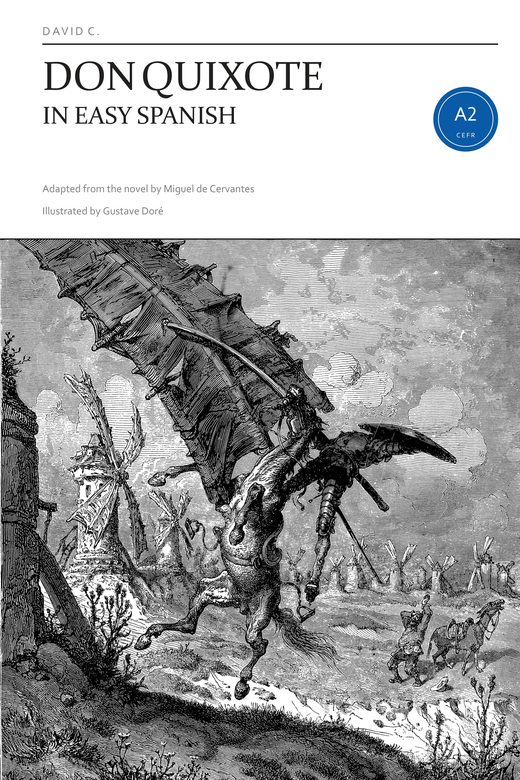
Don Quixote in Easy Spanish: the whole novel retold in Spanish you can actually read, in 58 short episodes, with the hard words glossed in the margin. It is where every Don Quixote sentence on this page comes from.
In EPUB and PDF, with a second novel in the same Spanish. See the books.
Where the course teaches this
One lesson covers it, each one inside a chapter of the story rather than in the abstract. Free to read, with the vocabulary, the audio and the exercises.
- Suffixes: how Spanish manufactures new wordsLesson 88The Plan to Become Shepherds
Next to this one
The points that sit closest to this one, and that a student usually meets around the same time.