Spanish grammar · A2 · Updated
Spanish adverbs in -mente
Take the feminine singular of the adjective and add -mente: rápida gives rápidamente. When two of them come one after the other, only the last one carries the ending. Spanish uses them less than English does and often prefers de forma plus the adjective, or simply a different verb.
The short answer
Take the feminine singular of the adjective and add -mente: rápida gives rápidamente. If the adjective has no separate feminine, add it straight on: fácil gives fácilmente. The adjective keeps any accent it had. In a list, only the last one takes -mente.
How to remember it
Feminine adjective plus -mente
| Ends in -o | switch to -a first | rápido gives rápidamente |
|---|---|---|
| No separate feminine | add it straight on | fácil gives fácilmente |
| Keeps the accent | the adjective holds its own written accent | rápidamente |
| In a list | only the last one takes -mente | lenta y claramente |
| Or avoid it | Spanish often prefers a phrase to a long adverb | con cuidado |
The forms
From adjective to adverb
| adjective | feminine | adverb |
|---|---|---|
| rápido | rápida | rápidamente |
| lento | lenta | lentamente |
| claro | clara | claramente |
| fácil | fácil | fácilmente |
| normal | normal | normalmente |
| feliz | feliz | felizmente |
20 sentences that show the difference
Everyday Spanish, the kind you would actually say. The label under each one says which part of the rule it shows.
Habla lentamente.
He speaks slowly.
From lento
Lo hizo rápidamente.
He did it quickly.
Accent kept
Se explica claramente.
He explains himself clearly.
From claro
Es fácilmente reconocible.
It is easily recognisable.
No separate feminine
Normalmente ceno a las nueve.
I usually have dinner at nine.
At the start of a sentence
Probablemente venga mañana.
He will probably come tomorrow.
Probablemente can take the subjunctive
Solamente quería preguntar.
I only wanted to ask.
Solamente, or just solo
Habló lenta y claramente.
He spoke slowly and clearly.
Only the last takes -mente
Actualmente vivo en Madrid.
I currently live in Madrid.
A false friend
Realmente no lo sé.
I really do not know.
Realmente
Hazlo con cuidado.
Do it carefully.
A phrase instead of an adverb
Lo dijo de repente.
He said it suddenly.
A phrase instead
Habla en voz baja.
Speak quietly.
A phrase instead
Trabaja duro.
He works hard.
An adjective used as an adverb
Habla claro.
Speak plainly.
An adjective used as an adverb
Corre rápido.
He runs fast.
Rápido as an adverb, very common
Últimamente no salgo.
I have not been going out lately.
Últimamente
Finalmente llegó.
He finally arrived.
Finalmente
Difícilmente lo conseguirá.
He will hardly manage it.
Means "hardly", not "with difficulty"
Perfectamente.
Absolutely.
On its own, as an answer
Where English gets in the way
English adds -ly straight onto the adjective and never thinks about gender: slow, slowly. Spanish makes you take one extra step first, into the feminine singular, and only then adds the ending. There is a second difference worth knowing. English is happy to pile up -ly words, while Spanish treats a run of -mente as clumsy and swaps in despacio, bien, mal, or con plus a noun. And note that some English adverbs have no -ly at all, like fast or hard, which trips learners into inventing forms that do not exist.
The mistake to avoid
Three that show up in every written exercise. First, building the adverb on the masculine: ✗ lentomente, ✗ tranquilomente → ✓ lentamente, ✓ tranquilamente. Always through the feminine. Second, losing the accent: ✗ rapidamente, ✗ facilmente → ✓ rápidamente, ✓ fácilmente. The tilde travels with the adjective. Third, repeating the ending in a pair: ✗ lentamente y tristemente → ✓ lenta y tristemente.
The cases that break the rule
Lenta y claramente
When two or more of these adverbs come in a row, only the last one keeps -mente and the others stay as feminine adjectives. It is a real rule and it looks wrong until you know it.
Corre rápido
Some adjectives double as adverbs with no ending at all: rápido, claro, alto, bajo, duro, fuerte. Corre rápido is far commoner in speech than corre rápidamente.
Con cuidado
Spanish often prefers a prepositional phrase to a long -mente adverb: con cuidado, de repente, en voz baja, sin querer. Piling up -mente sounds heavy.
Actualmente
A false friend. It means "currently", not "actually". For "actually" Spanish says en realidad or de hecho.
Difícilmente
Another one that is not what it looks like: it means "hardly" or "unlikely", not "with difficulty". Difícilmente lo conseguirá says he probably will not manage.
Solo and solamente
The same word. Solo lost its accent in 2010, so solo is both "only" and "alone" and the context decides. Old books write sólo for "only".
Spanish -mente adverb exercises
8 sentences to fill in. Type your answer and check it, or read them straight through with the answers showing. Accents count here, the way they count in the language.
-
Habla muy (lento) ___ para que le entiendan.
He speaks very slowly so that people understand him.
lentamente · Lento gives the feminine lenta, then -mente.
-
Lo resolvió (rápido) ___.
He solved it quickly.
rápidamente · The accent on rápida stays. Corre rápido would also be correct as an adverb.
-
Es (fácil) ___ el mejor de todos.
He is easily the best of the lot.
fácilmente · Fácil has no separate feminine, so -mente goes straight on, accent and all.
-
(Normal) ___ ceno sobre las nueve.
I usually have dinner around nine.
Normalmente · Normal has one form for both genders, so nothing changes before -mente.
-
Habló lenta y (claro) ___.
He spoke slowly and clearly.
claramente · Only the last one takes -mente. That is why the first is left as the bare feminine lenta.
-
(Actual) ___ vivo en Sevilla.
I currently live in Seville.
Actualmente · It means currently, not actually. For actually, say en realidad.
-
Hazlo ___ cuidado, que se rompe.
Do it carefully, it breaks easily.
con · Spanish prefers con cuidado to cuidadosamente, which sounds heavy.
-
Mi hermano trabaja muy ___.
My brother works very hard.
duro · Duro is one of the adjectives that works as an adverb with no ending.
More exercises, from Don Quixote
8 more, these ones straight out of the course: the inn, the windmills, Rocinante and the road. Same rule, older Spanish.
-
Don Quijote habló (lento) ___ y con mucha calma.
Don Quixote spoke slowly and very calmly.
lentamente · Take the feminine form of the adjective and add mente: lenta plus mente.
-
Sancho salió (rápido) ___ de la venta.
Sancho left the inn quickly.
rápidamente · Rápida plus mente. The accent of the adjective stays, even though the stress now falls on mente.
-
Lo dijo (claro) ___ delante de todos.
He said it clearly in front of everyone.
claramente · Clara plus mente. Any adjective ending in o goes to a first.
-
Siguieron el camino (tranquilo) ___.
They followed the road calmly.
tranquilamente · Same rule, longer word. Spanish is happy with five syllable adverbs.
-
Este libro se lee (fácil) ___.
This book reads easily.
fácilmente · Fácil has no separate feminine, so mente goes straight on, and the written accent stays put.
-
Contestó (cortés) ___ al ventero.
He answered the innkeeper politely.
cortésmente · Same as fácil: no feminine form, accent kept.
-
Lo hizo lenta y (cuidadoso) ___.
He did it slowly and carefully.
cuidadosamente · When two of these come in a row, only the last one keeps mente. The first stays in the feminine.
-
(General) ___, cenaban antes de que anocheciera.
Generally, they had supper before dark.
Generalmente · At the head of the sentence these adverbs comment on the whole thing, exactly as in English.
Common questions
How do I build an adverb in Spanish?
Feminine singular of the adjective plus -mente: rápida gives rápidamente, lenta gives lentamente. If the adjective has no separate feminine form, use it as it is: fácil gives fácilmente.
What happens with two -mente adverbs in a row?
Only the last one keeps the ending: habló lenta y claramente, not lentamente y claramente. The first adverb goes back to being a plain feminine adjective.
Does the accent survive?
Yes. Rápido keeps its accent in rápidamente even though the stress has moved onto the ending. This is the one suffix in Spanish that leaves the original accent mark alone.
How do I avoid saying -mente all the time?
Three ways, and Spaniards use all of them. Con plus a noun: con cuidado for carefully. De manera or de forma plus the adjective: de manera rápida. Or the bare adjective after some verbs: habla claro, canta bonito.
Which common adverbs never take -mente?
The most used ones: bien, mal, despacio, deprisa, pronto, tarde, temprano, así. There is no buenamente in the sense of well, so habla bien is the only way to say it.
What is the difference between bien and bueno?
Bueno describes a thing or a person: es un libro bueno. Bien describes how something is done: escribe bien. After estar you want bien for how somebody is: estoy bien. Estoy bueno means something else entirely.
Does -mente go on the masculine or the feminine form?
The feminine, when the adjective has one: rápida gives rápidamente, lenta gives lentamente. Adjectives with a single form just take the ending as they are: fácilmente, felizmente.
Where does the adverb go in the sentence?
Usually right after the verb: habla lentamente. It can move to the front for emphasis: lentamente, abrió la puerta. What it cannot do is sit between the verb and its object the way English allows.
The things to remember
- Feminine singular of the adjective, plus -mente.
- The adjective keeps its written accent: rápido gives rápidamente.
- In a list, only the last one takes -mente: lenta y claramente.
- Several adjectives work as adverbs on their own: rápido, claro, alto, duro.
- Spanish often prefers a phrase: con cuidado rather than cuidadosamente.
The same rule in Don Quixote
Real lines from the course, not invented examples. Each one is the sentence the lesson uses to introduce the point.
Buscaban agua completamente a oscuras.
They were looking for water completely in the dark.
The book this comes from
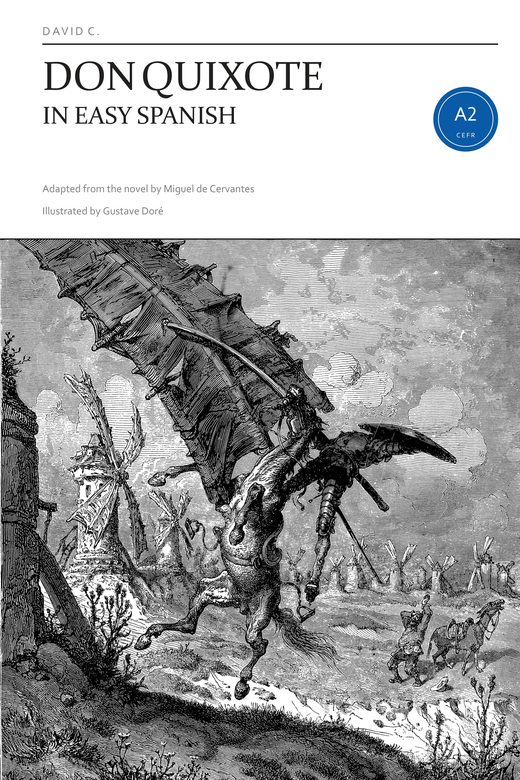
Don Quixote in Easy Spanish: the whole novel retold in Spanish you can actually read, in 58 short episodes, with the hard words glossed in the margin. It is where every Don Quixote sentence on this page comes from.
In EPUB and PDF, with a second novel in the same Spanish. See the books.
Where the course teaches this
One lesson covers it, each one inside a chapter of the story rather than in the abstract. Free to read, with the vocabulary, the audio and the exercises.
- Adverbs in -menteLesson 35The night of the fulling hammers
Next to this one
The points that sit closest to this one, and that a student usually meets around the same time.