Spanish grammar · A1 to A2 · Updated
Spanish possessives: mi, tu, su, nuestro
Mi, tu, su and nuestro go in front of the noun, and they agree with the thing owned rather than with the owner, so "his books" is sus libros. Su is the ambiguous one: his, her, their, or your formal. Spanish also has a strong set that goes behind the noun, and with parts of the body it prefers the article to the possessive altogether.
The short answer
The short possessives go in front of the noun and agree with the thing owned, not the owner: mis libros. Only nuestro and vuestro change for gender. Su is the trap: it means his, her, its, their and your formal, all at once. And Spanish uses the plain article for parts of the body and clothes.
How to remember it
They agree with what is owned, never with the owner
| Short form | in front of the noun: mi, tu, su, nuestro, vuestro, su | Mi casa |
|---|---|---|
| Plural | add -s if the thing is plural | Mis casas |
| Gender | only nuestro and vuestro change | Nuestra casa |
| Long form | after the noun or on its own: mío, tuyo, suyo | Un amigo mío |
| Body and clothes | the article, not the possessive | Me duele la cabeza |
The forms
Short and long, side by side
| short | long | |
|---|---|---|
| my | mi, mis | mío, mía, míos, mías |
| your (tú) | tu, tus | tuyo, tuya |
| his, her, your formal | su, sus | suyo, suya |
| our | nuestro, nuestra, nuestros | nuestro, nuestra |
| your (vosotros) | vuestro, vuestra | vuestro, vuestra |
| their, your formal plural | su, sus | suyo, suya |
20 sentences that show the difference
Everyday Spanish, the kind you would actually say. The label under each one says which part of the rule it shows.
Mi casa es pequeña.
My house is small.
Short form
Mis hermanos viven fuera.
My brothers live abroad.
Plural thing, plural mis
Tu coche está fuera.
Your car is outside.
Tu, no accent
Tú tienes mi libro.
You have my book.
Tú with an accent is the pronoun
Nuestra casa es antigua.
Our house is old.
Nuestro changes for gender
Nuestros amigos vienen.
Our friends are coming.
Nuestro, plural
Su hermana es médica.
His sister is a doctor.
Su, ambiguous
La hermana de él.
His sister.
Clearing up su
Un amigo mío.
A friend of mine.
Long form after a noun
Es mío.
It is mine.
Long form on its own
La culpa es tuya.
It is your fault.
Long form after ser
Este libro es suyo.
This book is his.
Long form
El mío es más grande.
Mine is bigger.
Article plus long form
Me duele la cabeza.
My head hurts.
Article, not the possessive
Se puso el abrigo.
He put his coat on.
Article, not the possessive
Me lavo las manos.
I wash my hands.
Article, not the possessive
¡Dios mío!
My God!
Long form in an exclamation
A tu salud.
Your health.
A toast
De mi parte.
From me.
Set phrase
Cada uno a lo suyo.
Everyone to their own.
Lo suyo, neuter
Where English gets in the way
English uses the possessive to tell you about the owner, so his helmet and her helmet are different words. Spanish uses it to tell you about the object, so both are su celada, and the plural sus celadas means several helmets, never several owners. That last point is worth reading twice: sus manos is one person with two hands, not two people.
The mistake to avoid
The trap is agreement. Because nuestro looks fixed, people leave it alone: ✗ nuestro celada, ✗ nuestro armas. It has to follow the noun: ✓ nuestra celada, ✓ nuestras armas. And because English marks the owner, people add an -s for a plural owner: ✗ los caballeros y sus celada. The -s belongs to the helmets, not to the knights: ✓ sus celadas if there are several, ✓ su celada if there is one each.
The cases that break the rule
Su
One word for his, her, its, their and your formal. Spanish lives with the ambiguity and only clears it up when it has to, by adding de él, de ella, de ustedes: la casa de ella.
Me duele la cabeza
For parts of the body and clothes, Spanish uses the article and lets the pronoun say whose. Me duele mi cabeza sounds as odd as "I wash my the hands" would in English.
Mis libros, not mío libros
The possessive agrees with the thing owned, never with the owner. Nuestra casa is our house whether "we" are men or women; what decides is that casa is feminine.
Tu and tú
Tu without an accent is your. Tú with an accent is you. The accent is the only difference and it changes the word completely: tú tienes tu libro.
Un amigo mío
The long form after a noun means "a friend of mine", one among several. Mi amigo suggests the friend, a particular one. It is a small difference that native speakers hear.
Vuestro
Only used in Spain. Latin America says su and sus for a group as well, so vuestro disappears entirely there and de ustedes takes over when it needs to be clear.
Spanish possessive exercises
8 sentences to fill in. Type your answer and check it, or read them straight through with the answers showing. Accents count here, the way they count in the language.
-
___ hermanos viven en Sevilla.
My brothers live in Seville.
Mis · Mis because hermanos is plural. The possessive agrees with them and not with me.
-
___ casa es muy antigua.
Our house is very old.
Nuestra · Nuestra because casa is feminine. Only nuestro and vuestro change for gender.
-
Me duele ___ cabeza desde ayer.
My head has been hurting since yesterday.
la · The article and not the possessive. Me already says whose head it is.
-
Este libro no es mío, es ___.
This book is not mine, it is yours.
tuyo · The long form on its own, after ser.
-
Ayer vino un amigo ___ a cenar.
A friend of mine came for dinner yesterday.
mío · Long form after the noun: one friend among several. Mi amigo would point at a particular one.
-
La casa de ___ está en la playa.
Her house is at the beach.
ella · De ella clears up what su cannot: his, her, their or yours.
-
Se puso ___ abrigo y salió.
He put his coat on and went out.
el · The article for clothes, exactly as for parts of the body.
-
Tú tienes ___ libro en la mesa.
You have your book on the table.
tu · Tu without an accent is your. Tú with one, right at the start, is you. The accent is the whole difference.
More exercises, from Don Quixote
8 more, these ones straight out of the course: the inn, the windmills, Rocinante and the road. Same rule, older Spanish.
-
___ caballo se llama Rocinante.
My horse is called Rocinante.
Mi · Mi has no gender: mi caballo, mi espada. Only the plural changes: mis caballos.
-
___ escudero es Sancho Panza.
His squire is Sancho Panza.
Su · Su covers his, her, its, their and your for usted. Only the context sorts it out.
-
___ libros son de caballerías.
Our books are books of chivalry.
Nuestros · Nuestro is the only one that shows gender: nuestro libro, nuestra casa, nuestros libros.
-
Don Quijote es amigo ___.
Don Quixote is a friend of mine.
mío · After the noun it becomes mío, tuyo, suyo, and now it does agree: una amiga mía.
-
La casa ___ es más grande que la de ellos.
Our house is bigger than theirs.
nuestra · After the noun, nuestro agrees with the house, so nuestra.
-
___ mujer se llama Teresa.
His wife is called Teresa.
Su · To make it clear whose, Spanish adds a tail: la mujer de él, la mujer de Sancho.
-
Me duele ___ cabeza.
My head hurts.
la · With parts of the body Spanish uses the article, not the possessive. Me duele mi cabeza sounds foreign.
-
Estos libros son ___.
These books are yours.
tuyos · After ser it is the long form, agreeing with the books: tuyos.
Common questions
Why is "his books" sus libros?
Because the possessive agrees with what is owned, not with who owns it. One owner or many changes nothing: su libro, sus libros. Only nuestro and vuestro also change for gender.
How do I clear up what su means?
Add de plus the person: su casa becomes la casa de él, la casa de ella, la casa de ustedes. Spanish does this whenever the context does not already make it obvious.
Why is it me lavo las manos and not mis manos?
Because the reflexive pronoun already says whose hands they are, so the possessive would only repeat it. The same goes for clothes and body parts: se quitó el sombrero.
What is the difference between mi and mío?
Mi goes in front of the noun: mi casa. Mío goes after it or on its own: un amigo mío, es mío. The short one is the everyday one, and the long one is what you use for emphasis and after ser.
How do I say a friend of mine?
Un amigo mío. Spanish puts the long possessive after the noun and keeps the article at the front, which is exactly the shape of the English of mine. Mi amigo would mean the friend, one you have already talked about.
How do I say mine and yours?
Article plus the long form, agreeing with the thing owned: el mío, la tuya, los nuestros. After ser the article usually drops: este libro es mío.
Is vuestro used in Latin America?
No. Latin America uses ustedes for every plural you, so the possessive is su or de ustedes. Vuestro is Spain only, and it is one of the clearest markers of where somebody learned their Spanish.
Do possessives agree with the owner or the thing?
With the thing owned, always. Sus libros is his books or her books or their books, and the s on sus is there because there are several books, not several owners. This is the opposite of English his and her, and it is why su is so ambiguous.
The things to remember
- The possessive agrees with the thing owned, not with the owner.
- Only nuestro and vuestro change for gender. Mi, tu and su just add -s.
- Su means his, her, its, their and your formal. Use de él or de ella to be clear.
- For body parts and clothes Spanish uses the article: me duele la cabeza.
- The long form goes after the noun, after ser, or on its own: un amigo mío, es mío.
The same rule in Don Quixote
Real lines from the course, not invented examples. Each one is the sentence the lesson uses to introduce the point.
Su celada no está entera.
His helmet is not complete.
El ventero, su mujer y su hija los recibieron en la puerta.
The innkeeper, his wife and his daughter met them at the door.
The book this comes from
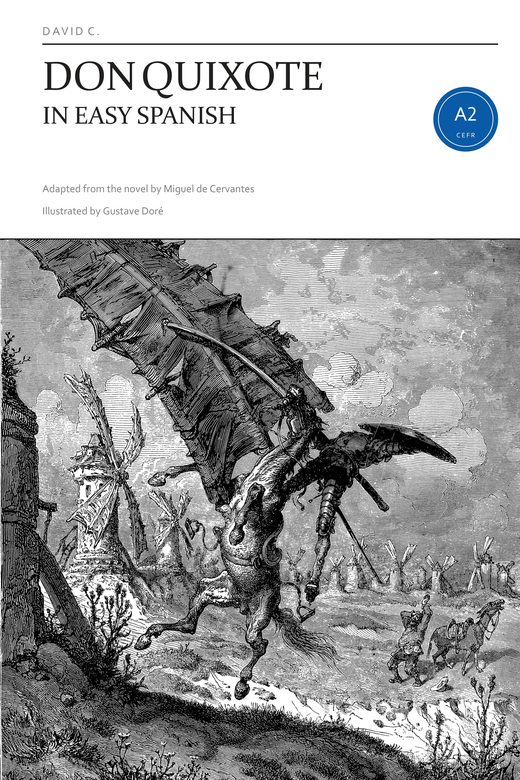
Don Quixote in Easy Spanish: the whole novel retold in Spanish you can actually read, in 58 short episodes, with the hard words glossed in the margin. It is where every Don Quixote sentence on this page comes from.
In EPUB and PDF, with a second novel in the same Spanish. See the books.
Where the course teaches this
2 lessons build it up, each one inside a chapter of the story rather than in the abstract. Free to read, with the vocabulary, the audio and the exercises.
- Mi, tu, su, nuestroLesson 6The cardboard helmet
- Possessives: the weak set and the strong setLesson 28The inn by night: Maritornes
Next to this one
The points that sit closest to this one, and that a student usually meets around the same time.