Spanish grammar · A1 to A2 · Updated
How gustar works in Spanish
Gustar does not mean "to like". It means "to please", and the thing you like is the subject of the sentence. So me gustan los libros is literally "the books please me", and that is why the verb agrees with the books and not with me. Doler, faltar, quedar and encantar all behave the same way.
The short answer
Gustar does not mean "to like". It means "to please", so the thing you like is the subject and you are the object: me gusta el café is "coffee pleases me". That is why the verb agrees with the coffee and not with you, and why it is nearly always gusta or gustan and almost never gusto.
How to remember it
Turn the English sentence around
| You | become the pronoun in front: me, te, le, nos, os, les | Me |
|---|---|---|
| The thing | becomes the subject, and the verb agrees with it | gusta el café |
| Singular | one thing, or a verb, takes gusta | Me gusta leer |
| Plural | more than one thing takes gustan | Me gustan los libros |
| A mí | added in front only to stress or to clear up le and les | A ella le gusta |
The forms
Gustar with one thing and with several
| one thing | several things | |
|---|---|---|
| to me | me gusta | me gustan |
| to you | te gusta | te gustan |
| to him, her, you formal | le gusta | le gustan |
| to us | nos gusta | nos gustan |
| to you all | os gusta | os gustan |
| to them, you all formal | les gusta | les gustan |
20 sentences that show the difference
Everyday Spanish, the kind you would actually say. The label under each one says which part of the rule it shows.
Me gusta el café.
I like coffee.
One thing
Me gustan los libros.
I like books.
Several things
Me gusta leer.
I like reading.
A verb counts as one
Me gusta leer y pasear.
I like reading and walking.
Two verbs still take gusta
A mí me gusta el té.
I like tea.
A mí only for stress
A ella le gusta bailar.
She likes dancing.
A ella clears up le
No me gusta nada.
I do not like it at all.
Negative
Nos gusta esta casa.
We like this house.
Nos
Me encanta esta canción.
I love this song.
Encantar, same shape
Me interesa la historia.
I am interested in history.
Interesar, same shape
Me duele la cabeza.
My head hurts.
Doler, same shape
Me duelen los pies.
My feet hurt.
Doler in the plural
Me falta un euro.
I am one euro short.
Faltar, same shape
Me quedan dos.
I have two left.
Quedar, same shape
Me parece bien.
It seems fine to me.
Parecer, same shape
Me molesta el ruido.
The noise bothers me.
Molestar, same shape
Te gusto.
You like me.
The rare gusto, about a person
Me gustaría un café.
I would like a coffee.
Polite conditional
Me gustó mucho la película.
I really liked the film.
In the past
A mis padres les gusta el campo.
My parents like the countryside.
A plus a name still needs le
Where English gets in the way
In English the person is the subject: I like the books. In Spanish the thing is the subject, so the verb agrees with the thing, not with you. Learning this verb means turning the whole sentence around.
The mistake to avoid
English speakers say ✗ Yo gusto los libros, which actually means "I am pleasing to the books". The right form is ✓ Me gustan los libros. And with a plural thing the verb goes plural too: ✗ Me gusta los libros → ✓ Me gustan los libros.
The cases that break the rule
Me gusta leer y escribir
Two verbs and still gusta. Infinitives never make the verb plural, however many you pile up, because what pleases you is the activity and not a list of things.
Te gusto
The one place gusto is normal: when the thing that pleases is a person. Me gustas is I fancy you. Learners avoid it out of habit and then it sounds odd when a Spaniard says it.
A Juan le gusta
Even with the name right there, le stays. Spanish doubles it up: the a phrase names the person and the pronoun is still compulsory. Dropping it is the commonest mistake at A2.
Me gustaría
The conditional is the polite request, not a real "would like". In a bar you say me gustaría un café or, more usually, me pones un café.
Encantar has no muy
Me encanta already means "I love it", so me encanta mucho is wrong. Gustar takes mucho, encantar does not.
Me gusta él
To say you like a person as company, most speakers prefer me cae bien. Me gusta él means you find him attractive, which is a different conversation.
Gustar exercises
8 sentences to fill in. Type your answer and check it, or read them straight through with the answers showing. Accents count here, the way they count in the language.
-
Me ___ mucho los libros de historia.
I really like history books.
gustan · Plural, because the verb agrees with the books and not with me.
-
A mi hermana ___ gusta el chocolate.
My sister likes chocolate.
le · Le is compulsory even with a mi hermana right there. Spanish names the person twice.
-
Nos ___ mucho esta ciudad.
We really like this city.
gusta · Singular, because there is one city. Nos is us, and it never changes the ending.
-
Me ___ leer y escuchar música.
I like reading and listening to music.
gusta · Singular, because infinitives never make it plural, however many there are.
-
Me ___ la cabeza desde ayer.
My head has been aching since yesterday.
duele · Doler works exactly like gustar: the head is the subject and you are the object.
-
A ellos no ___ gusta madrugar.
They do not like getting up early.
les · Les for a plural person. A ellos on its own is not enough.
-
¿Te ___ la película de ayer?
Did you like yesterday's film?
gustó · Preterite, because the film is over. The shape does not change in the past.
-
Me ___ dos euros para el billete.
I am two euros short for the ticket.
faltan · Faltar takes the same shape, and here it is plural because two euros are missing.
More exercises, from Don Quixote
8 more, these ones straight out of the course: the inn, the windmills, Rocinante and the road. Same rule, older Spanish.
-
A don Quijote le (gustar) ___ los libros de caballerías.
Don Quixote likes books of chivalry.
gustan · The books are the subject and they are plural, so the verb is plural. Don Quixote is not the subject at all.
-
A Sancho le (gustar) ___ el vino.
Sancho likes wine.
gusta · One thing pleases him, so the verb is singular. Word by word: to Sancho, the wine is pleasing.
-
A mí me (encantar) ___ las novelas largas.
I love long novels.
encantan · Encantar works exactly like gustar, and so do interesar, importar and doler.
-
A nosotros ___ gusta el campo de Montiel.
We like the plain of Montiel.
nos · The pronoun is compulsory even when a nosotros is already there. The a phrase only adds emphasis.
-
A los duques les (interesar) ___ la broma.
The duke and duchess are interested in the joke.
interesa · La broma is singular, so the verb is singular, however many dukes there are.
-
A Sancho le (doler) ___ las costillas.
Sancho's ribs hurt.
duelen · Spanish makes the ribs do the hurting. Sancho is only the one they happen to.
-
No me (importar) ___ tus razones.
Your reasons do not matter to me.
importan · Razones is plural, so importan. The verb never agrees with me.
-
A ellos ___ gustaron los molinos.
They liked the windmills.
les · The pronoun for ellos is les. Me, te, le, nos, os, les: those six and no others.
Common questions
Why is it me gustan los libros and not me gusto los libros?
Because the books are doing the pleasing. Gustar agrees with what is liked, so a plural thing gives gustan and a singular thing gives gusta. Me gusto would mean I like myself.
What is the a mí for in a mí me gusta?
Emphasis or contrast, nothing more. The me is already there doing the grammatical work. A mí me gusta el vino, a ella no. With a name you do need it: a Sancho le gusta.
Which other verbs work this way?
Encantar, doler, faltar, quedar, importar, interesar, molestar and parecer. Me duele la cabeza is literally "the head hurts me", and that is the same grammar as gustar.
How do I say I like you in Spanish?
Me caes bien if you mean you are good company. Me gustas if you mean you are attracted to them, and it is understood that way, so the two are not interchangeable. For a thing or an activity, me gusta carries no such weight.
What is the difference between gustar and encantar?
Encantar is the strong one, and it already means love, so you never add mucho: me encanta, not me encanta mucho. Spanish keeps amar for people, which is why me encanta is how you say you love a film or a city.
How do I say I do not like it?
Put no in front of the pronoun, not in front of the verb: no me gusta. The whole block stays together, so also no me gustan, no me gustó, a mí no me gusta.
Why is it me duele la cabeza?
Because doler works exactly like gustar: the head is the subject and does the hurting, and you are the one it happens to. That is also why Spanish says la cabeza and not mi cabeza, since the me has already said whose it is.
Is it me gusta or me gusta a mí?
Me gusta is complete on its own. A mí me gusta is not a repetition by mistake, it adds emphasis or a contrast: a mí me gusta, a ella no. Spanish puts it at the front, never at the end.
The things to remember
- Gustar means "to please". Turn the English round and everything falls into place.
- The verb agrees with the thing liked, so it is gusta or gustan, and almost never gusto.
- An infinitive always takes gusta, even two or three of them in a row.
- A mí, a ti, a Juan are extra. The pronoun me, te, le is the compulsory part.
- Encantar, interesar, doler, faltar, quedar, parecer and molestar all work the same way. Learn the shape once.
The same rule in Don Quixote
Real lines from the course, not invented examples. Each one is the sentence the lesson uses to introduce the point.
Al ventero no le gusta nada la idea.
The innkeeper does not like the idea at all.
A don Quijote le dolía todo el cuerpo.
Don Quixote ached all over.
The book this comes from
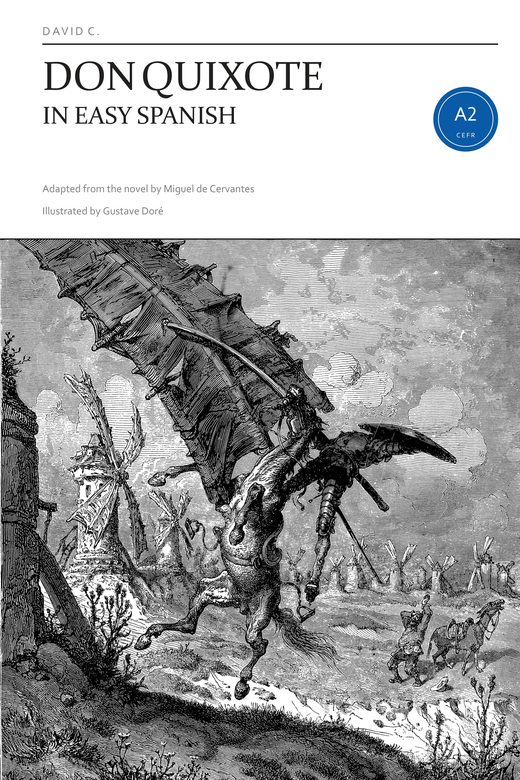
Don Quixote in Easy Spanish: the whole novel retold in Spanish you can actually read, in 58 short episodes, with the hard words glossed in the margin. It is where every Don Quixote sentence on this page comes from.
In EPUB and PDF, with a second novel in the same Spanish. See the books.
Where the course teaches this
2 lessons build it up, each one inside a chapter of the story rather than in the abstract. Free to read, with the vocabulary, the audio and the exercises.
- GUSTAR and the pronouns me / te / leLesson 13The night of the armour vigil
- The body and the verb dolerLesson 30The balm and the blanket
Next to this one
The points that sit closest to this one, and that a student usually meets around the same time.