Spanish grammar · A1 to A2 · Updated
Spanish reflexive verbs and the four uses of se
Se is doing four different jobs and they are worth separating. Truly reflexive: he washes himself. A change of state: se durmió, he fell asleep. Accidental: se me cayó, it fell and I am not taking the blame. Impersonal: se dice, people say. One word, four grammars.
The short answer
A reflexive verb turns the action back on the person doing it: lavo el coche is I wash the car, me lavo is I wash myself. The pronoun changes with the person, me, te, se, nos, os, se, and goes in front of the verb. Many Spanish verbs simply come in a pair, and the se version means something slightly different.
How to remember it
The action comes back to the doer
| Truly reflexive | you do it to yourself | Me lavo |
|---|---|---|
| Reciprocal | two people do it to each other | Se escriben |
| A change of state | getting angry, getting up, falling asleep | Me enfado |
| A pair with a twist | ir is to go, irse is to leave | Me voy |
| No se | the same verb with an object needs no pronoun | Lavo el coche |
The forms
Levantarse in the present
| pronoun | verb | |
|---|---|---|
| yo | me | levanto |
| tú | te | levantas |
| él, ella, usted | se | levanta |
| nosotros | nos | levantamos |
| vosotros | os | levantáis |
| ellos, ustedes | se | levantan |
20 sentences that show the difference
Everyday Spanish, the kind you would actually say. The label under each one says which part of the rule it shows.
Me levanto a las siete.
I get up at seven.
Daily routine
Se ducha por la mañana.
He showers in the morning.
Daily routine
Nos acostamos tarde.
We go to bed late.
Daily routine
Me llamo Ana.
My name is Ana.
Literally: I call myself
Se llama Rocinante.
It is called Rocinante.
Naming
Me enfado con facilidad.
I get angry easily.
Change of mood
Se puso rojo.
He went red.
Ponerse plus adjective
Se quedó callado.
He stayed quiet.
Quedarse
Se escriben cada semana.
They write to each other every week.
Reciprocal
Nos vemos mañana.
See you tomorrow.
Reciprocal, and a goodbye
Me voy.
I am off.
Irse, not ir
Voy al mercado.
I am going to the market.
Ir, no pronoun
Se durmió en el sofá.
He fell asleep on the sofa.
Dormirse, the moment
Durmió ocho horas.
He slept for eight hours.
Dormir, the stretch
Me comí toda la tarta.
I ate the whole cake.
The se of finishing it off
Lavo el coche los sábados.
I wash the car on Saturdays.
Object, so no pronoun
Me lavo las manos.
I wash my hands.
The part of the body takes el, not mi
Voy a levantarme temprano.
I am going to get up early.
Stuck on the infinitive
Levántate.
Get up.
Stuck on a positive order
No te levantes.
Do not get up.
In front on a negative order
Where English gets in the way
English almost never marks this. It says I get up, I wash, I get dressed, and myself shows up only when you want to insist on it. In Spanish the pronoun is not decoration: it is part of the verb, and without it the sentence means something else. Lavo el caballo = I wash the horse. Me lavo = I wash. Same verb, one small word apart.
The mistake to avoid
English speakers say ✗ Yo llamo Ana (that means "I phone Ana") or ✗ Me llamo es Ana (two verbs, one too many). The right form is ✓ Me llamo Ana. And ✗ Levanto a las siete means "I lift something at seven": the right form is ✓ Me levanto a las siete.
The cases that break the rule
Me lavo las manos
Spanish says the hands, not my hands. The pronoun has already said whose they are, so mi manos sounds as odd as "I wash my the hands" would in English.
Ir and irse
Ir is to go somewhere and needs a destination. Irse is to leave, and needs nothing. Me voy on its own is a complete sentence and one of the most useful in the language.
Dormir and dormirse
Dormir is the stretch of sleeping, dormirse is the moment of dropping off. The same split runs through ir and irse, comer and comerse, llevar and llevarse.
Se me cayó
Two pronouns and no blame. Spanish moves the accident away from you: literally "it fell itself on me". Lo tiré would say you threw it, which is a different admission.
Nos vemos
A reciprocal used as a goodbye. It does not mean "we see ourselves" but "we will see each other", and it is what most people say instead of adiós.
Levántate
The pronoun goes on the end of a positive order and an accent appears to hold the stress where it was. The negative puts it back in front, with no accent: no te levantes.
Spanish reflexive verb exercises
8 sentences to fill in. Type your answer and check it, or read them straight through with the answers showing. Accents count here, the way they count in the language.
-
Todos los días ___ levanto a las siete.
Every day I get up at seven.
me · Me for yo. The pronoun changes with the person, exactly like the ending does.
-
Mi hermana ___ llama Elena.
My sister is called Elena.
se · Se for the third person. Llamarse is literally to call oneself.
-
___ lavamos las manos antes de comer.
We wash our hands before eating.
Nos · Nos for nosotros. And notice las manos, not nuestras manos: the pronoun already says whose.
-
Ya es tarde, ___ voy.
It is late, I am off.
me · Irse is to leave, and it needs no destination. Voy on its own would be waiting for one.
-
Los dos hermanos ___ escriben cada semana.
The two brothers write to each other every week.
se · Reciprocal se: not to themselves but to each other.
-
Anoche ___ durmió en el sofá.
Last night he fell asleep on the sofa.
se · Dormirse is the moment of dropping off. Durmió would be the eight hours that followed.
-
Voy a acostar___ pronto.
I am going to go to bed early.
me · On the end of the infinitive. Me voy a acostar is equally correct.
-
No ___ preocupes, no pasa nada.
Do not worry, it is nothing.
te · A negative order puts the pronoun back in front. Preocúpate would be the positive one.
More exercises, from Don Quixote
8 more, these ones straight out of the course: the inn, the windmills, Rocinante and the road. Same rule, older Spanish.
-
Don Quijote ___ levanta al amanecer.
Don Quixote gets up at daybreak.
se · The plain reflexive: he raises himself. Levanta on its own would mean he lifts something else.
-
Yo ___ llamo Alonso Quijano.
My name is Alonso Quijano.
me · Word for word, I call myself. The pronoun changes with the person: me, te, se, nos, os, se.
-
Sancho y su amo ___ miran sin decir nada.
Sancho and his master look at each other without saying anything.
se · The reciprocal se: not each one at himself, but one at the other. Only plurals can do this.
-
Aquí ___ vende vino.
Wine is sold here.
se · The passive se: nobody says who sells it. This is how Spanish writes most signs and notices.
-
___ dice que la ínsula no existe.
They say the island does not exist.
Se · The impersonal se, for the English they or people. There is no subject at all, and the verb stays singular.
-
Nosotros ___ acostamos tarde.
We go to bed late.
nos · Nos for nosotros. Acostar without the pronoun means to put somebody else to bed.
-
¿Cómo ___ llamas?
What is your name?
te · Te for tú. The question is literally how do you call yourself.
-
Don Quijote ___ comió toda la olla.
Don Quixote ate the whole stew.
se · This se adds nothing to the meaning and a lot to the tone: the whole thing, down to the last spoon.
Common questions
What are the four uses of se?
Reflexive, where the action comes back on the subject: se lava. A change of state: se durmió. Accidental, where the blame slides off: se me cayó. And impersonal or passive: se dice, se venden casas.
What changes when a verb takes se?
Often the meaning. Ir is to go and irse is to leave. Dormir is to sleep and dormirse is to fall asleep. Acordar is to agree and acordarse is to remember. Treat each pair as two separate verbs.
Where does the pronoun go?
In front of the conjugated verb: me levanto. On the end of an infinitive, a gerund or a positive command: levantarse, levantándose, levántate. With two verbs together either position is correct.
What is the difference between ir and irse?
Ir is to go somewhere and wants a destination: voy al mercado. Irse is to leave, and the point is the place you are abandoning: me voy. The se adds departure, not direction, and that is the pattern behind many of these pairs.
Why do Spaniards say me comí toda la pizza?
Because that se says the whole thing was finished off. Comí pizza is neutral, me comí la pizza is I polished off the lot. It works the same with beberse, leerse, aprenderse and saberse, and it always needs a definite quantity.
How do I say each other in Spanish?
With the same se, used reciprocally: se miraron, they looked at each other. If it could be misread as themselves, Spanish adds el uno al otro or mutuamente to settle it.
Is se me olvidó correct?
Yes, and it is what most people actually say. That construction hands the blame to the thing rather than the person: se me olvidó, it slipped my mind. It works with caer, romper, perder and acabar, and the verb agrees with what was lost or broken: se me rompieron las gafas.
Which verbs are always reflexive?
Some exist only with se and there is no version without it: arrepentirse, quejarse, atreverse, darse cuenta, portarse. They are not reflexive in meaning, the pronoun is simply part of the verb, so learn them with the se attached.
The things to remember
- The pronoun changes with the person: me, te, se, nos, os, se.
- It is not always about doing something to yourself. Getting up, getting angry and leaving all take it.
- Many verbs come in a pair, and the se version shifts the meaning: ir and irse, dormir and dormirse.
- With parts of the body Spanish says el and not mi, because the pronoun already says whose.
- It goes in front of the verb, on the end of an infinitive, a gerund or a positive order.
The same rule in Don Quixote
Real lines from the course, not invented examples. Each one is the sentence the lesson uses to introduce the point.
Don Quijote se levanta muy temprano.
Don Quixote gets up very early.
Se le rompió la cincha y se le cayó la silla.
The girth broke on him and the saddle came off.
Aquí se cobra a todo el mundo.
Everybody gets charged here.
The book this comes from
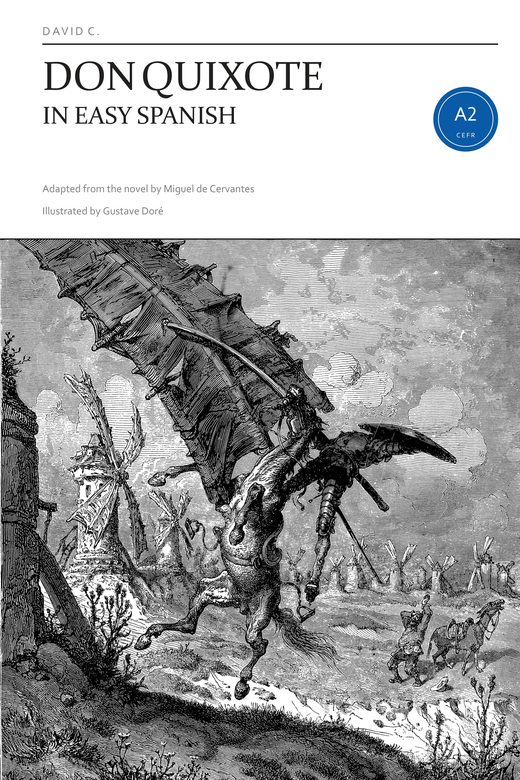
Don Quixote in Easy Spanish: the whole novel retold in Spanish you can actually read, in 58 short episodes, with the hard words glossed in the margin. It is where every Don Quixote sentence on this page comes from.
In EPUB and PDF, with a second novel in the same Spanish. See the books.
Where the course teaches this
3 lessons build it up, each one inside a chapter of the story rather than in the abstract. Free to read, with the vocabulary, the audio and the exercises.
- Reflexive verbs and seLesson 9Dulcinea of El Toboso
- The accidental se: se me cayóLesson 27The Yanguesans
- Impersonal se and the reflexive passiveLesson 31What you pay for at an inn
Next to this one
The points that sit closest to this one, and that a student usually meets around the same time.