Level A2 · Chapter 27
The Yanguesans
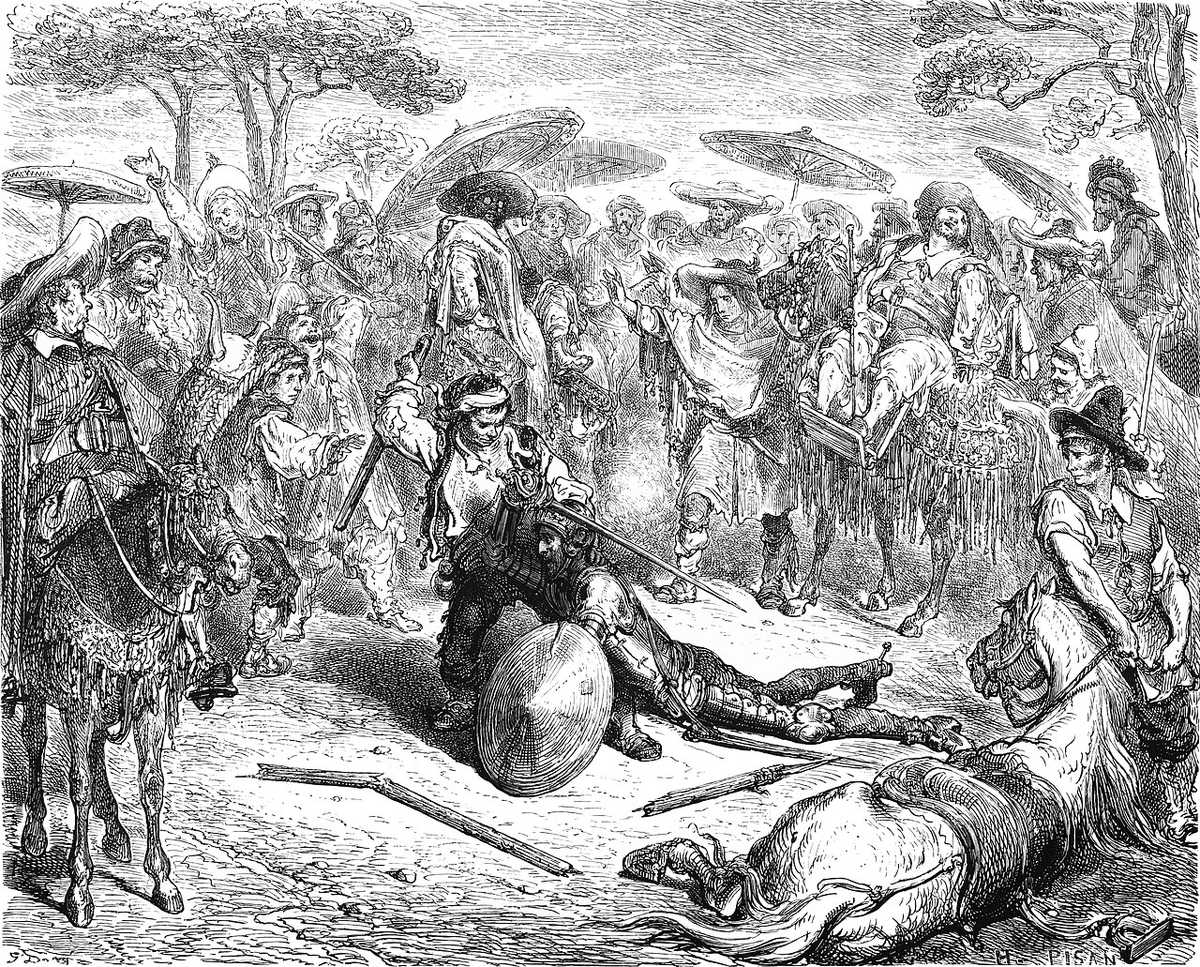
Rocinante gets too close to a herd of Galician mares, and twenty muleteers beat all three of them. Nobody is to blame: things fall by themselves.
What you will learn
- Tell of an accident without blaming anyone: se me cayó, se le rompió.
- Say who the mishap happened to, with me, te, le, nos, os, les.
- Tell breaking something apart from something breaking on you.
Before you read
In this lesson almost nobody does anything. Things break by themselves and fall by themselves, and they happen to somebody. Watch the order of the little words: se comes first, then me, te or le.The story in easy Spanish
Aquella tarde don Quijote y Sancho llegaron a un prado verde.
That afternoon Don Quixote and Sancho came to a green meadow.
Los dos estaban cansados. Bajaron de sus animales y comieron sin mantel.
They were both tired. They got down from their animals and ate with no tablecloth.
En el prado había veinte yeguas gallegas. Unos arrieros yangüeses las guardaban.
There were twenty Galician mares in the meadow. Some Yanguesan muleteers were watching over them.
A Rocinante se le olvidó que era el caballo de un caballero.
Rocinante forgot that he was a knight’s horse.
Se acercó a las yeguas con muy buenas intenciones.
He went up to the mares with the very best of intentions.
Ellas no querían fiestas y lo recibieron a coces y a dentelladas.
They were in no mood for a party and met him with kicks and bites.
Al pobre caballo se le rompió la cincha y se le cayó la silla.
The girth broke on the poor horse and his saddle came off.
Los arrieros llegaron con estacas y le dieron muchos palos.
The muleteers came running with stakes and gave him a good beating.
«Sancho, amigo, estos hombres no son caballeros. Son gente baja.»
"Sancho, my friend, these men are not knights. They are common people."
«Señor, ellos son más de veinte y nosotros somos dos.»
"Sir, there are more than twenty of them and two of us."
Don Quijote sacó la espada. Sancho lo siguió sin ninguna gana.
Don Quixote drew his sword. Sancho followed him with no enthusiasm at all.
Los arrieros apalearon a los dos y los dejaron en el suelo.
The muleteers thrashed the pair of them and left them on the ground.
Después recogieron su recua y siguieron su camino sin mirar atrás.
Then they gathered up their mule train and went on their way without looking back.
A don Quijote se le cayó la espada entre la hierba.
Don Quixote dropped his sword somewhere in the grass.
«Sancho, ¿estás vivo?» «Señor, creo que se me rompieron tres costillas.»
"Sancho, are you alive?" "Sir, I think three of my ribs are broken."
«La culpa es mía. No debía sacar la espada contra hombres sin armas.»
"The fault is mine. I should not have drawn my sword against men who were not knights."
A los dos se les quitaron las ganas de aventuras por aquel día.
The two of them lost all appetite for adventures that day.
Sancho puso a su señor encima del burro y ató a Rocinante detrás.
Sancho put his master on the donkey and tied Rocinante on behind.
Así salieron del prado, molidos y despacio, a buscar una venta.
And so they left the meadow, aching and slow, looking for an inn.
Vocabulary
The meadow and the animals
- el prado
- the meadow
- la yegua
- the mare
- la hierba
- the grass
- la coz
- the kick
- la cincha
- the girth
The muleteers
- el arriero
- the muleteer
- la recua
- the mule train
- la estaca
- the stake, the club
- apalear
- to beat with sticks
- gente baja
- common people, people of low birth
After the beating
- molido / molida
- aching all over
- la costilla
- the rib
- el suelo
- the ground
- la culpa
- the blame, the fault
- las ganas
- the appetite for something, the will
The accidental se: se me cayó
Se le rompió la cincha y se le cayó la silla.
Se me rompieron tres costillas.
A los dos se les quitaron las ganas de aventuras.
Spanish has a whole machine for telling of a mishap without accusing anybody. English needs the passive or a shrug. Spanish just moves the words around.
The order never changes. First se, then the person as me, te, le, nos, os, les, then the verb, then the thing.
| se | to whom | verb | the thing | English |
|---|---|---|---|---|
| se | me | cayó | la espada | I dropped my sword |
| se | te | rompió | la lanza | you broke your lance |
| se | le | olvidó | el nombre | he forgot the name |
| se | nos | perdieron | las armas | we lost the armour |
| se | os | cayeron | los libros | you lot dropped the books |
| se | les | quitaron | las ganas | they lost the urge |
The verb agrees with the thing
This is the part that catches people out. The subject is the object that fell, not the person who suffered it. So se me rompió una costilla but se me rompieron tres costillas. Change the number of ribs and the verb changes with them.
The five verbs you will use every day
caerse to drop, romperse to break, olvidarse to forget, perderse to lose, quedarse to be left behind. There are more, and Spain adds new ones happily, but these five carry most of the traffic.
Saying it on purpose, or not
Both versions exist and they mean different things. Rompí la lanza says you broke it, and you knew what you were doing. Se me rompió la lanza says it broke, and you were merely standing there. Spanish speakers choose the second one very often, and not always innocently.
With le and les you can add the person at the front for clarity: a don Quijote se le cayó la espada, a los dos se les quitaron las ganas.
The muleteers, masters of the roads
Spain in 1605 had almost no wheeled traffic worth the name. Roads were tracks, bridges were rare and carts were slow. Nearly everything sold in the country moved on the backs of mules, and the men who drove them were the muleteers.
They travelled in groups of ten or twenty, walked hundreds of kilometres a year and slept where they could. They were poor, but they were not weak and they were never alone. A stake of hard wood was standard equipment, and a man who insulted one of them had insulted all twenty.
The Yanguesans came from Yanguas, in the province of Soria, and drove their trains south to Andalusia and back every season along the same routes. Cervantes chose them on purpose. The joke of the chapter is that Don Quixote, who spends his life looking for enemies worthy of a knight, finally meets the real power on the roads of Castile, and it beats him flat in about a minute.
Note also what he says afterwards. His shame is not that he lost. It is that he broke the rules of chivalry by drawing a sword against men who were not knights. He loses the fight and worries about the etiquette.
Cervantes in the original · «Mas yo me tengo la culpa de todo…»
Mas yo me tengo la culpa de todo, que no había de poner mano a la espada contra hombres que no fuesen armados caballeros como yo.
But I have myself to blame for all of it, for I ought not to have laid hand on my sword against men who were not dubbed knights as I am.
Look at yo me tengo la culpa. Modern Spanish would say yo tengo la culpa, and that extra me is the same pronoun you have just learned. It adds nothing to the meaning and everything to the feeling: it puts the speaker inside his own sentence. Había de poner is an old way of saying debía poner, and fuesen is a past subjunctive you will meet in B1.