Level A2 · Chapter 28
The inn by night: Maritornes
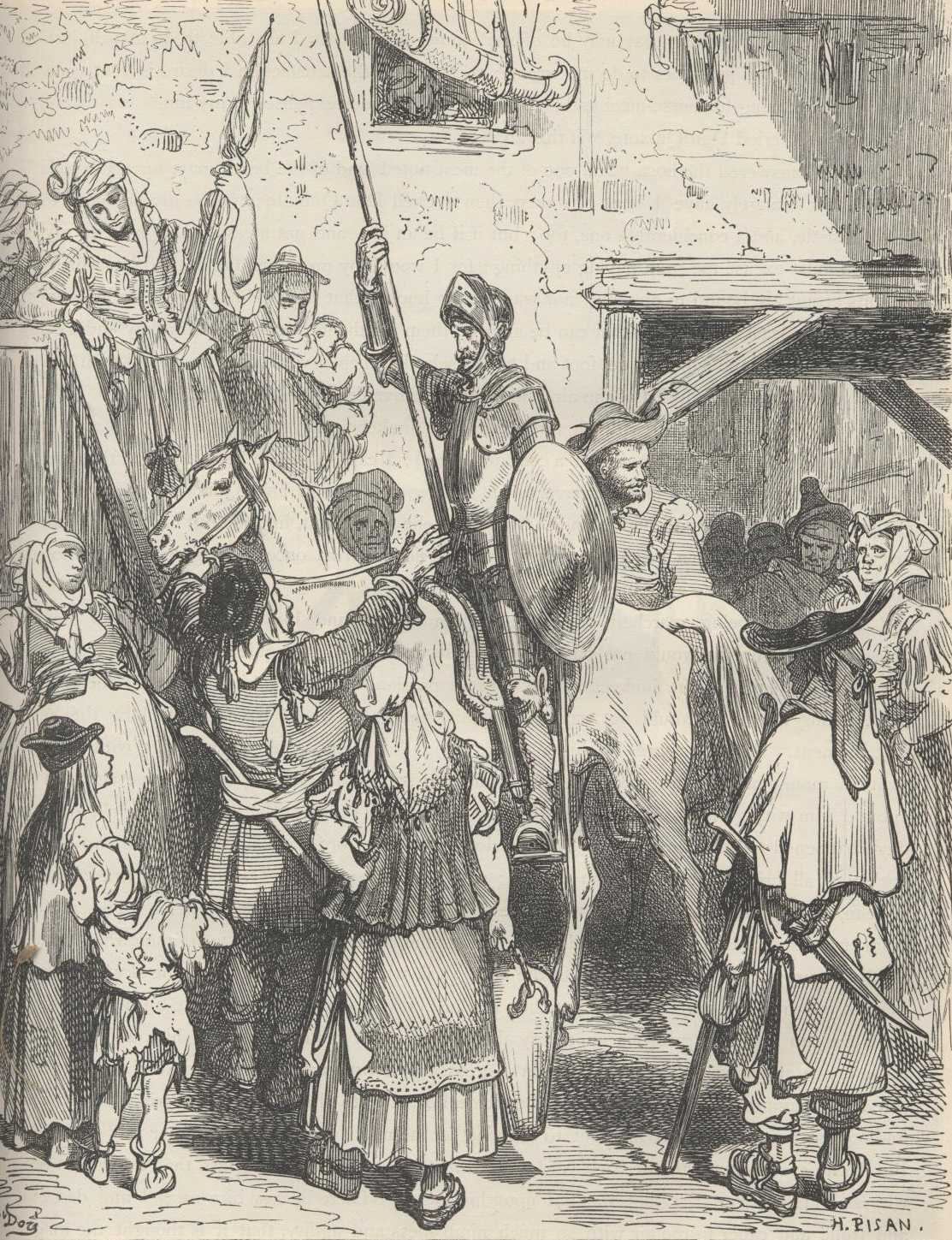
Battered by the muleteers, the two of them reach an inn. In the dark, Don Quixote mistakes the serving girl for a princess in love with him.
What you will learn
- Say who something belongs to with mi, tu, su, nuestro.
- Use the strong form: un amigo mío, esta cama es mía, el suyo.
- Avoid the possessive with parts of the body.
Before you read
Tonight everybody is saying who owns what: my bed, his daughter, my lady, the heart is hers. Spanish has two sets of possessives, and this scene uses both.The story in easy Spanish
Los dos llegaron molidos a una venta del camino.
The two of them reached a roadside inn, aching all over.
Para don Quijote aquella venta no era una venta: era un castillo.
For Don Quixote that inn was not an inn: it was a castle.
El ventero, su mujer y su hija los recibieron en la puerta.
The innkeeper, his wife and his daughter met them at the door.
También servía allí Maritornes, una moza asturiana de cara ancha.
A girl from Asturias called Maritornes worked there too, broad in the face.
Les hicieron una cama en un camaranchón viejo, encima del establo.
They were given a bed in an old loft, above the stable.
La cama de don Quijote era dura como una piedra. La de Sancho, peor.
Don Quixote’s bed was hard as a stone. Sancho’s was worse.
En el mismo cuarto dormía un arriero. Su cama era la mejor de las tres.
A muleteer slept in the same room, and his bed was the best of the three.
La mujer del ventero y su hija curaron al caballero con paños y aceite.
The innkeeper’s wife and her daughter treated the knight with cloths and oil.
«Señora mía, esta casa vuestra es un castillo, y vos sois su princesa.»
"My lady, this house of yours is a castle, and you are its princess."
Aquella noche Maritornes tenía una cita con el arriero.
That night Maritornes had an appointment with the muleteer.
Entró a oscuras y buscó a tientas la cama de su amigo.
She came in in the dark and felt her way to her friend’s bed.
Don Quijote oyó los pasos y le cogió la muñeca.
Don Quixote heard the footsteps and caught her by the wrist.
Creía que la hija del ventero estaba enamorada de él.
He believed the innkeeper’s daughter was in love with him.
«Princesa, esta mano mía os da las gracias por vuestra visita.»
"Princess, this hand of mine thanks you for your visit."
«Pero mi corazón ya no es mío. Es de mi señora Dulcinea del Toboso.»
"But my heart is no longer mine. It belongs to my lady Dulcinea del Toboso."
Maritornes no entendía nada y solo quería soltarse.
Maritornes understood none of it and only wanted to get free.
El arriero oyó aquellas palabras y no le gustaron nada.
The muleteer heard all this and did not like it one bit.
Le dio un puñetazo al caballero y la cama se le hundió encima.
He punched the knight, and the bed caved in on top of him.
El ventero se despertó y buscó su vela. Todo el mundo gritaba a oscuras.
The innkeeper woke up and looked for his candle. Everyone was shouting in the dark.
Maritornes se escondió en la cama de Sancho. El pobre se llevó los golpes suyos.
Maritornes hid in Sancho’s bed, and the poor man took the blows meant for her.
Al final volvió el silencio. Nadie de aquella casa durmió bien.
In the end the silence came back. Nobody in that house slept well.
Vocabulary
The inn and its people
- la venta
- the roadside inn
- el ventero / la ventera
- the innkeeper
- la moza
- the serving girl
- el establo
- the stable
- el camaranchón
- the loft
The night
- la cama
- the bed
- la manta
- the blanket
- la vela
- the candle
- a oscuras
- in the dark
- a tientas
- groping, feeling your way
The mix-up
- la cita
- the appointment, the date
- la muñeca
- the wrist
- el puñetazo
- the punch
- hundirse
- to collapse
- enamorado / enamorada
- in love
Possessives: the weak set and the strong set
El ventero, su mujer y su hija los recibieron en la puerta.
Señora mía, esta casa vuestra es un castillo.
Mi corazón ya no es mío.
Spanish keeps two sets of possessives and uses them in different places. English has only one, which is why this needs a minute.
The weak set, before the noun
mi, tu, su, nuestro, vuestro, su. These lean on the noun and never stand alone: mi cama, su hija, nuestro camino. They also replace the article, so you never say el mi caballo.
The strong set, after the noun or on its own
mío, tuyo, suyo, nuestro, vuestro, suyo. Three jobs:
| job | example | English |
|---|---|---|
| after a noun | un amigo mío | a friend of mine |
| after ser | esta cama es mía | this bed is mine |
| with an article, as a pronoun | el mío, la suya | mine, hers |
There is a fourth job, and Don Quixote lives in it: calling someone by name. Señora mía, amigo mío, Dios mío. English does the same in my lady, but Spanish puts the word second and it sounds solemn.
Agreement is with the thing, never with the owner
One innkeeper, two daughters: sus hijas. Twenty muleteers, one road: su camino. The ending answers the question how many things, not how many owners. Only nuestro and vuestro also change for gender in the short set.
su is ambiguous, and Spanish fixes it
Su cama can be his, hers, yours or theirs. When it matters, Spanish drops the possessive and says la cama de él, la cama de ella, la cama de usted. This is normal, not clumsy.
Body parts take the article
Where English says he caught her wrist, Spanish says le cogió la muñeca. The pronoun le already tells you whose it is, so the possessive would be repeating itself. Same with me duele la cabeza and se rompió el brazo.
Sleeping at a Spanish inn
The whole comedy of this chapter depends on one fact: nobody had a room of their own. A venta was a house standing alone on a road, with a stable on the ground floor and a loft above it. Travellers slept where there was space, side by side with strangers, and often two to a bed.
The beds themselves were four boards, some straw and a blanket. Cervantes describes Don Quixote’s in loving detail as a monument to discomfort. Guests brought their own food more often than not, and the innkeeper sold wine, fire and floor space.
And it was dark. Candles and oil cost money, so once the fire went out nobody lit anything for a small noise upstairs. That is why a serving girl could cross a room full of sleeping men to keep an appointment, and why a knight lying awake could catch a wrist and be certain, with no evidence whatsoever, that the daughter of the lord of the castle had come to him in secret.
Maritornes herself is worth a note. Cervantes gives her the flattest, least romantic description in the whole book, and then treats her with more sympathy than most of the gentlefolk in it. She is poor, she is plain, she keeps her word, and later in the same inn she is the one who brings water to a man tied up by the wrist all night.
Cervantes in the original · «Servía en la venta asimesmo una moza asturiana…»
Servía en la venta asimesmo una moza asturiana, ancha de cara, llana de cogote, de nariz roma, del un ojo tuerta y del otro no muy sana.
There also worked at the inn a girl from Asturias, broad of face, flat at the back of the head, snub-nosed, blind in one eye and not very sound in the other.
This is the least flattering introduction in the novel, and Cervantes then spends the rest of the book being kinder to her than to almost anyone. Note the grammar of this lesson working in the original: del un ojo tuerta, with the article, where English needs in one of her eyes. Spanish still describes bodies that way. Asimesmo is the old spelling of asimismo, and cogote, the back of the neck, is still very much in use.