Level B1 · Chapter 64
The Knight of the Mirrors
Another knight errant boasts of having beaten Don Quixote. They fight at dawn, and under the loser’s helmet there is a familiar face.
What you will learn
- Compare two things with más que, menos que and tan como.
- Say something is the utmost with el más de and with -ísimo.
- Compare against a whole clause using más de lo que.
Before you read
Two knights spend a night boasting, so the lesson is wall-to-wall comparison. Collect three shapes as you read: the ordinary one that compares two things, the one that says something is the most of a whole group, and a third one that compares a thing against a whole clause and uses a word you would not expect between más and the verb.The story in easy Spanish
Una noche, en un bosque oscuro, don Quijote y Sancho oyeron quejarse a alguien.
One night, in a dark wood, Don Quixote and Sancho heard somebody complaining.
Era otro caballero andante, con la armadura cubierta de espejitos redondos.
It was another knight errant, his armour covered in small round mirrors.
El desconocido hablaba muy alto, como si quisiera que lo oyera el bosque entero.
The stranger spoke very loudly, as if he wanted the whole wood to hear him.
Decía que su dama, Casildea de Vandalia, era la más hermosa de la tierra.
He said that his lady, Casildea de Vandalia, was the most beautiful on earth.
Añadía que él era el más desdichado de todos los hombres del mundo.
He added that he was the most wretched of all the men in the world.
Después dijo algo mucho peor, que a don Quijote le cambió la cara.
Then he said something far worse, which changed Don Quixote’s face.
Contó que había vencido en combate al mismísimo don Quijote de la Mancha.
He claimed he had defeated in combat Don Quixote of La Mancha himself.
«Eso es imposible», respondió nuestro caballero saliendo de entre los árboles.
"That is impossible," our knight replied, coming out from among the trees.
«Yo soy don Quijote y a mí no me ha vencido nadie todavía».
"I am Don Quixote and nobody has defeated me yet."
«Vos habréis vencido a alguien parecidísimo a mí, pero no a mí».
"You must have beaten somebody extremely like me, but not me."
Los dos decidieron pelear en cuanto hubiera luz suficiente para verse.
The two agreed to fight as soon as there was light enough to see each other.
Mientras tanto, los escuderos se apartaron un poco a charlar entre ellos.
Meanwhile the two squires moved off a little to chat between themselves.
El otro llevaba unas alforjas mucho mejor provistas que las de Sancho.
The other man carried saddlebags far better stocked than Sancho’s.
Había en ellas más vino y más pan blanco del que Sancho recordaba.
They held more wine and more white bread than Sancho could remember.
Con la primera luz, Sancho miró la cara del Caballero de los Espejos.
At first light, Sancho looked at the face of the Knight of the Mirrors.
Se quedó helado, porque era igualito que el bachiller Sansón Carrasco.
He was stunned, because the man was the spitting image of Sansón Carrasco.
Tenía la misma nariz, la misma boca y hasta la misma manera de mirar.
He had the same nose, the same mouth and even the same way of looking at you.
Empezó el combate antes de que nadie tuviera tiempo de explicar nada.
The fight began before anybody had time to explain anything.
Rocinante corrió más deprisa de lo que corría el caballo del otro.
Rocinante ran faster than the other man’s horse was running.
Don Quijote derribó a su enemigo del primer encuentro, sin apenas esfuerzo.
Don Quixote knocked his enemy down at the first charge, with barely any effort.
En el suelo, el vencido tenía exactamente la cara del bachiller del pueblo.
On the ground, the loser had exactly the face of the graduate from their village.
Sancho gritó que aquello era lo más raro que había visto en su vida.
Sancho shouted that it was the strangest thing he had seen in his life.
Don Quijote explicó que era el encantamiento más asombroso de cuantos conocía.
Don Quixote explained that it was the most astonishing enchantment he knew of.
Dijo que los magos son tan hábiles como crueles y no se cansan nunca.
He said that wizards are as skilful as they are cruel and never tire.
Después subió a Rocinante y siguió su camino tan tranquilo como siempre.
Then he climbed onto Rocinante and rode on as calmly as ever.
Detrás quedó Sansón Carrasco, más furioso de lo que había estado nunca.
Behind them lay Sansón Carrasco, angrier than he had ever been.
Vocabulary
Comparing
- más que
- more than
- menos que
- less than
- tan como
- as … as
- tanto como
- as much as
- igual que
- the same as
- parecido a
- similar to
- mejor que
- better than
- peor que
- worse than
The utmost
- el más de
- the most of
- el mejor de
- the best of
- sin par
- without equal
- hermosísima
- extremely beautiful
- parecidísimo
- extraordinarily alike
- mismísimo
- the very same
- igualito
- the spitting image
- asombroso
- astonishing
The fight
- la armadura
- the armour
- el espejo
- the mirror
- el encuentro
- the charge
- derribar
- to knock down
- el vencido
- the loser
- el escudero
- the squire
- hábil
- skilful
- furioso
- furious
Comparatives and superlatives
Sus alforjas estaban mejor provistas que las de Sancho.
Casildea era la más hermosa de la tierra.
Rocinante corrió más deprisa de lo que corría el otro.
Comparison in Spanish is regular and quick to learn. The trouble comes from three specific places, and this lesson goes at those.
1. The three basic moulds
| Spanish | English |
|---|---|
| más deprisa que el otro | faster than the other one |
| menos vino que Sancho | less wine than Sancho |
| tan hábil como cruel | as skilful as he is cruel |
| tanto pan como yo | as much bread as me |
Tan goes with adjectives and adverbs, tanto with nouns and verbs, and tanto agrees: tanta agua, tantos libros, tantas piedras.
2. When que becomes de
This is the first real trap. Spanish switches to de in two situations.
| what follows | Spanish | English |
|---|---|---|
| a number | más de doce mil libros | more than twelve thousand books |
| a whole clause | más deprisa de lo que corría el otro | faster than the other one was running |
| a clause, with a noun | más vino del que recordaba | more wine than he remembered |
The second and third rows are the ones to practise. English keeps than throughout, so there is no signal in the English to warn you. The rule is mechanical: if a verb follows the comparison, you need de lo que, or del que, de la que, de los que when the thing compared is a noun and the article agrees with it.
3. Superlatives
| Spanish | English | note |
|---|---|---|
| la más hermosa de la tierra | the most beautiful on earth | de, never en |
| el más desdichado de todos | the unhappiest of all | same |
| el mejor de la compañía | the best in the company | irregular form |
| hermosísima | stunningly beautiful | no group involved |
The -ísimo ending is not a comparison at all. It just turns the volume up, and it is everywhere in speech: parecidísimo, guapísimo, malísimo. Spelling shifts when the stem ends in a hard sound: rico gives riquísimo, largo gives larguísimo. And mismísimo is a special case meaning the very same one, as in el mismísimo don Quijote.
4. The four irregulars
| adjective | comparative |
|---|---|
| bueno | mejor |
| malo | peor |
| grande | mayor |
| pequeño | menor |
Never say más bueno or más malo for quality, and never say más mejor. Mayor and menor in everyday Spanish usually mean older and younger rather than bigger and smaller.
A rival who is a mirror
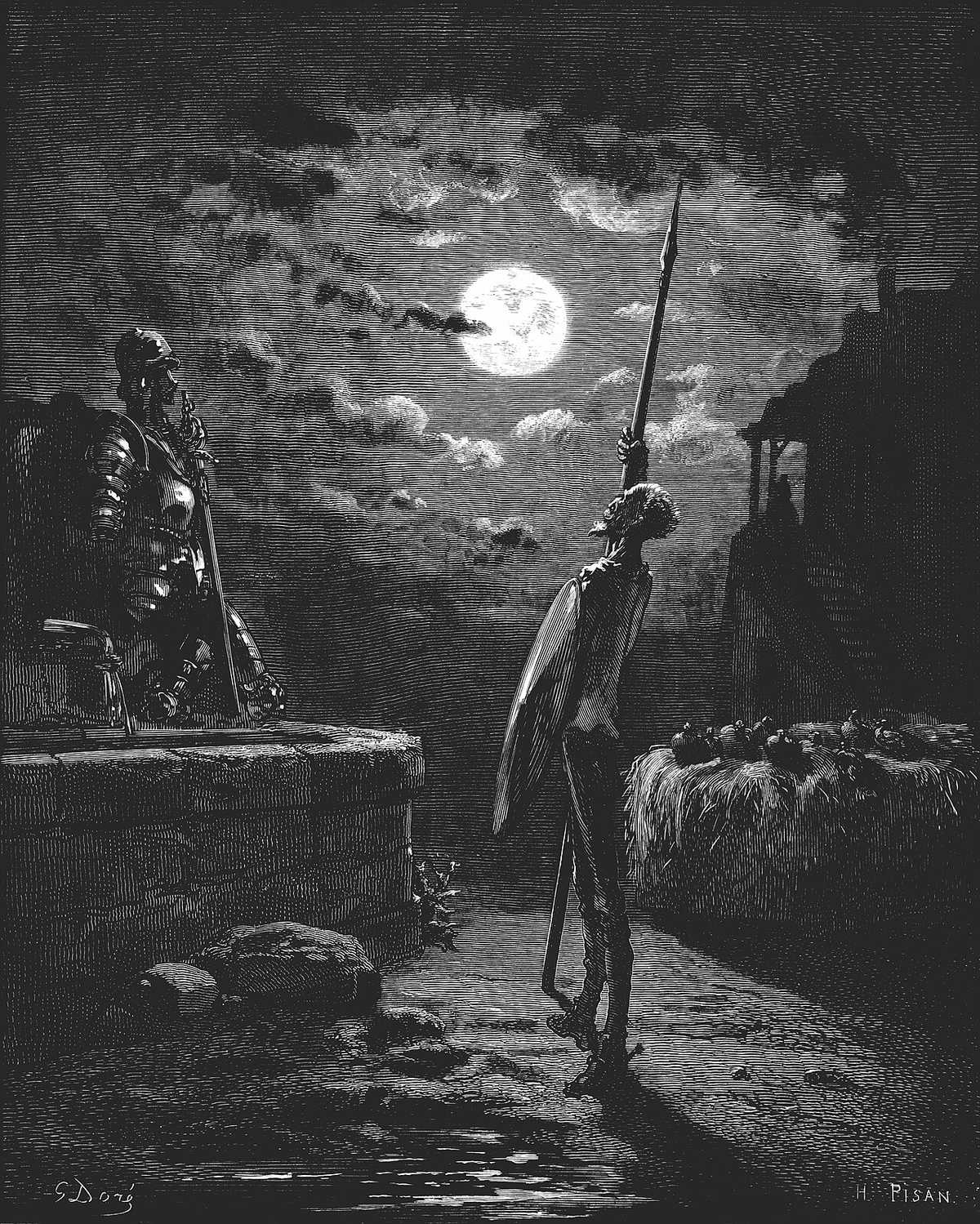
The disguise is a joke made of glass. A knight covered in little mirrors is a knight who shows you your own face, and the man inside the armour is a neighbour who has come out onto the road pretending to be exactly what Don Quixote is. The rival is a reflection, and Cervantes lets the costume say so without a word of commentary.
The plan behind it is practical. Sansón Carrasco, the priest and the barber have agreed that the way to get the old man home is to beat him in single combat and impose, as the loser’s penance, a year of staying put. It is the cage on the ox cart again, upgraded from kidnapping to theatre. And it fails, because the graduate can borrow armour but cannot borrow the thing that makes Don Quixote dangerous, which is that he genuinely does not care whether he lives.
He comes back. Much later, at the seashore in Barcelona, the same man appears as the Knight of the White Moon, wins, and imposes the year at home. That defeat is the beginning of the end of the novel, and the reader who remembers this night in the wood will notice that Don Quixote is destroyed not by a giant or an enchanter but by a neighbour with a good idea and a second attempt.
Cervantes in the original · «Llámola sin par porque no le tiene…»
Llámola sin par porque no le tiene, así en la grandeza del cuerpo como en el estremo del estado y de la hermosura
I call her peerless because she has no peer, alike in the greatness of her body as in the utmost degree of her rank and her beauty
From II, 14, in the mouth of the Knight of the Mirrors, and it is this lesson served on a plate. Sin par is a superlative built by denial: not the most of a group, but a claim that the group has only one member. He then explains the term, porque no le tiene, because she has no equal, which is the kind of circular reasoning knights errant produce when praising ladies. Así… como is the formal ancestor of today’s tanto… como, a comparison of equality holding two things in balance. And el estremo is the utmost degree, the point past which nothing goes. The spelling is the 1615 spelling, before the initial e settled into extremo, and the same shortening survives in estraño for extraño elsewhere in the novel. What makes the sentence funny rather than merely grand is the first item on the list. Of all the qualities to put ahead of rank and beauty, he chooses la grandeza del cuerpo, the size of her body, which is not what a reader expects a lover to lead with.