Level B1 · Chapter 63
The Cart of the Players
A cart full of devils, angels and emperors appears on the road. They are actors coming back from a performance, and there is still a fight.
What you will learn
- React out loud with ¡qué cara!, ¡qué mala suerte!, ¡vaya!
- Talk about a performance: who acts, what they are putting on.
- Build longer exclamations with qué plus noun plus más plus adjective.
Before you read
Sancho spends this lesson shouting, and Spanish exclamations have a fixed skeleton that is easy to copy once you see it. Watch every phrase that starts with ¡qué…! and notice what comes after it: sometimes a noun, sometimes an adjective, and sometimes a noun and an adjective joined by a word you would not expect. Watch also for the old exclamations sworn on God and on one’s own life, which are still audible in Spain today in softened forms.The story in easy Spanish
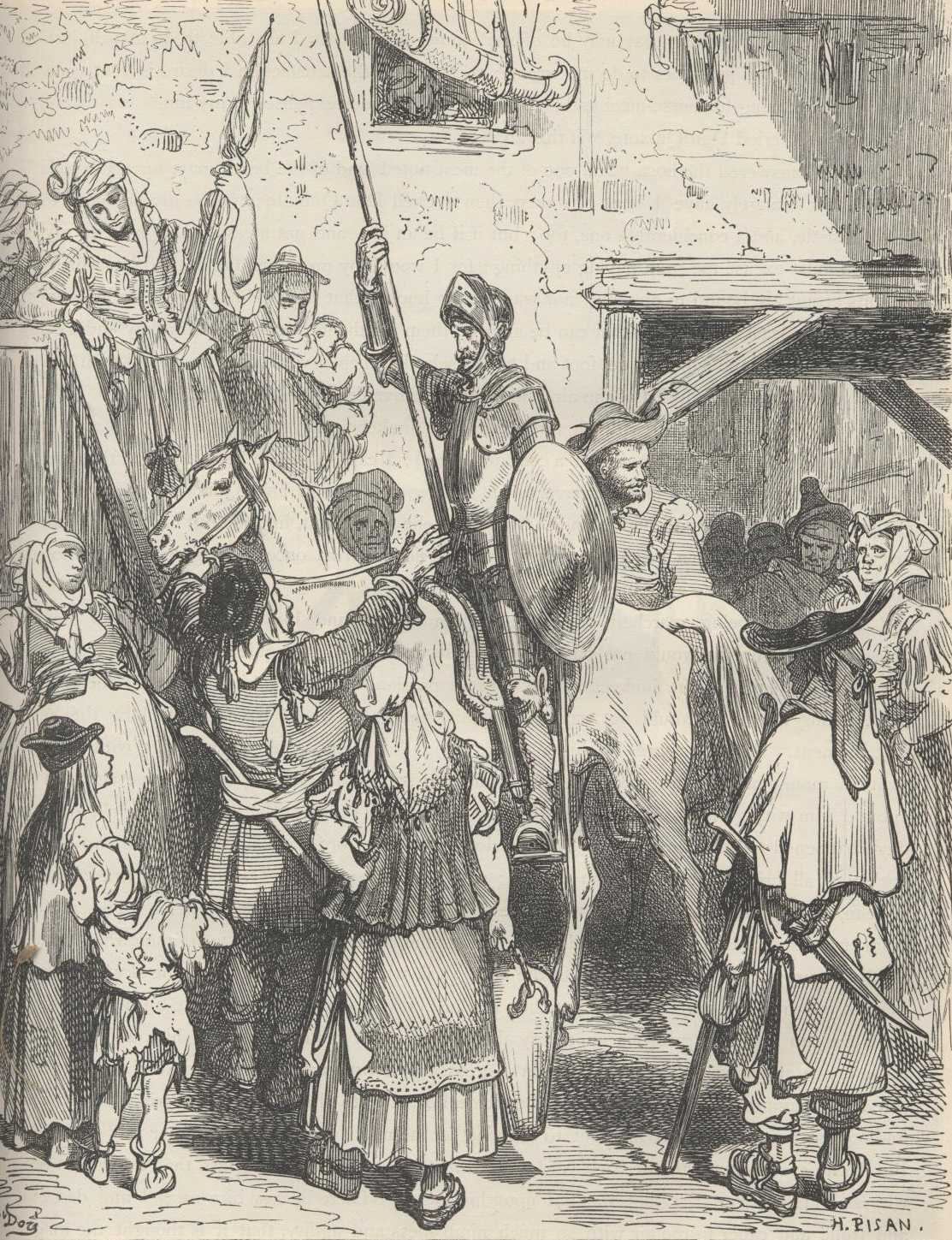
Iban don Quijote y Sancho por el camino cuando vieron venir un carro extraño.
Don Quixote and Sancho were riding along when they saw a strange cart coming.
Estaba cargado con las figuras más raras que se pueden imaginar.
It was loaded with the strangest figures anyone could imagine.
Lo conducía un demonio con cuernos, que llevaba las riendas de las mulas.
It was driven by a devil with horns, holding the reins of the mules.
«¡Válgame Dios!», gritó Sancho, y se agarró al cuello de su rucio.
"Heaven help us!" shouted Sancho, grabbing his donkey by the neck.
«¡Qué cara tiene ese hombre y qué cuernos más grandes lleva en la frente!»
"What a face that man has, and what enormous horns he has on his forehead!"
Dentro del carro iba la Muerte con cara humana y ojos tranquilos.
Inside the cart rode Death with a human face and calm eyes.
La acompañaban un ángel con alas grandes y un emperador con corona de oro.
She was accompanied by an angel with big wings and an emperor with a gold crown.
También había un caballero armado y una reina con vestido de papel.
There was also a knight in armour and a queen in a paper dress.
Don Quijote se puso delante con la lanza y preguntó quiénes eran.
Don Quixote planted himself in front with his lance and asked who they were.
El demonio paró las mulas y contestó con toda la naturalidad del mundo.
The devil stopped the mules and answered with complete matter-of-factness.
«Somos comediantes de la compañía de Angulo el Malo, para servirle».
"We are actors from Angulo el Malo’s company, at your service."
«Esta mañana hemos representado el auto de las Cortes de la Muerte».
"This morning we performed the play of the Courts of Death."
«Y esta tarde lo representamos otra vez en el pueblo de al lado».
"And this afternoon we are performing it again in the next village."
«¡Por vida mía!», dijo el caballero bajando la lanza muy despacio.
"Upon my life!" said the knight, lowering his lance very slowly.
«¡Y yo que pensaba que era una gran aventura de las mías!»
"And there was I thinking this was a great adventure of mine!"
«Los trajes engañan a cualquiera que los mire desde lejos».
"Costumes fool anybody who looks at them from a distance."
Todo habría acabado en paz si un actor no se hubiera acercado.
It would all have ended peacefully if one actor had not come closer.
Iba vestido de bufón y traía unas vejigas hinchadas colgando de un palo.
He was dressed as a fool and carried inflated bladders hanging from a stick.
Las hizo sonar contra el suelo, muy cerca de las patas de Rocinante.
He banged them against the ground, very close to Rocinante’s legs.
El caballo, que era viejo pero no sordo, salió disparado por el campo.
The horse, who was old but not deaf, bolted off across the fields.
Don Quijote cayó al suelo entre las piedras y no se levantó enseguida.
Don Quixote hit the ground among the stones and did not get up at once.
«¡Qué desgracia tan grande y qué mala suerte la nuestra!», gritaba Sancho corriendo detrás.
"What a disaster, and what rotten luck we have!" Sancho shouted, running after him.
Cuando el caballero quiso vengarse, la compañía entera lo esperaba en fila.
When the knight tried to take revenge, the whole company was waiting for him in a line.
Todos tenían piedras en la mano y ninguno parecía tener miedo.
They all had stones in their hands and none of them looked frightened.
Don Quijote miró aquella escena y decidió que con actores no se pelea.
Don Quixote looked at that scene and decided that one does not fight actors.
Siguieron su camino, y detrás quedó la Muerte saludando desde el carro.
They rode on, and behind them Death stood waving from the cart.
Vocabulary
The theatre
- el comediante
- the actor
- la compañía
- the company
- representar
- to perform
- la función
- the performance
- el papel
- the role
- el traje
- the costume
- el escenario
- the stage
- el público
- the audience
Shouting in surprise
- ¡qué cara!
- what a face!
- ¡qué desgracia!
- what a disaster!
- ¡qué mala suerte!
- what rotten luck!
- ¡vaya!
- well, well!
- ¡válgame Dios!
- heaven help us!
- ¡por vida mía!
- upon my life!
- ¡anda!
- goodness!
- ¡cuánto ruido!
- what a racket!
The figures on the cart
- el demonio
- the devil
- el cuerno
- the horn
- el ángel
- the angel
- el ala
- the wing
- el emperador
- the emperor
- la corona
- the crown
- el bufón
- the fool
- la vejiga
- the bladder
Exclamations with qué
¡Qué cuernos!
¡Qué mala suerte!
¡Qué carro más raro!
Spanish exclamations are built from a very small number of shapes. Learn the shapes and you can improvise the rest all day.
1. The basic frame
Everything starts with qué, always with its accent, and there is never an article after it.
| pattern | Spanish | English |
|---|---|---|
| qué + noun | ¡Qué cara! | What a face! |
| qué + adjective | ¡Qué raro! | How strange! |
| qué + adverb | ¡Qué bien! | How nice! |
| qué + noun + adjective | ¡Qué mala suerte! | What rotten luck! |
The missing article is the first thing to fix. English needs one, what a face, and Spanish forbids it: ✗ ¡qué una cara! is impossible.
2. The long form with más or tan
When the adjective comes after the noun, Spanish inserts más or tan between them. This is the shape English speakers never guess, because the literal translation of más is more and there is no comparison going on.
| Spanish | English |
|---|---|
| ¡Qué carro más raro! | What a strange cart! |
| ¡Qué demonio tan feo! | What an ugly devil! |
| ¡Qué compañía más valiente! | What a brave company! |
The two are interchangeable. Más is commoner in Spain, tan commoner in much of America.
3. Cuánto and cómo
| Spanish | English | note |
|---|---|---|
| ¡Cuánto ruido hacen! | What a racket they make! | quantity, agrees with the noun |
| ¡Cuántas piedras tienen! | What a lot of stones they have! | feminine plural |
| ¡Cómo corre ese caballo! | How that horse runs! | manner, never changes |
4. The fixed cries
These have no grammar left in them and are learnt whole. Several are old oaths worn smooth by four centuries of use.
| Spanish | English | register |
|---|---|---|
| ¡Vaya! | Well, well. | everyday, very common |
| ¡Anda! | Goodness. | everyday surprise |
| ¡Válgame Dios! | Heaven help me. | old, still heard from older speakers |
| ¡Por vida mía! | Upon my life. | archaic, Golden Age |
Vaya also works in front of a noun, exactly like qué, and adds a note of irony: vaya aventura usually means it was not much of an adventure.
A real theatre cart
Everything on this cart is documentary. Travelling companies really did move between villages in costume, because unpacking and repacking a wardrobe twice a day was not worth the trouble, and a cart carrying Death, an angel, an emperor and a devil down a road in La Mancha would have been an ordinary sight in June. The play they name, Las Cortes de la Muerte, is a real auto sacramental, and Angulo el Malo was a real theatre manager whose company toured Castile. Cervantes gives him his actual nickname.
He had every reason to know. Before the novels he wrote for the stage, with modest success and considerable ambition, and he never quite forgave the theatre for preferring Lope de Vega. The auto sacramental was the biggest popular art form of the period: short allegorical religious plays performed in the open air at Corpus Christi, on wheeled stages, in front of the entire town, free.
Which is why this episode belongs in the book rather than being a digression. The novel keeps asking what happens when somebody takes a representation for the thing itself, and here it arrives in its purest form. Don Quixote sees a devil and lowers his lance, then hears the word comediantes and puts it up again, and his own comment is the sharpest line in the chapter: costumes fool anyone who looks from a distance. He is right, and he does not notice that he is describing himself in armour.
Cervantes in the original · «El que guiaba las mulas y servía de carretero era…»
El que guiaba las mulas y servía de carretero era un feo demonio.
The man driving the mules and acting as carter was an ugly devil.
From II, 11, and a small lesson in how Cervantes sets a trap. The sentence contains no hedge of any kind. It does not say the carter looked like a devil, or that he was dressed as a devil. It states flatly that the man driving the mules was an ugly devil, in the same neutral tone the paragraph uses for the mules themselves. For the length of one sentence the reader is standing exactly where Don Quixote is standing, and the correction only arrives when the devil opens his mouth and explains, very politely, that they are actors. The verb servía de is worth collecting on its own: it means acting as, standing in for, doing the job of, and it is the ordinary way to say that somebody is filling a role temporarily. Which is precisely the joke here, since the man is serving as a carter while dressed as a devil while employed as an actor.