A1 to A2 · Updated
Spanish numbers from 0 to 1,000,000
Spanish numbers are regular once you know where the patterns break: one word up to veintinueve, then tens joined with y, then hundreds that agree with the noun. Learn the three irregular hundreds and the rest builds itself.
The short answer
Up to 29 every number is one word: dieciséis, veintitrés. From 31 the tens join the units with y: treinta y uno. Hundreds agree with the noun: doscientas casas. Uno becomes un before a masculine noun, and mil never takes un or a plural.
How to remember it
One word to 29, y from 31, hundreds agree
| 0 to 29 | always one word | veintidós |
|---|---|---|
| 31 to 99 | tens + y + units, three words | cuarenta y cinco |
| 100 | cien alone, ciento before more numbers | cien euros, ciento diez |
| 200 to 900 | agree with the noun | trescientas personas |
| 1,000 | mil, never un mil, never miles in a figure | dos mil |
The forms
The numbers you cannot build from the others
| number | Spanish | note |
|---|---|---|
| 11 to 15 | once, doce, trece, catorce, quince | learn them as words |
| 16 to 19 | dieciséis, diecisiete, dieciocho, diecinueve | diez + y + unit, fused |
| 20 to 29 | veinte, veintiuno, veintidós... | one word, accents on -dós, -trés, -séis |
| 30, 40, 50 | treinta, cuarenta, cincuenta | then sesenta, setenta, ochenta, noventa |
| 100 | cien / ciento | cien alone, ciento uno |
| 500 | quinientos | not cincocientos |
| 700 | setecientos | not sietecientos |
| 900 | novecientos | not nuevecientos |
| 1,000,000 | un millón | millón takes un and de: un millón de euros |
16 sentences that show the difference
Everyday Spanish, the kind you would actually say. The label under each one says which part of the rule it shows.
Tengo veintiún años.
I am twenty-one.
Veintiuno shortens before a noun
Hay veintiuna personas.
There are twenty-one people.
Feminine noun, veintiuna
El billete cuesta cien euros.
The ticket costs a hundred euros.
Cien alone
Son ciento veinte euros.
That is a hundred and twenty euros.
Ciento before more numbers
Doscientas páginas.
Two hundred pages.
Hundreds agree
Quinientos kilómetros.
Five hundred kilometres.
An irregular hundred
Mil personas.
A thousand people.
Never un mil
Dos mil veintiséis.
Two thousand and twenty-six.
A year
Un millón de habitantes.
A million inhabitants.
Millón takes de
Treinta y cinco.
Thirty-five.
Tens with y
Noventa y nueve.
Ninety-nine.
Tens with y
Ciento uno.
A hundred and one.
No y after ciento
Mi número es el seis, cuatro, cero.
My number is six, four, zero.
Phone numbers digit by digit
Vivo en el tercer piso.
I live on the third floor.
Ordinal, tercero shortens
Es la primera vez.
It is the first time.
Ordinals agree
Miles de personas.
Thousands of people.
Miles only as a noun
Where English gets in the way
English joins tens and units with a hyphen and adds and after the hundred: a hundred and one. Spanish does the opposite. The y goes between the tens and the units, treinta y uno, and never after the hundred, ciento uno. English numbers never change for the noun, but Spanish ones do: un, una, doscientos, doscientas.
The mistake to avoid
Un mil and cincocientos. The first copies the English a thousand, the second builds 500 like the other hundreds. It is mil on its own and quinientos, with setecientos and novecientos as the other two irregular hundreds.
The cases that break the rule
Veintiún años
Uno and every number ending in uno drops the -o before a masculine noun: un libro, veintiún libros, treinta y un días. Before a feminine noun it becomes -una: veintiuna casas.
Cien o ciento
Cien when it stands alone or multiplies: cien euros, cien mil. Ciento when another number follows: ciento tres. Saying ciento for a plain hundred sounds old-fashioned, except in por ciento.
Ciento uno
No y between the hundred and the rest. The y only ever joins tens and units: ciento treinta y dos, never ciento y treinta.
Mil
Never un mil and never miles inside a figure: dos mil, diez mil. Miles is a noun that means thousands: miles de turistas.
Un millón de
Millón is a noun, so it takes un, goes plural and needs de before the thing counted: dos millones de euros. With another number in between, the de goes: un millón doscientos mil euros.
1.000 y 2,5
Spain writes the thousands with a point and the decimals with a comma, the reverse of English: 1.500 euros, 2,5 kilos. Read the comma as coma: dos coma cinco.
Spanish numbers exercises
8 sentences to fill in. Type your answer and check it, or read them straight through with the answers showing. Accents count here, the way they count in the language.
-
Mi hermano tiene ___ años. (21)
My brother is twenty-one.
veintiún · Veintiuno loses its -o before a masculine noun, and takes an accent to keep the stress.
-
En la clase hay ___ alumnas. (21)
There are twenty-one students in the class.
veintiuna · Alumnas is feminine, so the uno inside the number becomes una.
-
El abrigo cuesta ___ euros. (100)
The coat costs a hundred euros.
cien · A hundred on its own is cien. Ciento only appears when more numbers follow.
-
Son ___ quince euros. (115)
That is a hundred and fifteen euros.
ciento · Another number follows, so ciento, and no y after it.
-
El libro tiene ___ páginas. (200)
The book has two hundred pages.
doscientas · Páginas is feminine, and the hundreds from 200 agree with the noun.
-
Madrid está a ___ kilómetros. (500)
Madrid is five hundred kilometres away.
quinientos · One of the three irregular hundreds, with setecientos and novecientos.
-
En el concierto había ___ personas. (1.000)
There were a thousand people at the concert.
mil · Mil alone, never un mil.
-
La ciudad tiene un millón ___ habitantes.
The city has a million inhabitants.
de · Millón is a noun, so it needs de before the thing it counts.
More exercises, from Don Quixote
8 more, these ones straight out of the course: the inn, the windmills, Rocinante and the road. Same rule, older Spanish.
-
En el campo hay ___ molinos. (30)
There are thirty windmills in the field.
treinta · Round tens are one word: treinta, cuarenta, cincuenta.
-
Don Quijote tiene casi ___ años. (50)
Don Quixote is almost fifty.
cincuenta · Age takes tener and a plain number, with años after it.
-
Sancho tiene ___ burro. (1)
Sancho has one donkey.
un · Uno shortens to un before a masculine noun.
-
El ventero cobra ___ maravedís. (32)
The innkeeper charges thirty-two maravedis.
treinta y dos · From 31 the tens and the units are joined with y, in three words.
-
Es la ___ salida de don Quijote.
It is Don Quixote's first outing.
primera · Ordinals agree with the noun: salida is feminine, so primera.
-
Vuelve a casa por ___ vez.
He comes home for the third time.
tercera · Vez is feminine, so tercera. Before a masculine noun it would shorten to tercer.
-
Cervantes escribe la novela en mil ___ cinco. (1605)
Cervantes writes the novel in 1605.
seiscientos · Years are read as a full number: mil seiscientos cinco.
-
Había ___ ovejas en el camino. (200)
There were two hundred sheep on the road.
doscientas · Ovejas is feminine, so doscientas.
Common questions
How do you count to 10 in Spanish?
Uno, dos, tres, cuatro, cinco, seis, siete, ocho, nueve, diez. Zero is cero. Uno changes to un or una when it counts something: un café, una cerveza.
Why is 16 one word but 31 three?
Up to 29 the numbers fused into one word long ago: diez y seis became dieciséis, veinte y tres became veintitrés. From 31 the old spelling stays: treinta y uno, ochenta y ocho.
Is it cien or ciento?
Cien for exactly one hundred, before a noun or before mil: cien años, cien mil. Ciento when more numbers follow: ciento cincuenta. And in percentages: el diez por ciento.
Do Spanish numbers have a feminine form?
Three groups do. Uno and the numbers ending in it: una, veintiuna. The hundreds from 200 to 900: doscientas. And the ordinals: primera, segunda. The rest never change.
How do you say a year in Spanish?
As a full number, never in pairs: mil novecientos noventa y dos for 1992, dos mil veintiséis for 2026. There is no equivalent of nineteen ninety-two.
How do I say a phone number?
In Spain usually in pairs or threes after the first digit: seis, cuarenta y cinco, doce, treinta. Saying it digit by digit is always understood, so start there.
How do you write decimals in Spanish?
With a comma: 2,5, read dos coma cinco. Thousands take a point: 1.200. In Mexico and parts of Latin America the English convention is also common.
What are the ordinal numbers in Spanish?
Primero, segundo, tercero, cuarto, quinto, sexto, séptimo, octavo, noveno, décimo. After ten, people normally switch to the plain number: el piso doce, el siglo veintiuno.
The things to remember
- Everything up to 29 is one word. From 31, tens and units are joined with y.
- Uno becomes un before a masculine noun and una before a feminine one, also inside veintiuno.
- Cien alone, ciento with more numbers after it.
- The hundreds from 200 agree with the noun: doscientos libros, doscientas casas.
- Mil never takes un. Millón takes un and de.
The book this comes from
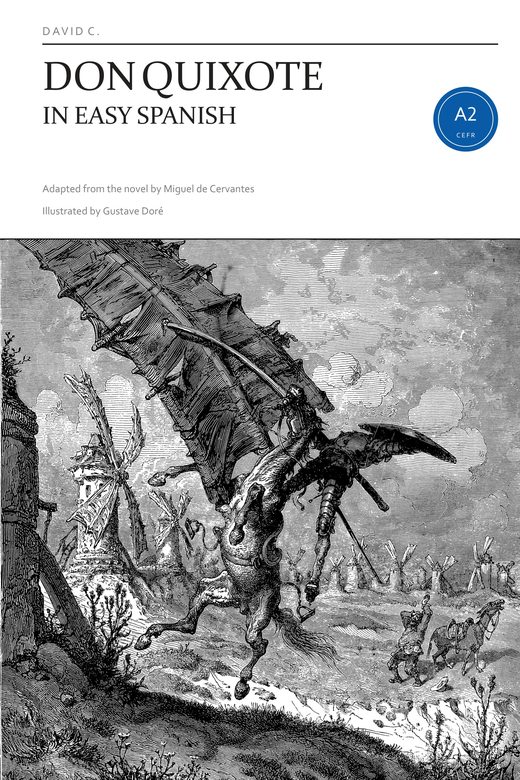
Don Quixote in Easy Spanish: the whole novel retold in Spanish you can actually read, in 58 short episodes, with the hard words glossed in the margin. It is where every Don Quixote sentence on this page comes from.
In EPUB and PDF with its audiobook, and a second novel in the same Spanish. See the books.
Where the course teaches this
2 lessons build it up, each one inside a chapter of the story rather than in the abstract. Free to read, with the vocabulary, the audio and the exercises.
- Numbers, ordinals and ageLesson 8Don Quixote of La Mancha
- The regular preteriteLesson 21The morning of the windmills
Next to this one
The points that sit closest to this one, and that a student usually meets around the same time.